

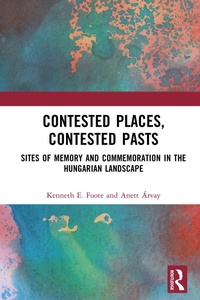
Contested Places, Contested Pasts
Sites of Memory and Commemoration in the Hungarian Landscape
1st Edition
Published on 21. February 2025
300 pages
978-1-040-30739-7 (ISBN)
Description

Contested Places, Contested Pasts focuses on how the First and Second World Wars, Holocaust, Cold War communist period, and 1956 Uprising have been memorialized and marked in the Hungarian landscape. The book explores the difficult debates surrounding the remembrance and commemoration of these events.
This is the first comprehensive, book-length study of Hungary's commemorative landscapes from the First World War to the present. By stressing the spatiality and materiality of memory practice, it offers new insights into why some events are celebrated widely, while other controversial events are marked modestly or not at all. Using a comparative case study methodology, the book crisscrosses the country using archival sources and extensive fieldwork to document the stories behind dozens of major and minor memorials. Examples from Budapest are important, but key contributions of this book are the examples drawn from cities, towns, and villages outside the capital. A wealth of photographs, maps, and diagrams are included to illustrate important ideas, especially the range of responses that have emerged to commemorate major historical events. In the end, the book highlights the value of studies like this one that explore the varied ways in which the World Wars, Holocaust, and Cold War have been represented in the commemorative landscapes of Europe and beyond.
This book is for readers interested in Hungarian and European history, public art and architecture, landscape studies, and commemorative practices. Weaving theory and examples in an engaging storyline, the book will appeal to broader audiences interested in the challenges of confronting Europe's legacies of twentieth-century war, violence, and political upheaval.
This is the first comprehensive, book-length study of Hungary's commemorative landscapes from the First World War to the present. By stressing the spatiality and materiality of memory practice, it offers new insights into why some events are celebrated widely, while other controversial events are marked modestly or not at all. Using a comparative case study methodology, the book crisscrosses the country using archival sources and extensive fieldwork to document the stories behind dozens of major and minor memorials. Examples from Budapest are important, but key contributions of this book are the examples drawn from cities, towns, and villages outside the capital. A wealth of photographs, maps, and diagrams are included to illustrate important ideas, especially the range of responses that have emerged to commemorate major historical events. In the end, the book highlights the value of studies like this one that explore the varied ways in which the World Wars, Holocaust, and Cold War have been represented in the commemorative landscapes of Europe and beyond.
This book is for readers interested in Hungarian and European history, public art and architecture, landscape studies, and commemorative practices. Weaving theory and examples in an engaging storyline, the book will appeal to broader audiences interested in the challenges of confronting Europe's legacies of twentieth-century war, violence, and political upheaval.
More details
Edition
1. Auflage
Language
English
Place of publication
London
United Kingdom
Publishing group
Taylor & Francis Ltd
Target group
College/higher education
Professional and scholarly
Illustrations
5 Tables, black and white; 104 Halftones, color; 104 Illustrations, color
ISBN-13
978-1-040-30739-7 (9781040307397)
Copyright in bibliographic data and cover images is held by Nielsen Book Services Limited or by the publishers or by their respective licensors: all rights reserved.
Schweitzer Classification
Other editions
Additional editions
Kenneth E. Foote | Anett Arvay
Contested Places, Contested Pasts
Sites of Memory and Commemoration in the Hungarian Landscape
Book
approx. 07/2026
1st Edition
Routledge
€57.50
Not yet published

Kenneth E. Foote | Anett Arvay
Contested Places, Contested Pasts
Book
03/2025
Taylor & Francis
Unfortunately, price unknown
Available (delivery time upon request)
Kenneth E. Foote | Anett Arvay
Contested Places, Contested Pasts
Sites of Memory and Commemoration in the Hungarian Landscape
Book
02/2025
1st Edition
Routledge
€230.65
Shipment within 10-20 days
Persons
Kenneth E. Foote is a Professor of Geography, Sustainability, Community and Urban Studies at the University of Connecticut. His research focuses on historic preservation, heritage tourism, and the commemorative landscapes of the United States and Europe, especially the way events of violence and tragedy are memorialized. His recent research has also focused on the spatial dimension of racialized and gendered violence in the United States. In addition, Foote is also known for his work in geospatial technologies, especially geovisualization, as well as his efforts to improve professional development opportunities for early career academics and department leaders. Foote is a past president and fellow of the American Association of Geographers (2010-11) and a past president of the US National Council for Geographic Education (2006). He has received major national and international awards for his research, teaching, mentoring, and service from the American Association of Geographers, the National Council for Geographic Education, the University Consortium for Geographic Information Science, and the Royal Geographical Society.
Anett Arvay was born and raised in Szombathely, Hungary. At the University of Szeged, she earned her BA in Hungarian studies and MA in Hungarian and English language and literature in 1996. She was awarded the PhD, summa cum laude, in applied linguistics at Eoetvoes Lorand University of Budapest. Currently, Anett is the Director and Lecturer in Hungarian Studies at the University of Szeged, Hungary. Her research endeavors are linked to intercultural pragmatics and to the interdisciplinary field of Hungarian studies, with a special focus on Hungarian public place, political and historical memorials, and commemorative traditions. She also researches methods for introducing Hungarian cultural heritage to foreigners and has designed several study abroad programs, workshops, and cultural awareness trainings for international students from all over the world. Her research has appeared in The Geographical Review, Hungarologia, IRAL, and Acta Linquistica Hungarica, among other professional journals.
Anett Arvay was born and raised in Szombathely, Hungary. At the University of Szeged, she earned her BA in Hungarian studies and MA in Hungarian and English language and literature in 1996. She was awarded the PhD, summa cum laude, in applied linguistics at Eoetvoes Lorand University of Budapest. Currently, Anett is the Director and Lecturer in Hungarian Studies at the University of Szeged, Hungary. Her research endeavors are linked to intercultural pragmatics and to the interdisciplinary field of Hungarian studies, with a special focus on Hungarian public place, political and historical memorials, and commemorative traditions. She also researches methods for introducing Hungarian cultural heritage to foreigners and has designed several study abroad programs, workshops, and cultural awareness trainings for international students from all over the world. Her research has appeared in The Geographical Review, Hungarologia, IRAL, and Acta Linquistica Hungarica, among other professional journals.
Content
Introduction
CHAPTER 1: Inscribing the Past on Place: Theoretical Perspectives on Hungary's Landscapes of Memory
CHAPTER 2: Key Moments in the Hungarian Past: A Historical Overview
CHAPTER 3: The Many Legacies of the First World War
CHAPTER 4: Confronting Defeat and Loss in the Second World War
CHAPTER 5: Remembering the Holocaust
CHAPTER 6: The Legacies of Communism
CHAPTER 7: The 1956 Uprising
CHAPTER 8: Hungary's Unquiet Places, Unquiet Pasts
CHAPTER 1: Inscribing the Past on Place: Theoretical Perspectives on Hungary's Landscapes of Memory
CHAPTER 2: Key Moments in the Hungarian Past: A Historical Overview
CHAPTER 3: The Many Legacies of the First World War
CHAPTER 4: Confronting Defeat and Loss in the Second World War
CHAPTER 5: Remembering the Holocaust
CHAPTER 6: The Legacies of Communism
CHAPTER 7: The 1956 Uprising
CHAPTER 8: Hungary's Unquiet Places, Unquiet Pasts
