

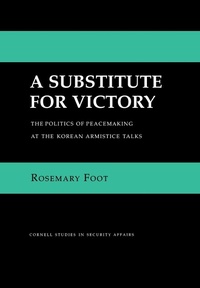
A Substitute for Victory
The Politics of Peacemaking at the Korean Armistice Talks
1st Edition
Published on 18. October 2018
248 pages
978-1-5017-2413-8 (ISBN)
Description

After more than two years of bitter negotiations during which combatants & civilians continued to suffer casualties, the Korean armistice was concluded in July 1953. Focusing on the Americans formulation of negotiating positions & on their attempts to coordinate political goals with military tactics, Rosemary Foot here charts the tortuous path to peace & offers a new explanation for the agonizing length of the talks. She also takes into account the role of the Western allies & the Indian, South Korean, North Korean, & Chinese governments as she examines the complex international setting in which the armistice took place.
More details
Series
Language
English
Place of publication
NY
United States
Target group
College/higher education
Edition type
Digital original
Illustrations
1 map
1 map
ISBN-13
978-1-5017-2413-8 (9781501724138)
Copyright in bibliographic data and cover images is held by Nielsen Book Services Limited or by the publishers or by their respective licensors: all rights reserved.
Schweitzer Classification
Other editions
Additional editions
Book
05/1990
Cornell University Press
€105.23
Shipment within 10-20 days
Person
FootRosemary:
Rosemary Foot is Professor of International Relations and John Swire Senior Research Fellow in the International Relations of East Asia St Antony's College.
Rosemary Foot is Professor of International Relations and John Swire Senior Research Fellow in the International Relations of East Asia St Antony's College.
Content
- Cover
- Title
- Copyright
- Dedication
- Contents
- Preface
- Chronology
- 1. Introduction: The Negotiations in Their Global and Domestic Settings
- 2. Early Opportunities: June 1950 to June 1951
- 3. The First Phase of the Negotiations: July to November 1951
- 4. Convergence: November 1951 to April 1952
- 5. Victims of the Cold War: The POW Issue
- 6. Panmunjom Bypassed: May to December 1952
- 7. Breaking the Stalemate: January to July 1953
- 8. Final Acts: August 1953 to June 1954
- 9. Conclusions
- Notes
- Bibliography
- Index
