

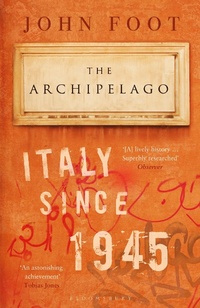
The Archipelago
Italy Since 1945
1st Edition
Published on 17. May 2018
496 pages
978-1-4088-4351-2 (ISBN)
Description

'An enjoyable, highly readable history that manages to bring murky, often fiendishly complex events into the light' Sunday Times
Italy emerged from the Second World War in ruins. Divided, invaded and economically broken, it was a nation that some people claimed had ceased to exist. And yet, as rural society disappeared almost overnight, by the 1960s, it could boast the fastest-growing economy in the world.
In The Archipelago, historian John Foot chronicles Italy's tumultuous history from the post-war period to the present day. From the silent assimilation of fascists into society after 1945 to the artistic peak of neorealist cinema, he examines both the corrupt and celebrated sides of the country. While often portrayed as a failed state on the margins of Europe, Italy has instead been at the centre of innovation and change - a political laboratory. This new history tells the fascinating story of a country always marked by scandal but with the constant ability to re-invent itself.
Comprising original research and lively insights, The Archipelago chronicles the crises and modernisations of more than seventy years of post-war Italy, from its fields, factories, squares and housing estates to Rome's political intrigue.
Italy emerged from the Second World War in ruins. Divided, invaded and economically broken, it was a nation that some people claimed had ceased to exist. And yet, as rural society disappeared almost overnight, by the 1960s, it could boast the fastest-growing economy in the world.
In The Archipelago, historian John Foot chronicles Italy's tumultuous history from the post-war period to the present day. From the silent assimilation of fascists into society after 1945 to the artistic peak of neorealist cinema, he examines both the corrupt and celebrated sides of the country. While often portrayed as a failed state on the margins of Europe, Italy has instead been at the centre of innovation and change - a political laboratory. This new history tells the fascinating story of a country always marked by scandal but with the constant ability to re-invent itself.
Comprising original research and lively insights, The Archipelago chronicles the crises and modernisations of more than seventy years of post-war Italy, from its fields, factories, squares and housing estates to Rome's political intrigue.
More details
Edition
1. Auflage
Language
English
Place of publication
London
United Kingdom
Illustrations
2x8pp colour plates section
ISBN-13
978-1-4088-4351-2 (9781408843512)
Copyright in bibliographic data and cover images is held by Nielsen Book Services Limited or by the publishers or by their respective licensors: all rights reserved.
Schweitzer Classification
Other editions
Additional editions
Book
06/2019
Bloomsbury Publishing PLC
€24.00
Shipment within 10-20 days
Book
05/2018
Bloomsbury Publishing PLC
€50.95
Article exhausted; check different version
Person
John Foot is the author of seven books, including Calcio: A History of Italian Football; Pedalare! Pedalare! A History of Italian Cycling; Milan Since the Miracle; Italy's Divided Memory; Modern Italy and The Man Who Closed the Asylums. He is Professor of Modern Italian History at the University of Bristol.
Content
- Cover
- Dedication Page
- A Note on the Author
- By the same Author
- Title Page
- Contents
- Map
- Preface
- Introduction: 1945 - Year Zero
- The Return
- Cycling Back to Normality
- 1946: Viva Toscanini!
- Paisà
- Republic of the Dead
- The Duce's Body
- 1 Rebuilding and Remaking Italy
- Democracy
- Republic or Monarchy?
- The Referendum Campaign
- To the Polls
- Counting the Votes
- Another King Departs
- Resistance, Anti-Fascism and Post-War Italy
- Qualunquismo and Anti-Politics
- Figureheads and Symbols in Republican Italy
- Building a New State: Italy's Constitution
- Cold War
- April and July 1948: Election and Revolution - Counting Votes, Weighing Votes
- July 1948: Italy at the Barricades58
- Revolution?
- Parishes, Priests and Catholic Culture
- The White Whale: Christian Democrats
- Corridors of Power
- Reds: Communists and the Communist Party in Italy after 1948
- Cult of Personality
- The 'Big Moustache' is Coming: Stalin, the Soviet Union and Italian Communism
- Following Orders?
- A Mass Party
- Legacies of War: Trieste
- 1956: The Secret Speech and Hungary
- Heart of Europe: Altiero Spinelli, Italy and European Integration
- 2 Takeoff: Italy in the Boom Years
- Final Act? Post-War Peasant Struggles and Reform
- Exodus: Stories from the Great Migration
- The End of Rural Italy
- The End of Sharecropping
- Former Jobs and Nostalgia
- Money, Money, Money
- Factories and Workers
- A Love Affair: Italians and Cars
- Motorway of the Sun
- Fiataly
- Riding the Tiger? Planning and Cities
- 1963: Vajont
- Landslip: Agrigento - July 1966
- 1966: Mud Angels
- The Brick Kings
- Cultural Change and the Boom: Italy's Soundtrack
- Cultural Change and the Boom: The Magic Rectangle - Italy and Television
- Love and Marriage before and during the Boom: Public Sinners?
- Marriage, Divorce and the Law
- The Cyclist and the 'White Lady'
- Communist Morality
- Responding to the Boom: The Church
- Responding to the Boom: Politics
- 1960: Riots and the Return of Anti-Fascism
- Striped Shirts on the Streets
- 1960: The World Comes to Rome
- Centre-Left
- 1964: Rome - End of an Era
- Moral Panic: Censorship and Modernisation
- 3 Blood and Reform: Institutional Change and Violence in the 1960s and 1970s
- Concrete Utopias: Franco Basaglia and the Revolution in Psychiatry
- Schools, Exams and Experiments
- Letter to a Teacher
- There is Hope, if this Can Happen in Vho
- Exam Factories?
- The Battle over Divorce
- Inside the Family - Parents and Children, Husbands and Wives
- The Workers' Statute
- Prisons and Riots
- Universities and 1968
- The Church and 1968
- Contesting Culture
- The Merlin Law: Closing the 'Closed Houses'
- Franca Viola and Forced Marriage through Rape
- Feminism: The Public and the Private
- Abortion
- Witch Trial: The Braibanti Case, 1964-82
- Other Italys in the 1960s, 1970s and 1980s
- Cholera: Naples - 1973
- Poison Cloud: Seveso
- Earthquake: Campania - 1980
- Blood and Lead: Bombs, Plots and Political Violence in Italy, 1969-80
- 12 December 1969: Massacre
- Accidental Death? The Pinelli Case
- The Coup: 1970
- The Revolt of Reggio Calabria: 1970
- The Millionaire and the Pylon
- Strategy of Tension
- 1977: A New 1968?
- Terrorism, Italian-Style
- 'Strike one in order to educate one hundred' (the Red Brigades)
- Fifty-Five Days in Rome
- Two Funerals, One Body
- 'Black' Terrorists
- Bologna: 2 August 1980
- Revolution, Reform and Blood
- 4 The 1980s and 1990s: From Boom to Collapse and Beyond
- 1980: The End
- After the Factory
- Politics in the 1980s: The 'Moral Question' and Partitocracy
- The Boy in the Well: Alfredino Rampi and Italian Television - 1981
- Secularisation and the Church
- Bettino Craxi: Modern Politics, Money and Corruption
- The Salesman: The Many Lives of Silvio Berlusconi
- All that Money . . .
- His Aerialness: Berlusconi and Television
- Neo-Television
- From Scandal to Triumph: The 1982 World Cup and the 'Footbalisation' of Italy
- Italy's Grandfather
- God in Naples: Maradona, 1984-91
- Maxiprocesso: The Mafia on Trial
- Hiding in Plain Sight
- The End of the Cold War and its Impact on Italy
- New Invasions: Italy's Borders and the End of the Cold War
- Stadium of Victory
- Berlusconi and Football
- 5 The Second Republic
- Tangentopoli and Clean Hands: The Scandal and Investigation that Ended the First Republic. 1992-3
- Il Senatur: The Rise of Umberto Bossi and the Lega Nord
- The Manager: Carlo 'il bello'
- Trial by Television: The Cusani Trial
- The Functionary: Severino Citaristi
- Decade of Austerity
- Raining Coins
- Presidents and Power
- 'Their faces are like their arses': Satire and Cuore
- Illustrious Corpses
- Mafiosi in Prison
- Neo-Post-Fascism
- The Second Republic, the Mattarellum and the End of the Christian Democrats
- Taking the Field: Berlusconi Enters Politics, 1993-4
- Forza Italia
- A Political Earthquake
- Berlusconi in Power: Act 1
- Naples: 'The Prime Minister is under Investigation'
- War with the Judiciary
- The Fall of Berlusconi's First Government: December 1994
- Interregnum: 1995-6
- Trial of the Century: 'Beelzebub' in the Dock
- Padania and the Lega Nord
- Tangentopoli: A Judicial Revolution?
- Counter-Attack: Tangentopoli as Conspiracy
- The Priebke Trials and Italian Memory
- Fosse Ardeatine
- A Nazi on Trial: Rome, 1996
- After the Trials: Priebke's Final Years in Rome and his Death
- Pure Climber: The Marco Pantani Story
- 1996: The Anti-Berlusconi
- The Euro, European Integration and Italy
- New Italians?
- Sport, Racism and Migration
- The Murder of Abdellah Doumi
- Controlling the Migrants
- Mosques and Islam in Italy
- Oriana Fallaci's 'The Rage and the Pride'
- Italy, Islam and the Catholic Church
- Crucifixes
- Cult: Padre Pio
- 6 Italy in the Twenty-First Century: Crisis, Post-Democracy and the Triumph of Populism
- Peak Berlusconi: 2001-6
- Genoa, 2001: Days of Rage, Days of Violence, Days of Death
- Berlusconi in Power: Ad Personam
- Opposing Berlusconi
- The Second War with the Judiciary
- Censorship and Media Power
- Explaining Berlusconi
- 2006: Another Scandal and another World Cup
- From Calciopoli to Triumph
- Late Berlusconi
- Bunga Bunga Republic: Berlusconi and Sex Scandals
- Rubygate
- Endgame: Post-Berlusconi?
- Professors in Power
- 7 Italy Today
- New Emigrants: Italians on the Move
- Five Star Movement
- The Rise and Fall and Rise of the Lega and the Future of Italy
- Mario Balotelli
- Eliminated. The Blues and the 2018 World Cup
- Pope Francis
- Life and Death
- A Floating Cemetery
- Lampedusa, Italy and Europe: An Island of Dreams and Nightmares
- Lampedusa and Italian Politics
- The Rise and Fall of Matteo Renzi
- The Yellow-Greens in Power
- Fragile Concrete. Genoa. 2018
- Riace
- Conclusion: Transformation and Crisis
- Acknowledgements
- Notes
- Index
- Copyright Page
