

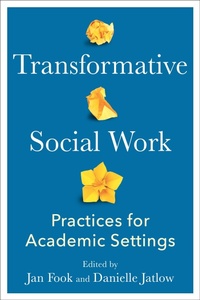
Transformative Social Work
Practices for Academic Settings
1st Edition
Published on 27. February 2024
376 pages
978-0-231-55676-7 (ISBN)
Description

This book brings together a range of contributors to reconsider transformative social work, focusing on concrete examples in academic settings both inside and outside the classroom.
More details
Other editions
Additional editions
Book
02/2024
Columbia University Press
€144.84
Shipment within 10-20 days
Book
02/2024
Columbia University Press
€37.14
Shipment within 10-20 days
Persons
Jan Fook is professor and chair of the Department of Social Work at the University of Vermont. She is an internationally recognized scholar who has held academic positions at universities in Australia, the United Kingdom, Canada, and Norway. She has published extensively on various topics including practice research, critical reflection, and critical social work.
Danielle Jatlow is a lecturer and the coordinator of the BSW program in the Department of Social Work at the University of Vermont. She has worked with adolescents, young adults, and their families for more than eighteen years as a social work practitioner. Jatlow is currently a PhD student at Simmons University.
Danielle Jatlow is a lecturer and the coordinator of the BSW program in the Department of Social Work at the University of Vermont. She has worked with adolescents, young adults, and their families for more than eighteen years as a social work practitioner. Jatlow is currently a PhD student at Simmons University.
Content
Part I. The Theoretical, Cultural, Community, and University Context
Introduction: What Is a Transformative Approach in Social Work?, by Jan Fook and Brenda Solomon
1. Revisiting Transformative Thinking in Social Work, by Anna Gupta
2. Transformative Social Work Contributions at the Executive Level, by Wanda Heading-Grant and Jan Fook
3. Managing a Transformative Departmental Culture, by Jan Fook
4. Developing a Transformative Approach as a Whole Department, by Ken Bechtel, Kate Ball Clem, Jan Fook, and BC Garvey
5. Anti-Racist Practices in Academia: Transformative Perspectives on Administration, by Laura S. Abrams, Dominique Mikell Montgomery, Jason Anthony Plummer, Gerry Laviña, Nana Sarkodee-Adoo, Latoya Small, and Nicole Vazquez
6. Transformative Justice in Praxis: Creating the Alliance of Disability and Social Work, by Sarah Nunes and Diane R. Wiener
Part II. Core Concepts and Courses in the Transformative Curriculum
7. Reflections on a Transformative Relational Experience, by Danielle Jatlow
8. Transformative Field Education: A Relational Approach, by JB Barna
9. Ethical Considerations on Racism: Strategies for a Transformative Anti-Racist Pedagogy, by Merlinda Weinberg
10. Transformative Learning in Social Work: A Critically Reflective Process to Affirm My Indigenous Worldview as a Child Welfare Intern, by Tiffany Tuttle
11. Practice Research and Transformative Social Work: Evolving Concepts and Social Impact, by Timothy Sim and Jan Fook
12. Jumping In, Becoming Immersed in Experience, and Taking Notes: A Swimmer's Guide to Teaching Transformative Social Work Research, by Brenda Solomon
13. A Transformative Approach to Environmental Social Work Education, by Siddhesh Mukerji, Kate Gannon, and Erin Mackenzie
14. The Soundscapes of Social Work, by Alexander Bobella
15. Toward a Transformative Approach to the Concept of Risk in Social Work, by Tucker Boyd
Part III. Specific Models and Strategies
16. Critical Reflection in Environmental/Ecological Social Work Practice, by Erin Mackenzie
17. Transformative Social Work Education: Using Critical Reflection to Develop Culturally Safe Practice, by Christine Morley and Ratna Beekman
18. Linking Political Action, Critical Thinking, and Value-Driven Learning: A Proposed New Paradigm for Teaching Social Work for Social Change, by Lia Levin, Adaya Liberman, Dedi Buzaglo, Dor Robinzon, and Roni Arditi
19. Bridging the Gap Between Critical Reflection and Professional Practice, by Shachar Timor-Shlevin, Tamar Aharon, Sharon Segev, Shani Mazor, and Emily Ishai
20. Transformative Assessment in Social Work Education: Using Critical Performance Pedagogy as a Creative Strategy, by Jean Carruthers
Conclusion: Transformative Practice in Academic Social Work, by Jan Fook
Contributors
Index
Introduction: What Is a Transformative Approach in Social Work?, by Jan Fook and Brenda Solomon
1. Revisiting Transformative Thinking in Social Work, by Anna Gupta
2. Transformative Social Work Contributions at the Executive Level, by Wanda Heading-Grant and Jan Fook
3. Managing a Transformative Departmental Culture, by Jan Fook
4. Developing a Transformative Approach as a Whole Department, by Ken Bechtel, Kate Ball Clem, Jan Fook, and BC Garvey
5. Anti-Racist Practices in Academia: Transformative Perspectives on Administration, by Laura S. Abrams, Dominique Mikell Montgomery, Jason Anthony Plummer, Gerry Laviña, Nana Sarkodee-Adoo, Latoya Small, and Nicole Vazquez
6. Transformative Justice in Praxis: Creating the Alliance of Disability and Social Work, by Sarah Nunes and Diane R. Wiener
Part II. Core Concepts and Courses in the Transformative Curriculum
7. Reflections on a Transformative Relational Experience, by Danielle Jatlow
8. Transformative Field Education: A Relational Approach, by JB Barna
9. Ethical Considerations on Racism: Strategies for a Transformative Anti-Racist Pedagogy, by Merlinda Weinberg
10. Transformative Learning in Social Work: A Critically Reflective Process to Affirm My Indigenous Worldview as a Child Welfare Intern, by Tiffany Tuttle
11. Practice Research and Transformative Social Work: Evolving Concepts and Social Impact, by Timothy Sim and Jan Fook
12. Jumping In, Becoming Immersed in Experience, and Taking Notes: A Swimmer's Guide to Teaching Transformative Social Work Research, by Brenda Solomon
13. A Transformative Approach to Environmental Social Work Education, by Siddhesh Mukerji, Kate Gannon, and Erin Mackenzie
14. The Soundscapes of Social Work, by Alexander Bobella
15. Toward a Transformative Approach to the Concept of Risk in Social Work, by Tucker Boyd
Part III. Specific Models and Strategies
16. Critical Reflection in Environmental/Ecological Social Work Practice, by Erin Mackenzie
17. Transformative Social Work Education: Using Critical Reflection to Develop Culturally Safe Practice, by Christine Morley and Ratna Beekman
18. Linking Political Action, Critical Thinking, and Value-Driven Learning: A Proposed New Paradigm for Teaching Social Work for Social Change, by Lia Levin, Adaya Liberman, Dedi Buzaglo, Dor Robinzon, and Roni Arditi
19. Bridging the Gap Between Critical Reflection and Professional Practice, by Shachar Timor-Shlevin, Tamar Aharon, Sharon Segev, Shani Mazor, and Emily Ishai
20. Transformative Assessment in Social Work Education: Using Critical Performance Pedagogy as a Creative Strategy, by Jean Carruthers
Conclusion: Transformative Practice in Academic Social Work, by Jan Fook
Contributors
Index
