

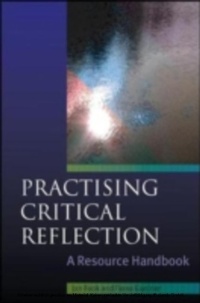
Practising Critical Reflection
A Resource Handbook
1st Edition
Published on 1. September 2007
234 pages
978-0-335-23487-5 (ISBN)
Description

This accessible handbook focuses on a description and analysis of the theoretical input as well as the approach involved in critical reflection.
More details
Other editions
Additional editions
Book
09/2007
Open University Press
€40.00
Available immediately
Content
- Front Cover
- Half-title
- Title Page
- Copyright Page
- Contents
- Preface
- Acknowledgements
- Part 1: The Theory and Contexts of Critical Reflection
- Chapter 1: The context for professionals
- A sense of powerlessness: uncertainty and human service organizations
- Fear of risk
- Increased complexity
- Organizational responses to uncertainty, risk and complexity
- Where does this leave professionals in organizations?
- The place of critical reflection
- Chapter summary
- Chapter 2: Clarifying our approach to critical reflection
- Developing our approach to critical reflection
- Unsettling individual assumptions to bring about social changes: details of the approach
- Chapter summary
- Chapter 3: The theoretical frameworks underlying critical reflection
- The reflective approach to theory and practice
- Reflexivity
- Postmodernism and deconstruction
- Critical social theory
- Chapter summary
- PART II: The Process of Critical Reflection
- Chapter 4: The critical reflection model and process
- Introduction
- Overview of the model
- Starting the critical reflection process
- Chapter summary
- Chapter 5: The introductory session
- Group introductions
- Introducing the critical reflection model
- The four traditions of critical reflection
- Overview of the process
- Facilitator modelling of the process
- Winding up and linking with the next session
- Chapter summary
- Chapter 6: The second session (stage 1)
- Overview of the session structure
- A typical presentation of a critical incident
- Broad principles and techniques
- Winding up and linking with stage 2
- Chapter summary
- Chapter 7: The third session (stage 2)
- Between sessions
- Stage 2: overview of structure
- A typical stage 2
- Ending the workshop
- Broad principles and techniques
- Chapter summary
- Chapter 8: The benefits and outcomes of critical reflection
- The issues involved in evaluating critical reflection
- The benefits of critical reflection
- The outcomes of critical reflection
- Chapter summary
- PART III: Application of the Critical Reflection Process
- Chapter 9: Using critical reflection in organizational settings
- Critical reflection and management
- Critical reflection and programme development
- Critical reflection and supervision
- Using critical reflection to develop or articulate a model of supervision
- Chapter summary
- Chapter10: Using critical reflection in research and evaluation
- Defining research and evaluation
- Current interest in evidence-based practice
- Using critical reflection in research and evaluation
- Chapter summary
- Chapter 11: Critical reflection and direct practice
- Common themes for direct practice using critical reflection
- How to use critical reflection in direct practice
- Using critical reflection in community work
- Critical reflection and working with individuals and/or families
- Critical reflection and policy development and implementation
- Chapter summary
- Chapter 12: Ongoing issues
- Balancing safety and challenge
- Inclusivity
- Participants who don't participate fully
- Balancing the focus on self and on others
- Critical reflection and critical practice
- Critical reflection and evidence-based practice
- Differentiating critical reflection and therapy
- The meaning of critical reflection
- References
- Index
- Back Cover
