

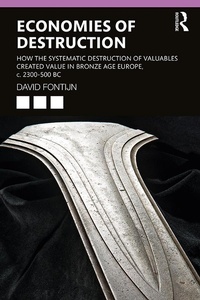
Economies of Destruction
How the systematic destruction of valuables created value in Bronze Age Europe, c. 2300-500 BC
1st Edition
Published on 10. July 2019
202 pages
978-1-351-61439-9 (ISBN)
Description

Why do people destroy objects and materials that are important to them? This book aims to make sense of this fascinating, yet puzzling social practice by focusing on a period in history in which such destructive behaviour reached unseen heights and complexity: the Bronze Age and Early Iron Age in Europe (c. 2300-500 BC).
This period is often seen as the time in which a 'familiar' Europe took shape due to the rise of a metal-based economy. But it was also during the Bronze Age that massive amounts of scarce and recyclable metal were deliberately buried in the landscape and never taken out again. This systematic deposition of metalwork sits uneasily with our prevailing perception of the Bronze Age as the first 'rational-economic' period in history - and therewith - of ourselves. Taking the patterned archaeological evidence of these seemingly un-economic metalwork depositions at face value, it is shown that the 'un-economic' giving-up of metal valuables was an integral part of what a Bronze Age 'economy' was about. Based on case studies from Bronze Age Europe, this book attempts to reconcile the seemingly conflicting political and cultural approaches that are currently used to understand this pivotal period in Europe's deep history. It seems that to achieve something in society, something else must be given up.
Using theories from economic anthropology, this book argues that - paradoxically - giving up that which was valuable created value. It will be invaluable to scholars and archaeologists interested in the Bronze Age, ancient economies, and a new angle on metalwork depositions.
This period is often seen as the time in which a 'familiar' Europe took shape due to the rise of a metal-based economy. But it was also during the Bronze Age that massive amounts of scarce and recyclable metal were deliberately buried in the landscape and never taken out again. This systematic deposition of metalwork sits uneasily with our prevailing perception of the Bronze Age as the first 'rational-economic' period in history - and therewith - of ourselves. Taking the patterned archaeological evidence of these seemingly un-economic metalwork depositions at face value, it is shown that the 'un-economic' giving-up of metal valuables was an integral part of what a Bronze Age 'economy' was about. Based on case studies from Bronze Age Europe, this book attempts to reconcile the seemingly conflicting political and cultural approaches that are currently used to understand this pivotal period in Europe's deep history. It seems that to achieve something in society, something else must be given up.
Using theories from economic anthropology, this book argues that - paradoxically - giving up that which was valuable created value. It will be invaluable to scholars and archaeologists interested in the Bronze Age, ancient economies, and a new angle on metalwork depositions.
Reviews / Votes
"This book sheds new light on one of the most pressing problems in European archaeology: why did people in the Bronze Age bury so much metalwork or consign it to rivers and bogs? David Fontijn's analysis is compelling, original and brilliantly argued. It will be influential and ought to take studies of ancient Europe in exciting new directions." - Richard Bradley, Reading University, UK"This innovative and insightful book explores the analytical lenses through which we encounter and explain the deposition of metal objects in Bronze Age and Early Iron Age Europe. Employing anthropological theories of value to call into question the distinctions archaeologists so often draw between social, religious and economic activities, this book will be of interest to anyone working on the significance of objects and depositional practice in the past." - Joanna Brueck, University of Bristol, UK
"Economies of Destruction is a book worthy of considerable reflection. It is a book filled with new terminology, new concepts and new approaches, drawing heavily on recent anthropological theory, and shifting the traditional focus from the sacred-profane explanations for deposition to concepts of practice and Bronze Age world views. Fontijn has the remarkable ability to present something new and thought-provoking that seems, at the same time, very obvious...No doubt this will become essential reading for all those interested in depositional practices." - Matthew G. Knight, The Prehistoric Society "This book sheds new light on one of the most pressing problems in European archaeology: why did people in the Bronze Age bury so much metalwork or consign it to rivers and bogs? David Fontijn's analysis is compelling, original and brilliantly argued. It will be influential and ought to take studies of ancient Europe in exciting new directions." - Richard Bradley, Reading University, UK
"This innovative and insightful book explores the analytical lenses through which we encounter and explain the deposition of metal objects in Bronze Age and Early Iron Age Europe. Employing anthropological theories of value to call into question the distinctions archaeologists so often draw between social, religious and economic activities, this book will be of interest to anyone working on the significance of objects and depositional practice in the past." - Joanna Brueck, University of Bristol, UK
More details
Edition
1. Auflage
Language
English
Place of publication
London
United Kingdom
Publishing group
Taylor & Francis Ltd
Target group
College/higher education
Illustrations
1 Tables, black and white; 1 Line drawings, black and white; 43 Halftones, black and white; 44 Illustrations, black and white
ISBN-13
978-1-351-61439-9 (9781351614399)
Copyright in bibliographic data and cover images is held by Nielsen Book Services Limited or by the publishers or by their respective licensors: all rights reserved.
Schweitzer Classification
Other editions
Additional editions
David Fontijn
Economies of Destruction
How the systematic destruction of valuables created value in Bronze Age Europe, c. 2300-500 BC
Book
07/2019
1st Edition
Routledge
€230.65
Shipment within 10-20 days
David Fontijn
Economies of Destruction
How the systematic destruction of valuables created value in Bronze Age Europe, c. 2300-500 BC
Book
07/2019
1st Edition
Routledge
€72.07
Shipment within 10-20 days
Person
David Fontijn is Professor in the Archaeology of Early Europe at the Faculty of Archaeology, University of Leiden, and affiliated member of the German Archaeological Institute (DAI). His research focuses on ritual landscapes and on the social evolution of prehistoric farming societies in Europe and Eurasia. Previous books include the award-winning Sacrificial Landscapes (2003) and Transformation through Destruction (2013; co-written/edited with S. Van der Vaart and R. Jansen).
Content
Acknowledgments; Preface; Chapter 1 Systematic irrationalities? The Bronze Age 'destructive economy'; Chapter 2 Selective deposition - what does it entail and how can it be studied?; Chapter 3 The value conundrum: What common things and splendid items share and why their deposition is selective; Chapter 4 Pre-Bronze Age selective deposition; Chapter 5 Trade hoards: The un-economic nature of the Bronze Age metal economy; Chapter 6 Gifts to familiar gods?; Chapter 7 The receiving landscape; Chapter 8 Economies of destruction: 'keeping-while-destroying'?; Index
