


Resistant Practices in Communities of Sound
1st Edition
Published on 15. July 2024
396 pages
978-0-2280-2175-9 (ISBN)
Description

Print - and by extension, visuality - has historically dominated the literary, artistic, and academic spheres in Canada; however, scholars and artists have become increasingly attuned to the creative and scholarly opportunities offered by paying attention to sound.
Resistant Practices in Communities of Sound turns to a particular opportunity, interrogating the ways that sonic practices act as forms of aesthetic and political dissent. Chapters explore, on the one hand, critical methods of engaging with sound - particularly bodies of literary and artistic work in their specific materiality as read, recited, performed, mediated, archived, and remixed objects; on the other hand, they also engage with creative practices that mobilize sound as a political aesthetic, taking on questions of identity, racialization, ability, mobility, and surveillance. Divided into nine pairings that bring together works originating in oral/aural forms with works originating in writing, the book explores the creative and critical output of leading sonic practitioners. It showcases diverse approaches to the equally complex formations of sound, resistance, and community, bridging the too-often separate worlds of the practical and the academic in generative, resonant dialogue.
Combining the oral and the written, the creative and the critical, and the mediated and the live, Resistant Practices in Communities of Sound asks us to attune ourselves as listeners as well as readers.
Resistant Practices in Communities of Sound turns to a particular opportunity, interrogating the ways that sonic practices act as forms of aesthetic and political dissent. Chapters explore, on the one hand, critical methods of engaging with sound - particularly bodies of literary and artistic work in their specific materiality as read, recited, performed, mediated, archived, and remixed objects; on the other hand, they also engage with creative practices that mobilize sound as a political aesthetic, taking on questions of identity, racialization, ability, mobility, and surveillance. Divided into nine pairings that bring together works originating in oral/aural forms with works originating in writing, the book explores the creative and critical output of leading sonic practitioners. It showcases diverse approaches to the equally complex formations of sound, resistance, and community, bridging the too-often separate worlds of the practical and the academic in generative, resonant dialogue.
Combining the oral and the written, the creative and the critical, and the mediated and the live, Resistant Practices in Communities of Sound asks us to attune ourselves as listeners as well as readers.
More details
Language
English
Place of publication
Montreal
Canada
Illustrations
21 figures
ISBN-13
978-0-2280-2175-9 (9780228021759)
Copyright in bibliographic data and cover images is held by Nielsen Book Services Limited or by the publishers or by their respective licensors: all rights reserved.
Schweitzer Classification
Other editions
Additional editions
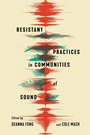
Deanna Fong | Cole Mash
Resistant Practices in Communities of Sound
Book
07/2024
McGill-Queen's University Press
€37.50
Shipment within 15-20 days
Deanna Fong | Cole Mash
Resistant Practices in Communities of Sound
Book
07/2024
McGill-Queen's University Press
€135.19
Shipment within 15-20 days
Persons
Deanna Fong is the literary editor of the Vancouver-based art and literary journal The Capilano Review.
Cole Mash is a poet, scholar, and community arts organizer from Syilx/Okanagan territory in Kelowna, BC.
Cole Mash is a poet, scholar, and community arts organizer from Syilx/Okanagan territory in Kelowna, BC.
Content
- Cover
- RESISTANT PRACTICES in COMMUNITIES of SOUND
- Title
- Copyright
- Dedication
- CONTENTS
- Figures and Scores
- Introduction: Resistant Practices in Communities of Sound
- On Transcription: A Prelude (in Conversation with Deanna Fong)
- 1 "We make something out of what records we can find": An Interview with Wayde Compton
- 2 Race, Multiplicity, and Dis/Located Voices: Wayde Compton's Turntablist Poetics
- 3 "The fact of my mouth": An Interview with Jordan Scott
- 4 Listening as Access: Toward Relational Listening for Nonnormative Speech and Communication
- 5 "That in-between space": An Interview with Oana Avasilichioaei
- 6 New Forms of Digital, Temporal, and Auditory Poiesis
- 7 "It doesn't mean anything except talking": An Interview with Tracie Morris
- 8 "It's resistance but it's also embrace": Tracie Morris's Collaborative Ear, An Open Letter
- 9 "What is being resisted is our 'yes'": An Interview with Tawhida Tanya Evanson, El Jones, and Erin Scott
- 10 The Whatever-icity of Spoken Word: Community, Identity, Performativity
- 11 "A taking in, a holding with": An Interview with Jordan Abel
- 12 Can We Think of Sound (or Voice) without Sight (or the Gaze)? Lacanian Theory and the Horror of Community
- 13 Transcript of Lesbian Liberation Across Media: A Sonic Screening Podcast, Introduction
- 14 Listening to LGBTQ2+ Communities at the Lesbian Liberation Across Media Watch Party
- 15 "It was an extension of the moment": Five Poets in Conversation on Analog Audio Recording and Creative Practice
- 16 Curatorial Agency at Véhicule Art Inc.: "Openness was a guiding spirit to VÉHICULE"
- 17 "Songs are so much more than songs": An Interview with Dylan Robinson
- 18 "Misaudition"
- Contributors
- Index
