

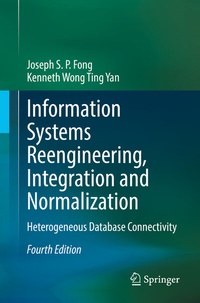
Information Systems Reengineering, Integration and Normalization
Description

Database technology is an important subject in Computer Science. Every large company and nation needs a database to store information. The technology has evolved from file systems in the 60's, to Hierarchical and Network databases in the 70's, to relational databases in the 80's, object-oriented databases in the 90's, and to XML documents and NoSQL today. As a result, there is a need to reengineer and update old databases into new databases. This book presents solutions for this task.
In this fourth edition, Chapter 9 - Heterogeneous Database Connectivity (HDBC) offers a database gateway platform for companies to communicate with each other not only with their data, but also via their database. The ability of sharing a database can contribute to the applications of Big Data and surveys for decision support systems. The HDBC gateway solution collects input from the database, transfers the data into its middleware storage, converts it into a common data format such as XML documents, and then distributes them to the users. HDBC transforms the common data into the target database to meet the user's requirements, acting like a voltage transformer hub. The voltage transformer converts the voltage to a voltage required by the users. Similarly, HDBC transforms the database to the target database required by the users.
This book covers reengineering for data conversion, integration for combining databases and merging databases and expert system rules, normalization for eliminating duplicate data from the database, and above all, HDBC connects all legacy databases to one target database for the users.
The authors provide a forum for readers to ask questions and the answers are given by the authors and the other readers on the Internet.
More details
Other editions
Additional editions
Previous edition
Persons
Kenneth Wong is an IT engineer and researcher. He graduated at City University of Hong Kong as a M.Phil. student by doing research in universal database. He was also a database administrator in a hosiptal in Hong Kong. He has been working as I.T. Practitioner in International Hybrid Learning Society since June 2016. He is a computer professional in web design technology and I.T in education. Now, he specializes in system and networking migration projects for world-wide companies.
Content
Preface.- Information Systems Reengineering, Integration and Normalization.- Database and Expert System Technology.- Schema Transition.- Data Conversion.- Database Program Translation.- Schema Integration.- Database and Expert-Systems Integration.- Data Normalization.- Heterogeneous Database Connectivity.- Conclusion.
