

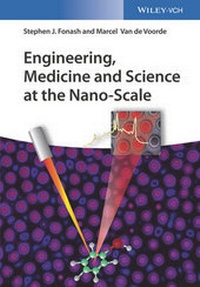
Engineering, Medicine and Science at the Nano-Scale
Description

The textbook begins by addressing, in general terms, the phenomena and peculiarities that occur at the nanoscale. In the following five chapters, readers are introduced in detail to nanoscale physics, chemistry, materials science, and biology, followed by chapters on synthesis and fabrication as well as characterization at the nanoscale. In the next four chapters a variety of exemplary applications taken from a wide range of sectors are also presented and discussed. Concerns for safety, environmental impact, workforce development, economic wellbeing, and societal change issues arising from nanotechnology are woven throughout the book and additionally form the focus of the last two chapters.
More details
Other editions
Additional editions
Persons
Marcel Van de Voorde is special advisor at IMEC, Belgium. He studied industrial and chemical engineering and received his PhD in nuclear engineering from the University of Nancy, France. He was co-founder and professor at the Hoger Instituut der Kempen, Geel, and the Technical Institute Don Bosco, Hoboken in Belgium. He further holds professorships at the Catholic University of Leuven, Ghent University, Delft University of Technology and is visiting professor at several recognized universities in Europe, US, Japan and China.
Content
Some Physics Fundamentals Pertinent to Nanotechnology
Some Chemistry Fundamentals Pertinent to Nanotechnology
Some Biology and Biochemistry Fundamentals Pertinent to Nanotechnology
Some Material Science Fundamentals Pertinent to Nanotechnology
Properties of Nanotechnology Materials
An Overview of Nanotechnology Characterization Approaches
Nano Material Preparation and Device Fabrication: Non-Biological Approaches
Nano Material Preparation and Device Fabrication: Biological Approaches
Nanotechnology and Engineering: Computing, Communications, Imaging, and Sensing
Nanotechnology and Engineering: Materials, Energy Technologies, the Environment, Food and Agriculture, and Chemical Processes
Nanotechnology and Medicine: NP Targeting for Therapy and Imaging
Nanotechnology and Medicine: Devices and Materials
Nanotechnology: The Risks
Nanotechnology: Economic, Environmental, Societal, and Health Impacts
Appendix
Index
1
Nanotechnology: What, Why, and Why Now?
.the builder's final frontier.
Richard Smalley, Nobel Laurate in Chemistry, 1943-2005
1.1. What Is Nanotechnology?
Nanotechnology is the nexus of engineering, medicine, and science. It is not a discipline in the traditional sense but a broad spectrum of human endeavors unified by thinking, exploring, and creating at the size scale of things like molecules and viruses. This is the size scale where it is possible to achieve advances ranging from targeted therapies for breakthroughs in disease treatment to light weight, strong hierarchical materials for high speed, safe transportation. The prefix "nano" in the word "nanotechnology" comes from both Greek and Latin. In both languages it meant "dwarf," as it still does in modern Italian. The term "nanotechnology" is used in this text to describe the practice of engineering, medicine, and science in this world of things of the size of viruses and molecules - the nanoscale. This size range is defined here to be from a nanometer (10-9?m?=?nm) or a little smaller (down to tenths of a nanometer) to 100?nm or a little larger (up to several hundred nanometers). Figure 1.1 shows how this nanotechnology range fits in among the micrometer (10-6?m?=?µm), picometer (10-12?m?=?pm), and femtometer (10-15?m?=?fm) size ranges. It also includes a few examples from these size scales. The boundaries of the nanotechnology size range are taken in this text to be fuzzy, not sharp. Structures in the nanosize range are constructed by putting varying amounts of atoms or molecules or both together in new ways with new results. In the pico- and femto-scales, things are being done at the scale of an atom or its nucleus. Aside from radioisotopes and nuclear reactors, there is no corresponding picotechnology or femtotechnology. For a more complete overview of size scale terminologies, we have additionally included a broader, more encompassing size range in Figure 1.1, which is denoted as the "mesoscopic" scale. This scale term is sometimes used, principally in physics, to denote a wide range of sizes from that of an atom to micrometers (microns).
Figure 1.1 A schematic showing where nanotechnology lies among the micro-, nano-, pico-, and femtoranges. Some natural as well as man-made examples from these different size ranges are sketched (not to scale). Nanotechnology is formally defined as working with objects with at least one dimension in the 1-100?nm range. We will think of nanotechnology as having somewhat broader, diffuse boundaries as conveyed by the green box.
To get an idea of how many atoms we are working with in nanotechnology, we note that a typical solid has something of the order of 1022?atoms/cm3. This means that a 100-nm-diameter nanoparticle contains?~?5?×?106?atoms, a 10?nm particle contains?~?5×10³ atoms, and a 1?nm particle contains?~?5?atoms. The excitement of nanotechnology comes from the fact that its structures are so small and from the fact that phenomena dominating for these relatively minute assemblages of atoms can be very different from those dominating at the micrometer and larger scales. Nanoscience, nanoengineering, and nanobiomedicine strive to exploit the resulting opportunities available at the size scale of nanotechnology to create new manufacturing approaches, new materials, and new structures for the betterment of society.
Because of this excitement and intense activity at the size range of objects such as viruses and molecules and because of its broad applicability, nanotechnology has received a great deal of public attention and "hype." Some may say it has been overhyped. What seems closest to the actual situation is that the timeline over which nanotechnology can deliver society-changing results has been underestimated. The application of nanotechnology has turned out to be often much easier in science than in engineering or medicine, both of which can entail dealing with economic and societal issues. A common failure has been to assume that, once a new basic nanomaterial or device has been created, or that a fundamental phenomenon has been observed, the step of employing it in an engineering or medical field is straightforward. In fact, the opposite is usually true. Developing something of societal impact - the making of a nanotechnology science advance into something practical, environmentally compatible, economically viable, and commercially manufacturable - is usually the more difficult task.
Nanotechnology has already contributed to addressing crucial issues such as defeating cancer, providing clean energy, and protecting the environment. It has already produced incredible advances in fields such as electronics, optoelectronics, and biomedical imaging. While it has not yet produced materials that will withstand the perils of any car accident, it has produced miniature sensors, computational circuits, lasers, and so on that make possible accident-avoidance cars and trucks and even fully self-driven vehicles. The needs of the twenty-first century are being addressed by nanotechnology but many challenges remain. We still need more contributions from nanotechnology to attain adequate water and energy resources for the future, reduction of scarce-materials usage, reduction in deleterious human impact on the planet, and enhanced control of diseases.
1.2. Why Is Nanotechnology So Unique?
The excitement and possibilities of nanotechnology become apparent when one simply asks the question "what are the unique features of this size range?" It turns out that, by our count, there are 10 answers. The first unique feature of the nanotechnology scale is the obvious one: nanotechnology sizes are very small. They are so small that they are in the same size realm of very basic biological and physical objects. For example, the sizes of pores in cell walls, of viruses, and of the diameter of DNA are all in the size realm of nanotechnology. The second unique feature is that the surface to volume ratio (which of course goes as 1/r for particles of radius r) can clearly be very large. This means the surface properties and surface forces can be very important relative to their bulk counterparts. For example, gravity, a bulk force, can be negligible with respect to surface interactions for particles in the nanotechnology range. In one of his famous three 1905 papers, Einstein realized that gravity was unimportant for nanoparticles in solution (then referred to as colloidal particles). He realized that in undergoing Brownian motion, such very small particles were only subject to surface forces. As long as they did not agglomerate due to surface bonding as they bounced around in their collisions with other particles, atoms, and molecules, they could stay in solution forever [1].
The increasing surface to volume importance with decreasing nanoparticle size is the basis of the third feature: that the atoms or molecules on the surface of a nanoparticle become increasingly important, compared to those in the interior, as Figure 1.2 suggests. Since these atoms "see" a different environment than those in the interior (bulk) and the number affected varies with the radius, the physical and chemical properties of a particle can change with radius. Experimental evidence emphasizing this point is offered in Figure 1.3, which shows data for the melting temperature of Au versus nanoparticle size [2].
Figure 1.2 A pictorial representation of the increasing role of surfaces as particle size diminishes.
Figure 1.3 The melting temperature of Au as a function of particle diameter. The curve has been added to aid the eye.
(© 1976 American Physical Society. Reprinted figure with permission from [2]).
A fourth unique feature of the nanotechnology size range is that remarkable forms of chemical bonding can exist for nanoscale structures. A very well-known demonstration of this phenomenon can be found in single wall carbon nanotube (), depicted in Figure 1.4. This figure shows the single sheet of atoms of the SWCNT has features of the hexagonal bonding of carbon in graphene and graphite (see Section 3.2.4.1). However, unlike graphene or graphite, this bonding present in the SWCNT is contorted. The contortion can have variable amounts of twisting depending on the process that produces the SWCNT. In any case, this single atom layer thick sheet of the SWCNT is clearly stressed. Amazingly, even with this twisting, these ~1-nm-diameter tubes are six times stronger than steel [3].
Figure 1.4 The single wall carbon nanotube (SWCNT). Carbon atoms are represented by the spheres.
(Reprinted with permission from http://www.tinymatter.com/.)
The fifth unique feature found in the nanotechnology realm is the phenomenon of self-assembly. Self-assembly is found in many forms in nature. At the nanoscale, it can be exploited and controlled; that is, we have learned to be able to create conditions at the nanoscale where particles, atoms, or molecules can self-assemble...
