

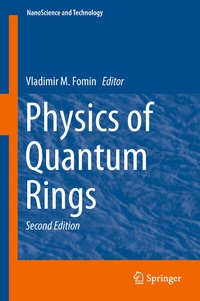
Physics of Quantum Rings
Description

This book, now in its second edition, introduces readers to quantum rings as a special class of modern high-tech material structures at the nanoscale. It deals, in particular, with their formation by means of molecular beam epitaxy and droplet epitaxy of semiconductors, and their topology-driven electronic, optical and magnetic properties. A highly complex theoretical model is developed to adequately represent the specific features of quantum rings. The results presented here are intended to facilitate the development of low-cost high-performance electronic, spintronic, optoelectronic and information processing devices based on quantum rings.
This second edition includes both new and significantly revised chapters. It provides extensive information on recent advances in the physics of quantum rings related to the spin-orbit interaction and spin dynamics (spin interference in Rashba rings, tunable exciton topology on type II InAs/GaAsSb quantum nanostructures), the electron-phonon interaction in ring-like structures, quantum interference manifestations in novel materials (graphene nanoribbons, MoS 2 ), and the effects of electrical field and THz radiation on the optical properties of quantum rings. The new edition also shares insights into the properties of various novel architectures, including coupled quantum ring-quantum dot chains and concentric quantum rings, topologic states of light in self-assembled ring-like cavities, and optical and plasmon m.odes in Möbius-shaped resonators.
Reviews / Votes
"Offers extensive material for scientists and upper-level students who wish to familiarize themselves with the subject in great breadth and depth, showing that, beyond points, lines and surfaces, there is still "a lot of room at the bottom"." (Translated from German, Prof. Dr. Axel Lorke, pro-physik.de, September 2019)More details
Other editions
Additional editions
Person
Vladimir M. Fomin is a Research Professor at the Institute for Integrative Nanosciences (IIN), Leibniz Institute for Solid State and Materials Research (IFW) Dresden and a Professor of Theoretical Physics at the State University of Moldova. He received his Ph.D. in Theoretical Physics from the State University of Moldova in 1978. His research pertained to non-linear optical properties and transport in semiconductors and multi-layer structures. He was awarded the State Prize of Moldova in 1987, and received his degree of Doctor of physical and mathematical sciences ("habilitation", Academy of Sciences of Moldova) in 1990. Since 1995 he has been a Professor of Theoretical Physics at the State University of Moldova. In 1999, he received a Diploma of a Scientific Discovery of the Phenomenon of the Propagation of Spatially-Extended Interface Phonon Polaritons in Composite Superlattices from the Academy of Natural Sciences of Russia. He was a Research Fellow of the Alexander von HumboldtFoundation (Martin-Luther-University of Halle, 1993-1994), University of Antwerp, 1995-2008 and Eindhoven University of Technology, 1998-1999 and 2003-2007, Catholic University of Leuven, 2008, University of Duisburg-Essen, 2008-2009, and the IIN IFW Dresden since 2009. In 2007 he became an Honorary Member of the Academy of Sciences of Moldova. His scientific interests currently concern topology- and geometry-driven phenomena in nanophysics, especially the physics of quantum rings. He has published four books and over 200 scientific articles, and holds 10 patents.
