

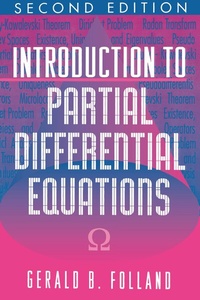
Introduction to Partial Differential Equations
Second Edition
2nd Edition
Published on 18. May 2020
336 pages
978-0-691-21303-3 (ISBN)
Description

The second edition of Introduction to Partial Differential Equations, which originally appeared in the Princeton series Mathematical Notes, serves as a text for mathematics students at the intermediate graduate level. The goal is to acquaint readers with the fundamental classical results of partial differential equations and to guide them into some aspects of the modern theory to the point where they will be equipped to read advanced treatises and research papers. This book includes many more exercises than the first edition, offers a new chapter on pseudodifferential operators, and contains additional material throughout.
The first five chapters of the book deal with classical theory: first-order equations, local existence theorems, and an extensive discussion of the fundamental differential equations of mathematical physics. The techniques of modern analysis, such as distributions and Hilbert spaces, are used wherever appropriate to illuminate these long-studied topics. The last three chapters introduce the modern theory: Sobolev spaces, elliptic boundary value problems, and pseudodifferential operators.
The first five chapters of the book deal with classical theory: first-order equations, local existence theorems, and an extensive discussion of the fundamental differential equations of mathematical physics. The techniques of modern analysis, such as distributions and Hilbert spaces, are used wherever appropriate to illuminate these long-studied topics. The last three chapters introduce the modern theory: Sobolev spaces, elliptic boundary value problems, and pseudodifferential operators.
More details
Other editions
Additional editions
Book
11/1995
2nd Edition
Princeton University Press
€99.10
Shipment within 10-20 days
Gerald B. Folland
Introduction to Partial Differential Equations
Book
08/1976
Princeton University Press
€43.40
Article exhausted; check different version
Person
Gerald B. Folland is Professor of Mathematics at the University of Washington. He is the author of a number of books, including Real Analysis, Fourier Analysis and Its Applications, and Harmonic Analysis in Phase Space (Princeton).
Content
- Cover Page
- Half-title Page
- Title Page
- Copyright Page
- Contents
- Preface
- Chapter 0: Preliminaries
- A. Notations and Definitions
- B. Results from Advanced Calculus
- C. Convolutions
- D. The Fourier Transform
- E. Distributions
- F. Compact Operators
- Chapter 1: Local Existence Theory
- A. Basic Concepts
- B. Real First Order Equations
- C. The General Cauchy Problem
- D. The Cauchy-Kowalevski Theorem
- E. Local Solvability: the Lewy Example
- F. Constant-Coefficient Operators:
- Chapter 2: The Laplace Operator
- A. Symmetry Properties of the Laplacian
- B. Basic Properties of Harmonic Functions
- C. The Fundamental Solution
- D. The Dirichlet and Neumann Problems
- E. The Green's Function
- F. Dirichlet's Principle
- G. The Dirichlet Problem in a Half-Space
- H. The Dirichlet Problem in a Ball
- I. More about Harmonic Functions
- Chapter 3: Layer Potentials
- A. The Setup
- B. Integral Operators
- C. Double Layer Potentials
- D. Single Layer Potentials
- E. Solution of the Problems
- F. Further Remarks
- Chapter 4: The Heat Operator
- A. The Gaussian Kernel
- B. Functions of the Laplacian
- C. The Heat Equation in Bounded Domains
- Chapter 5: The Wave Operator
- A. The Cauchy Problem
- B. Solution of the Cauchy Problem
- C. The Inhomogeneous Equation
- D. Fourier Analysis of the Wave Operator
- E. The Wave Equation in Bounded Domains
- F. The Radon Transform
- Chapter 6: The L2 Theory of Derivatives
- A. Sobolev Spaces on Mn
- B. Further Results on Sobolev Spaces
- C. Local Regularity of Elliptic Operators
- D. Constant-Coefficient Hypoelliptic Operators
- E. Sobolev Spaces on Bounded Domains
- Chapter 7: Elliptic Boundary Value Problems
- A. Strong Ellipticity
- B. On Integration by Parts
- C. Dirichlet Forms and Boundary Conditions
- D. The Coercive Estimate
- E. Existence, Uniqueness, and Eigenvalues
- F. Regularity at the Boundary: the Second Order Case
- G. Further Results and Techniques
- H. Epilogue: the Return of the Green's Function
- Chapter 8: Pseudodifferential Operators
- A. Basic Definitions and Properties
- B. Kernels of Pseudodifferential Operators
- C. Asymptotic Expansions of Symbols
- D. Amplitudes, Adjoints, and Products
- E. Sobolev Estimates
- F. Elliptic Operators
- G. Introduction to Microlocal Analysis
- H. Change of Coordinates
- Bibliography
- Index of Symbols
- Index
