

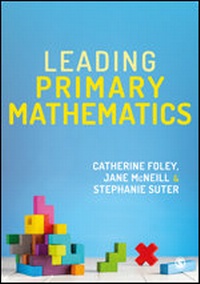
Leading Primary Mathematics
1st Edition
Published on 18. March 2019
256 pages
978-1-5264-7913-6 (ISBN)
Description

This book provides guidance and insight into 'what mathematics leadership looks like in practice' and shows readers how they can develop from a confident teacher into a curriculum subject leader. It does this through a careful blend of pedagogy and practical application, supported by a range of real-world case studies and opportunities to reflect critically on classroom practice. Key coverage includes:
The planning and application that underpins subject leadership
How international perspectives can influence leadership of mathematics
How to develop fluency through problem solving and reasoning
How to champion inclusive practice in mathematics
Assessing children's understanding
This is essential reading for anyone studying primary mathematics on initial teacher education courses, including undergraduate (BA Ed, BA with QTS) and postgraduate (PGCE, PGDE, School Direct and SCITT) routes, NQTs seeking to develop into curriculum leadership roles and those already leading mathematics in their school.
The planning and application that underpins subject leadership
How international perspectives can influence leadership of mathematics
How to develop fluency through problem solving and reasoning
How to champion inclusive practice in mathematics
Assessing children's understanding
This is essential reading for anyone studying primary mathematics on initial teacher education courses, including undergraduate (BA Ed, BA with QTS) and postgraduate (PGCE, PGDE, School Direct and SCITT) routes, NQTs seeking to develop into curriculum leadership roles and those already leading mathematics in their school.
Reviews / Votes
This book will be of use to everyone involved in teaching primary mathematics, ranging from pre-service teachers, to experienced mathematics educators. In the current education context, this book provides an appropriate balance of relevant literature and classroom activities, to support those wanting to develop their understanding of mathematics teaching and learning. -- Dr Gwen InesonMore details
Language
English
Place of publication
London
United Kingdom
Target group
College/higher education
ISBN-13
978-1-5264-7913-6 (9781526479136)
Copyright in bibliographic data and cover images is held by Nielsen Book Services Limited or by the publishers or by their respective licensors: all rights reserved.
Schweitzer Classification
Other editions
Additional editions
Catherine Foley | Jane McNeill | Stephanie Suter
Leading Primary Mathematics
Book
04/2019
1st Edition
SAGE Publications Ltd
€67.80
Shipment within 15-20 days
Catherine Foley | Jane McNeill | Stephanie Suter
Leading Primary Mathematics
Book
04/2019
1st Edition
SAGE Publications Ltd
€132.50
Shipment within 15-20 days
Persons
Catherine Foley is an Associate Professor of Mathematics Education at the University of Reading. Prior to this, she was a primary school teacher in West Berkshire and Oxfordshire and subsequently became a leading mathematics teacher and local authority consultant. After several years working for the Primary National Strategy as a senior adviser in the mathematics team she moved to her current role in initial teacher training, teaching across a range of undergraduate and postgraduate programmes. She currently leads the school-based Primary School Direct programme and leads the mathematics teaching within primary post-graduate initial teacher training. Her doctoral research focused upon the study of girls' perceptions of mathematics, and she continues to work closely with schools.
After many years as a primary teacher and mathematics subject leader Jane McNeill became a numeracy consultant in 1999, working for Oxfordshire Education Authority and then independently. As a numeracy and mathematics consultant, Jane worked extensively with local schools and also worked for national organisations including The National Strategies and the National Centre for Excellence in the Teaching of Mathematics. Building on her broad experience of supporting the professional development of teachers in schools, she decided to extend her repertoire by moving into Initial Teacher Education in 2010 and worked as a senior lecturer in Primary Mathematics Education at Oxford Brookes University until 2016. She has now returned to her role as an independent mathematics consultant.
Stephanie Suter is a Senior Lecturer at Bath Spa University where she teaches mathematics to primary post-graduate trainees. She started her career as a primary school teacher and mathematics subject leader in Northamptonshire and Bedfordshire before becoming a local authority numeracy consultant. Stephanie then worked as a mathematics senior adviser for the Primary National Strategy before moving into initial teacher training. She was a Senior Lecturer at Oxford Brookes University and the University of Worcester before joining Bath Spa University and in these roles has taught mathematics across a wide range of undergraduate and postgraduate programmes, including School Direct and Teach First.
After many years as a primary teacher and mathematics subject leader Jane McNeill became a numeracy consultant in 1999, working for Oxfordshire Education Authority and then independently. As a numeracy and mathematics consultant, Jane worked extensively with local schools and also worked for national organisations including The National Strategies and the National Centre for Excellence in the Teaching of Mathematics. Building on her broad experience of supporting the professional development of teachers in schools, she decided to extend her repertoire by moving into Initial Teacher Education in 2010 and worked as a senior lecturer in Primary Mathematics Education at Oxford Brookes University until 2016. She has now returned to her role as an independent mathematics consultant.
Stephanie Suter is a Senior Lecturer at Bath Spa University where she teaches mathematics to primary post-graduate trainees. She started her career as a primary school teacher and mathematics subject leader in Northamptonshire and Bedfordshire before becoming a local authority numeracy consultant. Stephanie then worked as a mathematics senior adviser for the Primary National Strategy before moving into initial teacher training. She was a Senior Lecturer at Oxford Brookes University and the University of Worcester before joining Bath Spa University and in these roles has taught mathematics across a wide range of undergraduate and postgraduate programmes, including School Direct and Teach First.
Content
Section A: Leading Primary Mathematics
Chapter 1: Becoming a leader of mathematical learning
Chapter 2: Attitudes, beliefs and mindsets
Section B: Extending pedagogy
Chapter 3: International perspectives
Chapter 4: Mathematical representation
Chapter 5: Developing fluency
Chapter 6: Problem solving and reasoning
Section C: Leading inclusive mathematics teaching
Chapter 7: Assessing mathematical learning
Chapter 8: Inclusive practice in mathematics
Chapter 9: Overcoming barriers to learning in mathematics
Chapter 10: Mathematics across the curriculum
Section D: Continuing development
Chapter 11: Children and families: partners in learning
Chapter 12: Continuing professional development
Chapter 1: Becoming a leader of mathematical learning
Chapter 2: Attitudes, beliefs and mindsets
Section B: Extending pedagogy
Chapter 3: International perspectives
Chapter 4: Mathematical representation
Chapter 5: Developing fluency
Chapter 6: Problem solving and reasoning
Section C: Leading inclusive mathematics teaching
Chapter 7: Assessing mathematical learning
Chapter 8: Inclusive practice in mathematics
Chapter 9: Overcoming barriers to learning in mathematics
Chapter 10: Mathematics across the curriculum
Section D: Continuing development
Chapter 11: Children and families: partners in learning
Chapter 12: Continuing professional development
