

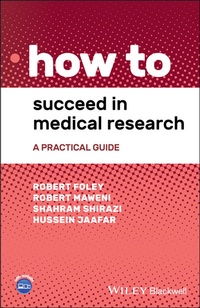
How to Succeed in Medical Research
Description

Presented in an accessible and conversational style, 14 succinct chapters walk readers through the essential stages of their research journey, from the initial steps to getting involved in research as a medical student, to effectively balancing clinical work, scientific research, and other academic pursuits early in your career as a healthcare professional. The book is packed with real-world case studies and expert tips to help readers apply the content directly in their own studies and careers. Straightforward and easy-to-use, this valuable guide:
* Covers a variety of clinical research and presentation skills using clear and engaging language
* Provides detailed guidance on writing a paper, conducting a clinical audit, creating a CV and portfolio, and other key proficiencies
* Develops writing skills for literature reviews, critical appraisals, and case reports
* Discusses how to further medical careers through research electives, PhD studies, teaching, and quality improvement projects
* Offers a range of helpful learning features including objectives, key points, case studies, review questions, and links to references and further readings
* Includes PowerPoint templates for oral presentations and posters via a companion website
How to Succeed in Medical Research: A Practical Guide is an ideal resource for medical students, junior doctors and other early career medical professionals.
More details
Other editions
Additional editions
Persons
Robert Foley, MB BCh BAO, MSc, MCh, GradCert (Statistics), MRCS, Specialist Registrar in Radiology, Health Education England Severn, Bristol, UK.
Robert Maweni, MB BCh BAO, MCh, MRCS (ENT), Specialist Registrar in Otorhinolaryngology, Health Education England Thames Valley, Oxford, UK.
Shahram Shirazi, MB BCh BAO, BSc, MRCS, Specialist Registrar in General Surgery, Health Education England London & South East, London, UK.
Hussein Jaafar, BSc (Biomed), MSc (Neuroscience), PhD (Candidate), Life Science Consultant, Life Science Dynamics, London, UK.
Content
Foreword ix
Preface xi
About the Companion Website xiii
Chapter 1 How to get involved in research 1
1.1 Why do research? 1
1.2 What can I become involved in? 2
1.3 Different types of research 2
1.4 Clinical vs laboratory 8
1.5 Getting ideas for research 8
References 9
Chapter 2 Conducting a study 11
2.1 How to find a research project 11
2.2 How to approach a mentor 14
2.3 Planning your study 17
2.4 Data collection 25
Chapter 3 Literature review and critical appraisal 27
3.1 Literature review 27
3.2 Search terms 28
3.3 Where to search 29
3.4 How to search 30
3.5 Critical appraisal 30
Chapter 4 Ethics and the ethical application 35
4.1 What is medical ethics and why is it important? 35
4.2 Main ethical considerations in medical research 35
4.3 Practical ethical applications 38
4.4 Dealing with conflicts in ethics 39
4.5 Ethical applications 40
Chapter 5 Analysing your data 42
5.1 What I need to know and how to find it 42
5.2 Variables 44
5.3 Analysis of categorical and continuous variables in two groups 47
5.4 Sensitivity and specificity 48
5.5 Positive predictive value and negative predictive value 50
5.6 Receiver operating characteristic curves 51
5.7 Logistic regression analysis 53
5.8 Other types of analysis 54
5.9 How to present your results 55
5.10 Conclusion 57
References 57
Chapter 6 Conferences and presentations: the next step in the research journey 58
6.1 Types of conferences 58
6.2 Prices and prizes 59
6.3 Abstract submission 60
6.4 Title 60
6.5 Introduction 60
6.6 Methods 60
6.7 Results 60
6.8 Conclusion 61
6.9 Poster presentation 63
6.10 Podium presentation 64
Chapter 7 Writing a paper 66
7.1 Title 66
7.2 Abstract 67
7.3 Introduction 68
7.4 Methods 69
7.5 Results 71
7.6 Discussion 72
7.7 Conclusion 73
7.8 References 74
7.9 Sending to seniors for review 74
Reference 75
Chapter 8 How to get published 76
8.1 Which journal? 76
8.2 Authorship 78
8.3 Getting your paper ready for the journal 79
8.4 Dealing with reviewer comments 80
8.5 Dealing with rejection 84
References 85
Chapter 9 Writing a case report 86
9.1 How to begin 86
9.2 Preparing to write the case report 88
9.3 Writing the case report 90
References 94
Chapter 10 Basic laboratory research 95
10.1 Introduction to laboratory research and translational research 95
10.2 Basic research versus clinical research 96
10.3 Laboratory hierarchy 97
10.4 Day to day of working in the lab 98
10.5 How to choose your lab 101
Chapter 11 Expanding your horizons in research 103
11.1 Research elective 103
11.2 Intercalated research degree 104
11.3 Postgraduate diplomas/certificates 105
11.4 Postgraduate degree 106
Chapter 12 Teaching 109
12.1 How to get involved in teaching 109
12.2 Teaching as an undergraduate student 110
12.3 Teaching as a postgraduate student 111
12.4 Teaching at work 112
12.5 Planning a lesson 115
12.6 Getting the most out of your teaching 116
12.7 Running a teaching course 118
12.8 How to set up a novel teaching course 118
12.9 How to run an established course 121
Chapter 13 Conducting an audit 122
13.1 What is clinical audit? 122
13.2 Conducting an audit 123
Chapter 14 Portfolio/CV 131
14.1 Keeping a portfolio 131
14.2 Curriculum vitae (CV) 135
Chapter 15 Maintaining a good balance 137
15.1 Stress and burnout 138
15.2 Improving your mindset to promote resilience 141
15.3 Other methods for resilience 142
15.4 Practical tips 144
References 145
Index 147
Chapter 1
How to get involved in research
1.1 Why do research?
Research involves logical and systematic investigation of a topic in order to reach new conclusions and to gain greater understanding. Research also fundamentally involves the recording of one's findings and the dissemination of the results to others, allowing for the research to be replicated. At its core, research is about finding the answer to meaningful questions. Research represents the backbone of progress within medicine. Becoming involved in research as a medical student, junior doctor, or healthcare professional is an incredibly valuable and rewarding tool to have in one's arsenal. The benefits offered by performing quality research are many; for example, research
- Demonstrates your interest in a topic.
- Allows you to build up your own knowledge base.
- Offers a stimulating reason to learn more about a topic.
- Can often keep you interested in your work.
- Allows you to become a better, more well-informed healthcare provider.
- May lead to improvements in your ability to provide patient care.
- Provides a great chance to improve your CV.
This book aims to offer a how to guide to starting your research career, whether you have any experience with research or not. Research involves time and effort. It is not always easy to start, continue, or to finish a project. However, if you are dedicated and invest your time wisely, you can succeed in medical research.
The goal of getting involved in research can be many of the above outlined benefits, but the main goal should be to gain experience in research, develop skills that will help you throughout your career, and decide how much of a research interest to pursue over the course of your career.
Figure 1.1 The hierarchy of evidence.
1.2 What can I become involved in?
There are a number of different areas of research within medicine. Broadly, there is pre-clinical research, which takes place in the laboratory, and clinical research, which takes place in a clinical setting such as a hospital. Clinical research will be the main focus of this book, and it is the easier branch to become involved in, especially if one is already working in the healthcare setting. We will also discuss pre-clinical research at various points throughout the course of the book.
Another important concept is the hierarchy of research (Figure 1.1). This hierarchy establishes what types of research publications are the most trustworthy and assigns each type a level of evidence. This is often represented as a pyramid and has evolved over the past few decades, guided by the principles of having the weakest study designs at the bottom and the most robust study designs at the top.
1.3 Different types of research
1.3.1 Case report
A case report involves the analysis of an interesting patient and the dissemination of the case and the interesting aspects of it to other healthcare professionals. It also generally involves a literature review to explain the context of the case in light of the current research on this topic. Although low down on the hierarchy of evidence, this is one of the best places to start if you are new to research. A case report allows you to perform many of the important parts of research, including discussion with colleagues, data collection, presentation, manuscript preparation, and submission for peer review. A more detailed guide of how to perform a case report is given in Chapter 9.
1.3.2 Case series
A case series is essentially the same as a case report except that it looks at more than one patient. The topic of the case series is generally one that means it is difficult to recruit large numbers of patients, and so the number in the series is usually small. This is also an excellent starting point for one's research journey and is discussed in Chapter 9.
1.3.3 Commentary
A commentary is a publication that offers the opinion of the authors on another newly published article. It usually will be offered by the editor of a journal to an expert on a particular topic. This may be difficult to become involved in; however, if you find a research mentor that is an expert in his or her field, it may be a potential opportunity to write a short but interesting piece.
1.3.4 Interesting approach
These articles are published in journals to highlight a technical skill or a new way of performing a common procedure. Because the focus is on a procedure, these are usually written by those who specialise in a surgical or interventional specialty. Again, this type of article will need heavy input from the senior colleague who performs the skill or technique, but it is a great opportunity to work in tandem with an expert and get started in research. Skills in manuscript preparation can be gained, and due to the technical nature of the article, it also offers the chance to develop skills in image editing/production for publication.
1.3.5 Letter
Ask senior colleagues if they have read a recent paper on which they have some opinions they would like to share or questions they would like to ask the author. In this way, you can become involved in writing a letter to the editor outlining these points. Letters can often be quite succinct and not take too much time to produce. However, often your mentor will not have the time to write a letter despite having excellent opinions and points on the topic. It is also a good chance for you to practice your writing and literature review.
Case Study 1.1 Letter to the editor [1]
One of my earliest mentors in research once commented that 'we should all be writing more letters to the editor'. Although it still happens, the concept is much less common than it was previously. It is an excellent opportunity to sum up one's thoughts on an article, to offer an alternative point of view, to ask any pressing questions of the authors, or to disagree with their conclusions. Often a letter to the editor and a reply from the original author can make for very interesting debate. While I was reading on the topic of quality of life in patients with a specific type of brain tumour (an acoustic neuroma), I came across a recently published paper by Lodder and colleagues [2]. I had written a similar paper previously and had read a number of similar papers in the preceding months. I was struck by how the paper and the conclusion focused on the same topic as everyone else. The authors found that patients with an acoustic neuroma had a similar quality of life outcome, whether they underwent treatment with surgery, radiotherapy, or both. However, the authors also found that overall, the quality of life scores were low in all patients. Unfortunately, this was not addressed in the article. Many papers with similar findings merely compared quality of life outcomes with different treatments rather than focus on the big picture - which is, that quality of life outcomes in these patients are low. It was my feeling that doctors should be aware that all patients with this disease may have a low quality of life, and so we must try to identify problems in every patient. It felt to me that many authors were ignoring the elephant in the room, and so I wrote to the editor to explain this point of view. Because it was something I felt strongly about, it was fun and relatively easy to write the letter.
1.3.6 Collaborative
Collaborative studies can be an excellent way to ease yourself into the research world. The main advantage is that it is simple! The lead authors will take care of most of the work, including the literature review, the research proposal, the ethical application, the data analysis, the write-up, and the submission process. The disadvantage is that in essence you can only be involved in the data collection. However, despite this obvious downside, it can still be quite a useful experience. The lead authors will provide lots of collaborators with a data collection plan, and you can follow this at your local institution. Usually, because collaborative studies use patients from lots of different areas, there is not too much data collection to be done, and so it may not take too much time. The reward can be gained without too much effort. The first thing to do is to find a collaborative study to become involved in. A number of different collaboratives exist, and there are often a number of options out there. For example:
- STARSurg - A student-led research collaborative with the aim to carry out large and impactful studies within surgery.
- BURST - A urology collaborative that will be discussed in the following case study.
- GlobalSurg - A research collaborative that aims to improve surgical outcomes through research on a global scale.
Case Study 1.2 MIMIC collaborative study [3]
I received an email advert for a new collaborative study being undertaken in the UK, called the MIMIC study, run by the BURST collaborative. The study was looking at patients presenting to the emergency department with renal colic (pain secondary to a kidney stone). I emailed the study lead to register my interest in collecting data on 50 patients at my local hospital. I also found one of the urology consultants at my hospital to...
