

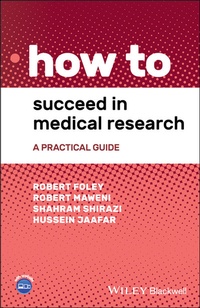
How to Succeed in Medical Research
Description

Presented in an accessible and conversational style, 14 succinct chapters walk readers through the essential stages of their research journey, from the initial steps to getting involved in research as a medical student, to effectively balancing clinical work, scientific research, and other academic pursuits early in your career as a healthcare professional. The book is packed with real-world case studies and expert tips to help readers apply the content directly in their own studies and careers. Straightforward and easy-to-use, this valuable guide:
* Covers a variety of clinical research and presentation skills using clear and engaging language
* Provides detailed guidance on writing a paper, conducting a clinical audit, creating a CV and portfolio, and other key proficiencies
* Develops writing skills for literature reviews, critical appraisals, and case reports
* Discusses how to further medical careers through research electives, PhD studies, teaching, and quality improvement projects
* Offers a range of helpful learning features including objectives, key points, case studies, review questions, and links to references and further readings
* Includes PowerPoint templates for oral presentations and posters via a companion website
How to Succeed in Medical Research: A Practical Guide is an ideal resource for medical students, junior doctors and other early career medical professionals.
More details
Other editions
Additional editions
Persons
Robert Foley, MB BCh BAO, MSc, MCh, GradCert (Statistics), MRCS, Specialist Registrar in Radiology, Health Education England Severn, Bristol, UK.
Robert Maweni, MB BCh BAO, MCh, MRCS (ENT), Specialist Registrar in Otorhinolaryngology, Health Education England Thames Valley, Oxford, UK.
Shahram Shirazi, MB BCh BAO, BSc, MRCS, Specialist Registrar in General Surgery, Health Education England London & South East, London, UK.
Hussein Jaafar, BSc (Biomed), MSc (Neuroscience), PhD (Candidate), Life Science Consultant, Life Science Dynamics, London, UK.
Content
Foreword ix
Preface xi
About the Companion Website xiii
Chapter 1 How to get involved in research 1
1.1 Why do research? 1
1.2 What can I become involved in? 2
1.3 Different types of research 2
1.4 Clinical vs laboratory 8
1.5 Getting ideas for research 8
References 9
Chapter 2 Conducting a study 11
2.1 How to find a research project 11
2.2 How to approach a mentor 14
2.3 Planning your study 17
2.4 Data collection 25
Chapter 3 Literature review and critical appraisal 27
3.1 Literature review 27
3.2 Search terms 28
3.3 Where to search 29
3.4 How to search 30
3.5 Critical appraisal 30
Chapter 4 Ethics and the ethical application 35
4.1 What is medical ethics and why is it important? 35
4.2 Main ethical considerations in medical research 35
4.3 Practical ethical applications 38
4.4 Dealing with conflicts in ethics 39
4.5 Ethical applications 40
Chapter 5 Analysing your data 42
5.1 What I need to know and how to find it 42
5.2 Variables 44
5.3 Analysis of categorical and continuous variables in two groups 47
5.4 Sensitivity and specificity 48
5.5 Positive predictive value and negative predictive value 50
5.6 Receiver operating characteristic curves 51
5.7 Logistic regression analysis 53
5.8 Other types of analysis 54
5.9 How to present your results 55
5.10 Conclusion 57
References 57
Chapter 6 Conferences and presentations: the next step in the research journey 58
6.1 Types of conferences 58
6.2 Prices and prizes 59
6.3 Abstract submission 60
6.4 Title 60
6.5 Introduction 60
6.6 Methods 60
6.7 Results 60
6.8 Conclusion 61
6.9 Poster presentation 63
6.10 Podium presentation 64
Chapter 7 Writing a paper 66
7.1 Title 66
7.2 Abstract 67
7.3 Introduction 68
7.4 Methods 69
7.5 Results 71
7.6 Discussion 72
7.7 Conclusion 73
7.8 References 74
7.9 Sending to seniors for review 74
Reference 75
Chapter 8 How to get published 76
8.1 Which journal? 76
8.2 Authorship 78
8.3 Getting your paper ready for the journal 79
8.4 Dealing with reviewer comments 80
8.5 Dealing with rejection 84
References 85
Chapter 9 Writing a case report 86
9.1 How to begin 86
9.2 Preparing to write the case report 88
9.3 Writing the case report 90
References 94
Chapter 10 Basic laboratory research 95
10.1 Introduction to laboratory research and translational research 95
10.2 Basic research versus clinical research 96
10.3 Laboratory hierarchy 97
10.4 Day to day of working in the lab 98
10.5 How to choose your lab 101
Chapter 11 Expanding your horizons in research 103
11.1 Research elective 103
11.2 Intercalated research degree 104
11.3 Postgraduate diplomas/certificates 105
11.4 Postgraduate degree 106
Chapter 12 Teaching 109
12.1 How to get involved in teaching 109
12.2 Teaching as an undergraduate student 110
12.3 Teaching as a postgraduate student 111
12.4 Teaching at work 112
12.5 Planning a lesson 115
12.6 Getting the most out of your teaching 116
12.7 Running a teaching course 118
12.8 How to set up a novel teaching course 118
12.9 How to run an established course 121
Chapter 13 Conducting an audit 122
13.1 What is clinical audit? 122
13.2 Conducting an audit 123
Chapter 14 Portfolio/CV 131
14.1 Keeping a portfolio 131
14.2 Curriculum vitae (CV) 135
Chapter 15 Maintaining a good balance 137
15.1 Stress and burnout 138
15.2 Improving your mindset to promote resilience 141
15.3 Other methods for resilience 142
15.4 Practical tips 144
References 145
Index 147
