

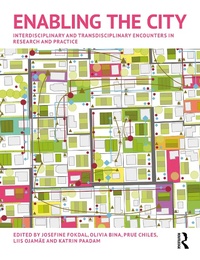
Enabling the City
Interdisciplinary and Transdisciplinary Encounters in Research and Practice
1st Edition
Published on 28. July 2021
326 pages
978-1-000-37008-9 (ISBN)
Description

Enabling the City is a collaborative book that focuses on how interdisciplinary and transdisciplinary processes of knowledge production may contribute to urban transformation at a local level in the 21st century, striking a balance between enthusiastic support for such transformational potential and a cautious note regarding the persistent challenges to the ethos as well as the practice of inter and transdisciplinarity.
The rich stories reflect different research and local practice cultures, exploring issues such as ageing, community, health and dementia, public space, energy, mobility cultures, heritage, housing, re-use, and renewal, as well as more universal questions about urban sustainability and climate change, and perhaps most importantly, education. Against this backdrop, aspirations for the 21st century are related to the international, national, and local agendas expressed in the Sustainable Development Goals (SDGs) and in the New Urban Agenda (NUA), raising fundamental questions of how to enable development. We highlight aspects of transformative learning and ways of knowing, critical to any collaborative and participatory process.
The rich stories reflect different research and local practice cultures, exploring issues such as ageing, community, health and dementia, public space, energy, mobility cultures, heritage, housing, re-use, and renewal, as well as more universal questions about urban sustainability and climate change, and perhaps most importantly, education. Against this backdrop, aspirations for the 21st century are related to the international, national, and local agendas expressed in the Sustainable Development Goals (SDGs) and in the New Urban Agenda (NUA), raising fundamental questions of how to enable development. We highlight aspects of transformative learning and ways of knowing, critical to any collaborative and participatory process.
Reviews / Votes
"This intellectually and visually attractive book offers an invaluable guide to the innovative inter- and transdisciplinary ideas, vocabularies and tools for crafting more sustainable urban futures. Applied case studies from Newcastle to Ljubljana and Tallinn to Calabria, by authors from diverse communities of practice, demonstrate the transformative power of combining different knowledges in co-productive collaborations. This is sure to become a landmark in its field." David Simon, Professor of Development Geography, Royal Holloway, University of London, UK"Transpositional knowledge has the power to ignite innovation and enrich collaboration when applied across the complex urban contexts that define the cities of today. The multi-regional and multi-scalar ethnographic accounts offered in this book illustrate the agency inter and in particular transdisciplinary approaches offer diverse stakeholders, at a time when the imperative for fostering cooperation couldn't be more acute." Harriet Harriss, Dean of the School of Architecture, Pratt Institute, US "This intellectually and visually attractive book offers an invaluable guide to the innovative inter- and transdisciplinary ideas, vocabularies and tools for crafting more sustainable urban futures. Applied case studies from Newcastle to Ljubljana and Tallinn to Calabria, by authors from diverse communities of practice, demonstrate the transformative power of combining different knowledges in co-productive collaborations. This is sure to become a landmark in its field."
David Simon, Professor of Development Geography, Royal Holloway, University of London, UK
"Transpositional knowledge has the power to ignite innovation and enrich collaboration when applied across the complex urban contexts that define the cities of today. The multi-regional and multi-scalar ethnographic accounts offered in this book illustrate the agency inter and in particular transdisciplinary approaches offer diverse stakeholders, at a time when the imperative for fostering cooperation couldn't be more acute."
Harriet Harriss, Dean of the School of Architecture, Pratt Institute, US
"Collectively this book contributes clear direction, terms, tools, and frameworks for thinking about cross-disciplinary work within communities. Scholars in urban planning interested in community-engaged urbanism and cross-disciplinarity will appreciate this work."
M. C. Childs, Professor Emeritus, University of New Mexico, US
More details
Edition
1. Auflage
Language
English
Place of publication
London
United Kingdom
Publishing group
Taylor & Francis Ltd
Target group
College/higher education
Professional and scholarly
File size
39,46 MB
ISBN-13
978-1-000-37008-9 (9781000370089)
Copyright in bibliographic data and cover images is held by Nielsen Book Services Limited or by the publishers or by their respective licensors: all rights reserved.
Schweitzer Classification
Other editions
Additional editions
Josefine Fokdal | Olivia Bina | Prue Chiles
Enabling the City
Interdisciplinary and Transdisciplinary Encounters in Research and Practice
Book
07/2021
1st Edition
Routledge
€179.51
Shipment within 15-20 days
Josefine Fokdal | Olivia Bina | Prue Chiles
Enabling the City
Interdisciplinary and Transdisciplinary Encounters in Research and Practice
Book
07/2021
1st Edition
Routledge
€85.10
Shipment within 15-20 days
Enabling the City
Interdisciplinary and Transdisciplinary Encounters in Research and Practice
Book
04/2021
Routledge
Unfortunately, price unknown
Available (delivery time upon request)
Persons
Josefine Fokdal is Senior Researcher and Lecturer at the Department of International Urbanism at the University of Stuttgart. Josefine's research focus is on co-production in urban development, governance, and informal dynamics amd she is involved in the Realworld Laboratory for Sustainable Mobility Culture.
Olivia Bina is a Principal Researcher at the University of Lisbon, Adjunct Assistant Professor in the department of Geography & Resource Management, Chinese University of Hong Kong, and Fellow of the World Academy of Art and Science. She has a degree in Political Sciences and PhD in Geography. Through interdisciplinarity Olivia searches for pathways that balance ever-smarter growth and technology with a recovery of the unlimited potential of human-nature connectedness. Olivia was the Chair of the COST Action Intrepid.
Prue Chiles is Professor of Architectural Design Research at Newcastle and part of the practice Chiles, Evans and Care Architects CE+CA. Prue works to strengthen connections between people, place, teaching, imagination, and architectural design.
Liis Ojamaee is Associate Professor at the School of Business and Governance at Tallinn University of Technology and also at the School of Governance, Law and Society, Tallinn University. Liis' research interests are related to urban housing: residential culture, housing policy and markets, housing re-construction, and sustainability.
Katrin Paadam is Professor of Sociology in the School of Business and Governance, Tallinn University of Technology. Katrin has an integrated approach towards urban and residential dynamics and her research focuses on transforming actors' practices and cultures on different scales of city space in the interplay of material structures and larger socio-spatial processes.
Olivia Bina is a Principal Researcher at the University of Lisbon, Adjunct Assistant Professor in the department of Geography & Resource Management, Chinese University of Hong Kong, and Fellow of the World Academy of Art and Science. She has a degree in Political Sciences and PhD in Geography. Through interdisciplinarity Olivia searches for pathways that balance ever-smarter growth and technology with a recovery of the unlimited potential of human-nature connectedness. Olivia was the Chair of the COST Action Intrepid.
Prue Chiles is Professor of Architectural Design Research at Newcastle and part of the practice Chiles, Evans and Care Architects CE+CA. Prue works to strengthen connections between people, place, teaching, imagination, and architectural design.
Liis Ojamaee is Associate Professor at the School of Business and Governance at Tallinn University of Technology and also at the School of Governance, Law and Society, Tallinn University. Liis' research interests are related to urban housing: residential culture, housing policy and markets, housing re-construction, and sustainability.
Katrin Paadam is Professor of Sociology in the School of Business and Governance, Tallinn University of Technology. Katrin has an integrated approach towards urban and residential dynamics and her research focuses on transforming actors' practices and cultures on different scales of city space in the interplay of material structures and larger socio-spatial processes.
Content
Part I: Setting the Scene
1. Setting the Stage
Josefine Fokdal, Olivia Bina, Prue Chiles, Liis Ojamaee and Katrin Paadam
2. The Inter- and Transdisciplinary Process: A Framework
Olivia Bina, Josefine Fokdal, Prue Chiles, Katrin Paadam and Liis Ojamaee
3. Words Matter: A Shared Baseline Vocabulary
Julie Mennes
Part II: Urban Stories Beyond Disciplines
1. The Place and Space of Power: Mess, Uncertainty and Change over Time
Prue Chiles, Anna Krzywoszynska, Helen Holmes, Alastair Buckley, Matt Watson and Jose Mawyin
2. A Creative "NanoTown": Framing Sustainable Development Scenarios with Local People in Calabria
Giulio Verdini, Olivia Bina, Prue Chiles, Pilar Maria Guerrieri, Etra Connie Occhialini, Alan Mace, Christian Nolf, Anna Paola Pola and Paola Raffa
3. Explorations on Residential Resilience: Brf Viva 2011-2019
Sten Gromark, Bjoern Andersson and Anna Braide
4. Swimming Free: The Citizen-Driven Transformation of Neubad Lucerne
Patricia Wolf, Christian Lars Schuchert, Sibylla Amstutz, Bettina Minder and Alex Willener
5. Real-World Laboratories as Catalysts for Urban Change: The Example of CASA Schuetzenplatz in Stuttgart
Raphael Dietz, Josefine Fokdal, Marius Gantert, Astrid Ley, Jesus Martinez Zarate and Antje Stokman
6. A Step Towards an Enjoyable City: Joining Expertise in Redesigning Public Space Along the "Main Street" in Tallinn
Katrin Paadam and Liis Ojamaee
7. Partnerships for Urban Regeneration in Bulgaria: Who Needs Academic Research?
Elena Dimitrova
8. Barriers and Potentials of Interprofessional Planning: Creating Care Homes for People with Dementia
Hans Thor Andersen and Inge Mette Kirkeby
9. Together on the Platform: Common Action and Reviving the Central Open Public Space in Ruski Car (Russian Tsar) in Ljubljana
Matej Niksic
Part III: Short Stories from Practice
1. Protohome - Newcastle
Julia Heslop
2. Spreefeld Co-Housing - Berlin
Michael LaFond, Prue Chiles and Alice Grant
3. Portland Works - Sheffield
Cristina Cerulli
4. Urban Change - Gagliato
Rob Wills, James Anderson, Emma Kingman and Prue Chiles
5. Sino - French Cooperation
Francoise Ged
6. City Forums - Tallinn
Raul Jaerg
7. Vodnikova Road - Ljubljana
Matej Niksic, Marko Peterlin and Prue Chiles
Part IV: Lessons Learned - Beyond Context
1. Transdisciplinarity Revisited: Transformative Potential of Lessons We Might Learn
Christoph Woiwode and Olivia Bina
2. Characteristics of Integration in Inter- and Transdisciplinary Urban Research and Practice
Erik Weber and Julie Mennes
3. Enabling the City: Learning for Transformational Change
Josefine Fokdal, Olivia Bina and Giulio Verdini
1. Setting the Stage
Josefine Fokdal, Olivia Bina, Prue Chiles, Liis Ojamaee and Katrin Paadam
2. The Inter- and Transdisciplinary Process: A Framework
Olivia Bina, Josefine Fokdal, Prue Chiles, Katrin Paadam and Liis Ojamaee
3. Words Matter: A Shared Baseline Vocabulary
Julie Mennes
Part II: Urban Stories Beyond Disciplines
1. The Place and Space of Power: Mess, Uncertainty and Change over Time
Prue Chiles, Anna Krzywoszynska, Helen Holmes, Alastair Buckley, Matt Watson and Jose Mawyin
2. A Creative "NanoTown": Framing Sustainable Development Scenarios with Local People in Calabria
Giulio Verdini, Olivia Bina, Prue Chiles, Pilar Maria Guerrieri, Etra Connie Occhialini, Alan Mace, Christian Nolf, Anna Paola Pola and Paola Raffa
3. Explorations on Residential Resilience: Brf Viva 2011-2019
Sten Gromark, Bjoern Andersson and Anna Braide
4. Swimming Free: The Citizen-Driven Transformation of Neubad Lucerne
Patricia Wolf, Christian Lars Schuchert, Sibylla Amstutz, Bettina Minder and Alex Willener
5. Real-World Laboratories as Catalysts for Urban Change: The Example of CASA Schuetzenplatz in Stuttgart
Raphael Dietz, Josefine Fokdal, Marius Gantert, Astrid Ley, Jesus Martinez Zarate and Antje Stokman
6. A Step Towards an Enjoyable City: Joining Expertise in Redesigning Public Space Along the "Main Street" in Tallinn
Katrin Paadam and Liis Ojamaee
7. Partnerships for Urban Regeneration in Bulgaria: Who Needs Academic Research?
Elena Dimitrova
8. Barriers and Potentials of Interprofessional Planning: Creating Care Homes for People with Dementia
Hans Thor Andersen and Inge Mette Kirkeby
9. Together on the Platform: Common Action and Reviving the Central Open Public Space in Ruski Car (Russian Tsar) in Ljubljana
Matej Niksic
Part III: Short Stories from Practice
1. Protohome - Newcastle
Julia Heslop
2. Spreefeld Co-Housing - Berlin
Michael LaFond, Prue Chiles and Alice Grant
3. Portland Works - Sheffield
Cristina Cerulli
4. Urban Change - Gagliato
Rob Wills, James Anderson, Emma Kingman and Prue Chiles
5. Sino - French Cooperation
Francoise Ged
6. City Forums - Tallinn
Raul Jaerg
7. Vodnikova Road - Ljubljana
Matej Niksic, Marko Peterlin and Prue Chiles
Part IV: Lessons Learned - Beyond Context
1. Transdisciplinarity Revisited: Transformative Potential of Lessons We Might Learn
Christoph Woiwode and Olivia Bina
2. Characteristics of Integration in Inter- and Transdisciplinary Urban Research and Practice
Erik Weber and Julie Mennes
3. Enabling the City: Learning for Transformational Change
Josefine Fokdal, Olivia Bina and Giulio Verdini
