

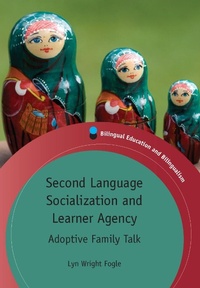
Second Language Socialization and Learner Agency
Adoptive Family Talk
Published on 2. August 2012
216 pages
978-1-84769-787-5 (ISBN)
Description

This book examines how Russian-speaking adoptees in three US families actively shape opportunities for language learning and identity construction in everyday interactions. By focusing on a different practice in each family (i.e. narrative talk about the day, metalinguistic discourse or languaging, and code-switching), the analyses uncover different types of learner agency and show how language socialization is collaborative and co-constructed. The learners in this study achieve agency through resistance, participation, and negotiation, and the findings demonstrate the complex ways in which novices transform communities in transnational contexts. The perspectives inform the fields of second language acquisition and language maintenance and shift. The book further provides a rare glimpse of the quotidian negotiations of adoptive family life and suggestions for supporting adoptees as young bilinguals.
Reviews / Votes
The book offers an innovative way of understanding and researching language socialization, and it is definitely worth attention as it does not put parents in the dominant position but highlights the role of youngsters in becoming members of a new community. -- Zuzanna Kiermasz, University of Lodz, Poland * SSLLT 6 (2). 2016. 349-354 * Fogle's groundbreaking work skillfully navigates unchartered waters in the field of applied linguistics. This close analysis of language use and language learning within transnational adoptive homes details the fascinating ways in which children and parents collaboratively make - and occasionally resist - family through language. Fogle's highly readable and engaging account highlights the active role children play in shaping their learning contexts and enriches our understanding of language learning processes. * Kendall King, University of Minnesota, USA * This is a highly innovative study of second language socialization involving an increasingly important group of learners. Through in-depth analyses of intimate family interactions, Fogle shows how dynamic the family language situation becomes when transnational adoptees enter the scene. Fogle's work is a valuable contribution to the growing field of family language policy and a must-read for those interested in multilingual families. * Elizabeth Lanza, University of Oslo, Norway * This book provides a fascinating account of language socialization in an understudied but increasingly important and common context: in the families of transnational adopted children. The various forms of socialization and agency observed in the multiple-case study of three quite different families provide compelling evidence of how Russian-speaking children and their new (American) parents actively socialize one another, through modeling, resistance, accommodation, and negotiation of languages and types of interaction, based on their respective ideologies, identities, and sensibilities. The study offers a timely, well researched, and dynamic illustration of multilingual socialization and language use in contemporary society. * Patricia A. Duff, University of British Columbia, Canada * "Second Language Socialization and Learner Agency: Adoptive Family Talk" makes important contributions to the field of bilingual education and bilingualism. Furthermore, it engages with, clarifies, and argues for the construct of agency in language learning research. In so doing, Fogle generates truly poignant accounts that reflect the challenges of crossing linguistic, cultural, and national boundaries as these adoptees and adoptive parents develop family identities through everyday talk. This lucid account of an ambitious investigation may also serve well to inform emerging researchers in PhD programs and more senior scholars who wish to engage in comparable projects.This volume would be a stimulating supplemental text in a graduate course on qualitative methods, bilingualism, discourse analysis, or language learner identity. This work will be most accessible to readers with a solid theoretical background in second language acquisition and particularly social and cultural approaches to SLA, but it also offers valuable insights and suggestions to parents, teachers, social workers, and other professionals who may encounter such families. * Amanda Lanier Temples, Georgia State University, USA on the LINGUIST List 24.963 (2013) * Fogle's fi ndings provide substantial insight for looking into the many factors that shape L2 socialization and for (re)considering the complex nature of socialization agency. Although the study focuses on transnational adoption, the analysis is also relevant for the study of other language socialization settings. For this reason, the book may be of interest for a broad audience in the field of SLA. * German Canale, Carnegie Mellon University, USA in SSLA issue 36:1(2014) *More details
Series
Language
English
Place of publication
Bristol
United Kingdom
Publishing group
Channel View Publications Ltd
Target group
Professional and scholarly
Product notice
Reflowable
ISBN-13
978-1-84769-787-5 (9781847697875)
Copyright in bibliographic data and cover images is held by Nielsen Book Services Limited or by the publishers or by their respective licensors: all rights reserved.
Schweitzer Classification
Other editions
Additional editions
Book
08/2012
Multilingual Matters
€42.00
Shipment within 10-20 days
Person
Lyn Wright Fogle is an Assistant Professor of Linguistics/TESOL at Mississippi State University. She holds a PhD In Linguistics from Georgetown University and an MA in TESOL from American University. Her research focuses on sociocultural aspects of second language learning and bilingualism with an emphasis on second language socialization, learner identities, and language policy. She is a co-editor of the volume Sustaining linguistic diversity: Endangered and minority languages and language varieties (Georgetown University Press), and her work has appeared in journals such as The International Journal of Bilingual Education and Bilingualism and Language and Linguistics Compass.
Content
Chapter 1: Introduction
Chapter 2: Second Language Socialization, Agency, and Identity
Chapter 3: Transnational Adoption and Language: An Overview
Chapter 4: 'I got nothin'!': Resistance, Routine, and Narrative
Chapter 5: 'But now we're your daughter and son!': Participation, Questions, and Languaging
Chapter 6: 'We'll help them in Russian, and they'll help us in English': Negotiation, Medium Requests, and Code-switching
Chapter 7: Conclusions and Implications
Chapter 8: Epilogue
Chapter 2: Second Language Socialization, Agency, and Identity
Chapter 3: Transnational Adoption and Language: An Overview
Chapter 4: 'I got nothin'!': Resistance, Routine, and Narrative
Chapter 5: 'But now we're your daughter and son!': Participation, Questions, and Languaging
Chapter 6: 'We'll help them in Russian, and they'll help us in English': Negotiation, Medium Requests, and Code-switching
Chapter 7: Conclusions and Implications
Chapter 8: Epilogue
