

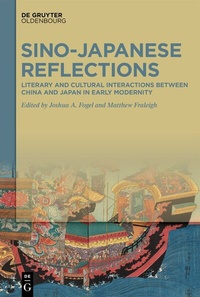
Sino-Japanese Reflections
Description

Sino-Japanese Reflections offers ten richly detailed case studies that examine various forms of cultural and literary interaction between Japanese and Chinese intellectuals from the late Ming to the early twentieth century. The authors consider efforts by early modern scholars on each side of the Yellow Sea to understand the language and culture of the other, to draw upon received texts and forms, and to contribute to shared literary practices. Whereas literary and cultural flow within the Sinosphere is sometimes imagined to be an entirely unidirectional process of textual dissemination from China to the periphery, the contributions to this volume reveal a more complex picture: highlighting how literary and cultural engagement was always an opportunity for creative adaptation and negotiation. Examining materials such as Chinese translations of Japanese vernacular poetry, Japanese engagements with Chinese supernatural stories, adaptations of Japanese historical tales into vernacular Chinese, Sinitic poetry composed in Japan, and Japanese Sinology, the volume brings together recent work by literary scholars and intellectual historians of multiple generations, all of whom have a strong comparative interest in Sino-Japanese studies.
More details
Other editions
Additional editions
Persons
Content
- Intro
- Contents
- Introduction
- Ming-Period Chinese Understanding of the Language and Poetry of the Japanese
- Japanese Writers and Chinese Readers in Edo-Period Nagasaki
- Reading Annotations: An Alternative Approach to the Reception of Qu You's New Tales for the Trimmed Lampwick in Tokugawa Japan
- Strange Tales from Edo: Liaozhai zhiyi in Early Modern Japan
- "Truly, they are a lady's words": Ema Saiko and the Construction of an Authentic Voice in Late Edo Period Kanshi
- Vassal of a Deposed Regime: Archetypes of Reclusion in the Poetry of Former Shogunal Official Yaguchi Kensai
- Kanshi in Translation: How Its Features Can Be Effectively Communicated
- "All Men Within the Four Seas Are Brothers": Transnational Kanshi Exchange in Meiji Japan
- From Kangaku to Shinagaku: On the Growing Significance of Contemporary China for Sinitic Scholarship in Nineteenth-Century Japan
- The Development of Naito Konan's Progressive View of History: A Point of Convergence with Zhang Xuecheng's Wenshi tongyi
- Index
