

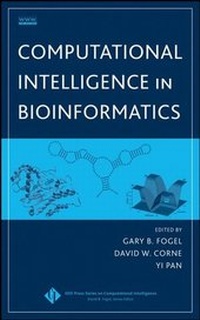
Computational Intelligence in Bioinformatics
Description

More details
Other editions
Additional editions

Persons
Content
Contributors.
Part One Gene Expression Analysis and Systems Biology.
1. Hybrid of Neural Classifi er and Swarm Intelligence in Multiclass Cancer Diagnosis with Gene Expression Signatures (Rui Xu, Georgios C. Anagnostopoulos, and Donald C. Wunsch II).
1.1 Introduction.
1.2 Methods and Systems.
1.3 Experimental Results.
1.4 Conclusions.
2. Classifying Gene Expression Profi les with Evolutionary Computation (Jin-Hyuk Hong and Sung-Bae Cho).
2.1 DNA Microarray Data Classifi cation.
2.2 Evolutionary Approach to the Problem.
2.3 Gene Selection with Speciated Genetic Algorithm.
2.4 Cancer Classifi ction Based on Ensemble Genetic Programming.
2.5 Conclusion.
3. Finding Clusters in Gene Expression Data Using EvoCluster (Patrick C. H. Ma, Keith C. C. Chan, and Xin Yao).
3.1 Introduction.
3.2 Related Work.
3.3 Evolutionary Clustering Algorithm.
3.4 Experimental Results.
3.5 Conclusions.
4. Gene Networks and Evolutionary Computation (Jennifer Hallinan).
4.1 Introduction.
4.2 Evolutionary Optimization.
4.3 Computational Network Modeling.
4.4 Extending Reach of Gene Networks.
4.5 Network Topology Analysis.
4.6 Summary.
Part Two Sequence Analysis and Feature Detection.
5. Fuzzy-Granular Methods for Identifying Marker Genes from Microarray Expression Data (Yuanchen He, Yuchun Tang, Yan-Qing Zhang, and Rajshekhar Sunderraman).
5.1 Introduction.
5.2 Traditional Algorithms for Gene Selection.
5.3 New Fuzzy-Granular-Based Algorithm for Gene Selection.
5.4 Simulation.
5.5 Conclusions.
6. Evolutionary Feature Selection for Bioinformatics (Laetitia Jourdan, Clarisse Dhaenens, and El-Ghazali Talbi).
6.1 Introduction.
6.2 Evolutionary Algorithms for Feature Selection.
6.3 Feature Selection for Clustering in Bioinformatics.
6.4 Feature Selection for Classifi cation in Bioinformatics.
6.5 Frameworks and Data Sets.
6.6 Conclusion.
7. Fuzzy Approaches for the Analysis CpG Island Methylation Patterns (Ozy Sjahputera, Mihail Popescu, James M. Keller, and Charles W. Caldwell).
7.1 Introduction.
7.2 Methods.
7.3 Biological Signifi cance.
7.4 Conclusions.
Part Three Molecular Structure and Phylogenetics.
8. Protein-Ligand Docking with Evolutionary Algorithms(René Thomsen).
8.1 Introduction.
8.2 Biochemical Background.
8.3 The Docking Problem.
8.4 Protein-Ligand Docking Algorithms.
8.5 Evolutionary Algorithms.
8.6 Effect of Variation Operators.
8.7 Differential Evolution.
8.8 Evaluating Docking Methods.
8.9 Comparison between Docking Methods.
8.10 Summary.
8.11 Future Research Topics.
9. RNA Secondary Structure Prediction Employing Evolutionary Algorithms (Kay C. Wiese, Alain A. Deschênes, and Andrew G. Hendriks).
9.1 Introduction.
9.2 Thermodynamic Models.
9.3 Methods.
9.4 Results.
9.5 Conclusion.
10. Machine Learning Approach for Prediction of Human Mitochondrial Proteins (Zhong Huang, Xuheng Xu, and Xiaohua Hu).
10.1 Introduction.
10.2 Methods and Systems.
10.3 Results and Discussion.
10.4 Conclusions.
11. Phylogenetic Inference Using Evolutionary Algorithms(Clare Bates Congdon).
11.1 Introduction.
11.2 Background in Phylogenetics.
11.3 Challenges and Opportunities for Evolutionary Computation.
11.4 One Contribution of Evolutionary Computation: Graphyl.
11.5 Some Other Contributions of Evolutionary computation.
11.6 Open Questions and Opportunities.
Part Four Medicine.
12. Evolutionary Algorithms for Cancer Chemotherapy Optimization (John McCall, Andrei Petrovski, and Siddhartha Shakya).
12.1 Introduction.
12.2 Nature of Cancer.
12.3 Nature of Chemotherapy.
12.4 Models of Tumor Growth and Response.
12.5 Constraints on Chemotherapy.
12.6 Optimal Control Formulations of Cancer Chemotherapy.
12.7 Evolutionary Algorithms for Cancer Chemotherapy Optimization.
12.8 Encoding and Evaluation.
12.9 Applications of EAs to Chemotherapy Optimization Problems.
12.10 Related Work.
12.11 Oncology Workbench.
12.12 Conclusion.
13. Fuzzy Ontology-Based Text Mining System for Knowledge Acquisition, Ontology Enhancement, and Query Answering from Biomedical Texts (Lipika Dey and Muhammad Abulaish).
13.1 Introduction.
13.2 Brief Introduction to Ontologies.
13.3 Information Retrieval form Biological Text Documents: Related Work.
13.4 Ontology-Based IE and Knowledge Enhancement System.
13.5 Document Processor.
13.6 Biological Relation Extractor.
13.7 Relation-Based Query Answering.
13.8 Evaluation of the Biological Relation Extraction Process.
13.9 Biological Relation Characterizer.
13.10 Determining Strengths of Generic Biological Relations.
13.11 Enhancing GENIA to Fuzzy Relational Ontology.
13.12 Conclusions and Future Work.
References.
Appendix Feasible Biological Relations.
Index.
