

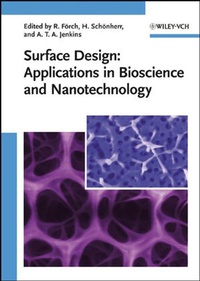
Surface Design: Applications in Bioscience and Nanotechnology
Applications in Bioscience and Nanotechnology
1st Edition
Published on 6. August 2009
XXI, 511 pages
978-3-527-62860-5 (ISBN)
Description

This carefully selected balance of tutorial-like review chapters and advanced research covers hot topics in the field of biointerfaces, biosensing, nanoparticles at interfaces, and functionalized quantum dots. It also includes chapters arising from non-published work with topics such as surface design and their applications, as well as new developments in analytical tools for materials science and life science.
Based on the very close and complementary collaboration of three distinguished leading research groups, this book highlights recent advances in the field ranging from synthesis and fabrication of organic and polymeric materials, surface and interface science to advanced analytical methods. It thus addresses new concepts in micro- and nanofabrication, bio-nanotechnology, biosensors and the necessary compositional and structural analysis. Particular attention is paid throughout to complex hierarchical interface architectures and possible applications of the chemical and physical methodologies discussed, covering bio-diagnostics, novel biosensors and adhesion science.
With its unique combination of expertise from chemistry, physics, biology, surface science and engineering, this is a valuable companion for students, practitioners and established experts.
Based on the very close and complementary collaboration of three distinguished leading research groups, this book highlights recent advances in the field ranging from synthesis and fabrication of organic and polymeric materials, surface and interface science to advanced analytical methods. It thus addresses new concepts in micro- and nanofabrication, bio-nanotechnology, biosensors and the necessary compositional and structural analysis. Particular attention is paid throughout to complex hierarchical interface architectures and possible applications of the chemical and physical methodologies discussed, covering bio-diagnostics, novel biosensors and adhesion science.
With its unique combination of expertise from chemistry, physics, biology, surface science and engineering, this is a valuable companion for students, practitioners and established experts.
More details
Other editions
Additional editions
Software
09/2009
Wiley-VCH
€231.31
No shipping information available
Renate Förch | Holger Schönherr | A. Tobias A. Jenkins
Surface Design: Applications in Bioscience and Nanotechnology
Book
06/2009
1st Edition
Wiley-VCH
€165.00
Article exhausted; check different version
Persons
Renate Förch studied Chemistry at the University of London, King's College and Queen Mary. After finishing her Ph.D. she went to the University of Western Ontario, Canada, where she built up a research group focussing on plasma surface modification of polymer films. Since February 1996 she has been holding a post at the Max Planck Institute for Polymer Research working on pulsed plasma polymerisation of thin organic films with the aim to develop functional coatings to improve surface properties of materials such as biocompatibility and tribological properties.
Holger Schönherr studied chemistry and polymer chemistry and physics in Mainz, Germany, and Toronto, Canada. After a post-doctoral position at Stanford, he became professor at the University of Twente, Netherlands. In 2008, he accepted a post as a full professor for Physical Chemistry at the University of Siegen, Germany. Professor Schönherr's major research interests are the chemistry and physics of surfaces and interfaces, functional platforms for biointerfacing, self-organized and macromolecular systems in confinement as well as scanning force microscopy. He is the author of more than 100 peer-reviewed papers.
A. Toby A. Jenkins received his Ph.D. degree from the University of Newcastle upon Tyne, Great Britain. After a post-doc position at the University of Leeds, he was awarded an Alexander-von-Humboldt fellowship in 1999, allowing him to work at the Max-Planck Institute for Polymer Research in Mainz, Germany, where he studied the interaction of lipid vesicles with micropatterned surfaces and polymer supports. In September 2000 he became a lecturer in the department of Chemistry at the University of Bath, Great Britain.
Holger Schönherr studied chemistry and polymer chemistry and physics in Mainz, Germany, and Toronto, Canada. After a post-doctoral position at Stanford, he became professor at the University of Twente, Netherlands. In 2008, he accepted a post as a full professor for Physical Chemistry at the University of Siegen, Germany. Professor Schönherr's major research interests are the chemistry and physics of surfaces and interfaces, functional platforms for biointerfacing, self-organized and macromolecular systems in confinement as well as scanning force microscopy. He is the author of more than 100 peer-reviewed papers.
A. Toby A. Jenkins received his Ph.D. degree from the University of Newcastle upon Tyne, Great Britain. After a post-doc position at the University of Leeds, he was awarded an Alexander-von-Humboldt fellowship in 1999, allowing him to work at the Max-Planck Institute for Polymer Research in Mainz, Germany, where he studied the interaction of lipid vesicles with micropatterned surfaces and polymer supports. In September 2000 he became a lecturer in the department of Chemistry at the University of Bath, Great Britain.
Content
1. Tutorial Reviews
1.1 Coupling Chemistries for the Modification and Functionalization of Surfaces to Create Advanced Bio-interfaces, H. Schönherr
1.2 Surface Plasmon Resonance-Based Biosensors, J. Dostálek, Chun Jen Huang and W. Knoll
1.3 Surface Modification and Adhesion, R. Förch
1.4 Modern Biological Sensors, A.T.A. Jenkins
2. Functional Thin Film Architectures and Platforms Based on Polymers
2.1 Controlled Block Copolymer Thin Film Architectures, M. Roerdink, M. A. Hempenius, G. J. Vancso
2.2 Stimuli Responsive Polymer Brushes, E. Benetti, M. Navarro, S. Zapotoczny, G. J. Vancso
2.3 Cyanate Ester Resins as Thermally Stable Adhesives for PEEK, B. Yameen, M. Tamm, N. Vogel, A. Echler, R. Förch, U. Jonas and W. Knoll
2.4 Structured and Functionalized Polymer Thin Film Architectures, H. Schönherr, C. L. Feng, A. Embrechts, G. J. Vancso
3. Biointerfaces, Biosensing, and Molecular Interactions
3.1 Surface Chemistry in Forensics, K. Bender
3.2 Modification of Surfaces by Photosensitive Silanes, X.S. Li, S. Pradhan-Kadam, M. Álvarez-Chamorro, U. Jonas
3.3 Solid Supported Bilayer Lipid Membranes, I. Köper, I. Vockenroth
3.4 Interaction of Structured and Functionalized Polymers with Cancer Cells, A. Embrechts, C. L. Feng, I. Bredebusch, J. Schnekenburger, Wolfram Domschke, G. J. Vancso, and H. Schönherr
3.5 Fabrication and Application of Surface Tethered Vesicles, A.T.A. Jenkins and T. L. Williams
3.6 Plasma Polymerized Allylamine Thin Films for DNA Sensing, L. Q. Chu, W. Knoll, R. Förch
4. Nanoparticles and -containers
4.1 Defined Colloidal 3D Architectures, N. V. Dziomkina, M. A. Hempenius, G. J. Vancso
4.2 Nanoparticles at the Interface: The Properties of Nanoparticles Assembled into 2-D and 3-D Structures at Planar Electrode Surfaces, P. J. Cameron
4.3 Surface Engineering of Quantum Dots with Designer Ligands, N. Tomczak, D. Janczewsk, O. Tagit, M. Y. Han, G. J. Vancso
4.4 Stimuli Responsive Capsules, Y. Ma, M. A. Hempenius, E. S. Kooij, W.-F. Dong, H. Möhwald, and G. J. Vancso
4.5 Nanoporous Thin Films as Highly Versatile and Sensitive Waveguide Biosensors, K.H. Aaron Lau, P. J. Cameron, H. Duran, A. I. Abou-Kandil, W. Knoll
5. Surface and Interface Analysis
5.1 Stretching and Rupturing Single Covalent and Associating Macromolecules by AFM-based Single Molecule Force Spectroscopy, M. I. Giannotti, W. Q. Shi, S. Zou, H. Schönherr, G. J. Vancso
5.2 Quantitative Lateral Force Microscopy, H. Schönherr, E. Tocha, J. Song, G. J. Vancso
5.3 Long Range Surface Plasmon-enhanced Fluorescence Spectroscopy as a Platform for Biosensors, A. Kasry, J. Dostalek, W. Knoll
6. Glossary of Surface Analytical Tools, R. Förch, H. Schönherr, and A. T. A. Jenkins
6.1 Atomic Force Microscopy
6.2 Contact Angle Goniometry
6.3 Ellipsometry
6.4 Infra Red Spectroscopy
6.5 Impedance Spectroscopy
6.6 Scanning Electron Microscopy
6.7 Surface Plasmon Resonance Spectroscopy
6.8 Optical Waveguide Mode Spectroscopy (OWS)
6.9 Waveguide Mode Spectroscopy (WaMS)
6.10 X-Ray Photoelectron Spectroscopy
1.1 Coupling Chemistries for the Modification and Functionalization of Surfaces to Create Advanced Bio-interfaces, H. Schönherr
1.2 Surface Plasmon Resonance-Based Biosensors, J. Dostálek, Chun Jen Huang and W. Knoll
1.3 Surface Modification and Adhesion, R. Förch
1.4 Modern Biological Sensors, A.T.A. Jenkins
2. Functional Thin Film Architectures and Platforms Based on Polymers
2.1 Controlled Block Copolymer Thin Film Architectures, M. Roerdink, M. A. Hempenius, G. J. Vancso
2.2 Stimuli Responsive Polymer Brushes, E. Benetti, M. Navarro, S. Zapotoczny, G. J. Vancso
2.3 Cyanate Ester Resins as Thermally Stable Adhesives for PEEK, B. Yameen, M. Tamm, N. Vogel, A. Echler, R. Förch, U. Jonas and W. Knoll
2.4 Structured and Functionalized Polymer Thin Film Architectures, H. Schönherr, C. L. Feng, A. Embrechts, G. J. Vancso
3. Biointerfaces, Biosensing, and Molecular Interactions
3.1 Surface Chemistry in Forensics, K. Bender
3.2 Modification of Surfaces by Photosensitive Silanes, X.S. Li, S. Pradhan-Kadam, M. Álvarez-Chamorro, U. Jonas
3.3 Solid Supported Bilayer Lipid Membranes, I. Köper, I. Vockenroth
3.4 Interaction of Structured and Functionalized Polymers with Cancer Cells, A. Embrechts, C. L. Feng, I. Bredebusch, J. Schnekenburger, Wolfram Domschke, G. J. Vancso, and H. Schönherr
3.5 Fabrication and Application of Surface Tethered Vesicles, A.T.A. Jenkins and T. L. Williams
3.6 Plasma Polymerized Allylamine Thin Films for DNA Sensing, L. Q. Chu, W. Knoll, R. Förch
4. Nanoparticles and -containers
4.1 Defined Colloidal 3D Architectures, N. V. Dziomkina, M. A. Hempenius, G. J. Vancso
4.2 Nanoparticles at the Interface: The Properties of Nanoparticles Assembled into 2-D and 3-D Structures at Planar Electrode Surfaces, P. J. Cameron
4.3 Surface Engineering of Quantum Dots with Designer Ligands, N. Tomczak, D. Janczewsk, O. Tagit, M. Y. Han, G. J. Vancso
4.4 Stimuli Responsive Capsules, Y. Ma, M. A. Hempenius, E. S. Kooij, W.-F. Dong, H. Möhwald, and G. J. Vancso
4.5 Nanoporous Thin Films as Highly Versatile and Sensitive Waveguide Biosensors, K.H. Aaron Lau, P. J. Cameron, H. Duran, A. I. Abou-Kandil, W. Knoll
5. Surface and Interface Analysis
5.1 Stretching and Rupturing Single Covalent and Associating Macromolecules by AFM-based Single Molecule Force Spectroscopy, M. I. Giannotti, W. Q. Shi, S. Zou, H. Schönherr, G. J. Vancso
5.2 Quantitative Lateral Force Microscopy, H. Schönherr, E. Tocha, J. Song, G. J. Vancso
5.3 Long Range Surface Plasmon-enhanced Fluorescence Spectroscopy as a Platform for Biosensors, A. Kasry, J. Dostalek, W. Knoll
6. Glossary of Surface Analytical Tools, R. Förch, H. Schönherr, and A. T. A. Jenkins
6.1 Atomic Force Microscopy
6.2 Contact Angle Goniometry
6.3 Ellipsometry
6.4 Infra Red Spectroscopy
6.5 Impedance Spectroscopy
6.6 Scanning Electron Microscopy
6.7 Surface Plasmon Resonance Spectroscopy
6.8 Optical Waveguide Mode Spectroscopy (OWS)
6.9 Waveguide Mode Spectroscopy (WaMS)
6.10 X-Ray Photoelectron Spectroscopy
