

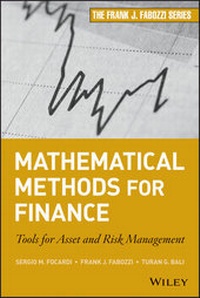
Mathematical Methods for Finance
Description

More details
Other editions
Additional editions
Persons
Content
Preface xi
About the Authors xvii
CHAPTER 1 Basic Concepts: Sets, Functions, and Variables 1
Introduction 2
Sets and Set Operations 2
Distances and Quantities 6
Functions 10
Variables 10
Key Points 11
CHAPTER 2 Differential Calculus 13
Introduction 14
Limits 15
Continuity 17
Total Variation 19
The Notion of Differentiation 19
Commonly Used Rules for Computing Derivatives 21
Higher-Order Derivatives 26
Taylor Series Expansion 34
Calculus in More Than One Variable 40
Key Points 41
CHAPTER 3 Integral Calculus 43
Introduction 44
Riemann Integrals 44
Lebesgue-Stieltjes Integrals 47
Indefinite and Improper Integrals 48
The Fundamental Theorem of Calculus 51
Integral Transforms 52
Calculus in More Than One Variable 57
Key Points 57
CHAPTER 4 Matrix Algebra 59
Introduction 60
Vectors and Matrices Defined 61
Square Matrices 63
Determinants 66
Systems of Linear Equations 68
Linear Independence and Rank 69
Hankel Matrix 70
Vector and Matrix Operations 72
Finance Application 78
Eigenvalues and Eigenvectors 81
Diagonalization and Similarity 82
Singular Value Decomposition 83
Key Points 83
CHAPTER 5 Probability: Basic Concepts 85
Introduction 86
Representing Uncertainty with Mathematics 87
Probability in a Nutshell 89
Outcomes and Events 91
Probability 92
Measure 93
Random Variables 93
Integrals 94
Distributions and Distribution Functions 96
Random Vectors 97
Stochastic Processes 100
Probabilistic Representation of Financial Markets 102
Information Structures 103
Filtration 104
Key Points 106
CHAPTER 6 Probability: Random Variables and Expectations 107
Introduction 109
Conditional Probability and Conditional Expectation 110
Moments and Correlation 112
Copula Functions 114
Sequences of Random Variables 116
Independent and Identically Distributed Sequences 117
Sum of Variables 118
Gaussian Variables 120
Appproximating the Tails of a Probability Distribution: Cornish-Fisher Expansion and Hermite Polynomials 123
The Regression Function 129
Fat Tails and Stable Laws 131
Key Points 144
CHAPTER 7 Optimization 147
Introduction 148
Maxima and Minima 149
Lagrange Multipliers 151
Numerical Algorithms 156
Calculus of Variations and Optimal Control Theory 161
Stochastic Programming 163
Application to Bond Portfolio: Liability-Funding Strategies 164
Key Points 178
CHAPTER 8 Difference Equations 181
Introduction 182
The Lag Operator L 183
Homogeneous Difference Equations 183
Recursive Calculation of Values of Difference Equations 192
Nonhomogeneous Difference Equations 195
Systems of Linear Difference Equations 201
Systems of Homogeneous Linear Difference Equations 202
Key Points 209
CHAPTER 9 Differential Equations 211
Introduction 212
Differential Equations Defined 213
Ordinary Differential Equations 213
Systems of Ordinary Differential Equations 216
Closed-Form Solutions of Ordinary Differential Equations 218
Numerical Solutions of Ordinary Differential Equations 222
Nonlinear Dynamics and Chaos 228
Partial Differential Equations 231
Key Points 237
CHAPTER 10 Stochastic Integrals 239
Introduction 240
The Intuition behind Stochastic Integrals 243
Brownian Motion Defined 248
Properties of Brownian Motion 254
Stochastic Integrals Defined 255
Some Properties of Ito^ Stochastic Integrals 259
Martingale Measures and the Girsanov Theorem 260
Key Points 266
CHAPTER 11 Stochastic Differential Equations 267
Introduction 268
The Intuition behind Stochastic Differential Equations 269
Ito^ Processes 272
Stochastic Differential Equations 273
Generalization to Several Dimensions 276
Solution of Stochastic Differential Equations 278
Derivation of Ito^ 's Lemma 282
Derivation of the Black-Scholes Option Pricing Formula 284
Key Points 291
Index 293
Preface
Since the pioneering work of Harry Markowitz in the 1950s, mathematical tools drawing from the fields of standard and stochastic calculus, set theory, probability theory, stochastic processes, matrix algebra, optimization theory, and differential equations have increasingly made their way into finance. Some of these tools have been used in the development of financial theory, such as asset pricing theory and option pricing theory, as well as like theories in the practice of asset management, risk management, and financial modeling.
Different areas of finance call for different mathematics. For example, asset management, also referred to as investment management and money management, is primarily concerned with understanding hard facts about financial processes. Ultimately, the performance of an asset manager is linked to an understanding of risk and return. This implies the ability to extract information from time series data that are highly noisy and appear nearly random. Mathematical models must be simple, but with a deep economic meaning. In other areas, the complexity of instruments is the key driver behind the growing use of sophisticated mathematics in finance. There is the need to understand how relatively simple assumptions on the probabilistic behavior of basic quantities translate into the potentially very complex probabilistic behavior of financial products. Examples of such products include option-type financial derivatives (such as options, swaptions, caps, and floors), credit derivatives, bonds with embedded option-like payoffs (such as callable bonds and convertible bonds), structured notes, and mortgage-backed securities.
One might question whether all this mathematics is justified in finance. The field of finance is generally considered much less accurate and viable than the physical sciences. Sophisticated mathematical models of financial markets and market agents have been developed but their accuracy is questionable to the point that the recent global financial crisis is often blamed on unwarranted faith on faulty mathematical models. However, we believe that the mathematical handling of finance is reasonably successful and models are not to be blamed for this crisis. Finance does not study laws of nature but complex human artifacts-the financial markets-that are designed to be largely uncertain. We could make financial markets less uncertain and, thereby, mathematical models more faithful by introducing more rules and collecting more data. Collectively, we have decided not to do so and, therefore, models can only be moderately accurate. Still, they offer a valuable design tool to engineer our financial systems. Nevertheless, the mathematics of finance cannot be that of physics. It is the mathematics of learning and complexity, similar to the mathematics used in studying biological and ecological systems.
In 1960, the physicist Eugene Wigner, recipient of the 1962 Nobel Prize in Physics, wrote his now famous paper "The Unreasonable Effectiveness of Mathematics in the Natural Sciences." Wigner argued that the success of mathematics in describing natural phenomena is so extraordinary that it is in itself a phenomenon that needs explanation.1 Mathematics in finance is reasonably effective and the reasons why it is reasonably effective deserve an explanation. Recently, the world went through the worst financial and economic crisis since the Great Depression. Many have pointed their fingers at the growing use of mathematics in finance and the resulting mathematical models. We would argue that mathematics does not have much to do with that crisis. In a nutshell, we believe that mathematics is reasonably effective in finance because we apply it to study large engineered artifacts-financial markets-that have been designed to have a lot of freedom. Modern financial systems are designed to be relatively unpredictable and uncontrolled in order to leave possibilities of changes and innovations. The level of unpredictability and control is different in different systems. Some systems are prone to crises. Mathematics does a reasonably good job to describe these systems. But the mathematics involved is not the same as that of physics. It is the mathematics of learning and complexity. Mathematics can be perceived as ineffective in finance only if we insist on comparing it with physics.
There are differences between finance and the physical sciences. In the three centuries following the publication of Newton's Principia in 1687, physics has developed into an axiomatic theory. Physical theories are axiomatic in the sense that that the entire theory can be derived through mathematical deduction from a small number of fundamental laws. Physics is not yet completely unified but the different disciplines that make the body of physics are axiomatic. Even more striking is the fact that physical phenomena can be approximately represented by computational structures, so that physical reality can be mimicked by a computer program.
Though it is clear that finance has made progress and will make additional progress only by adopting the scientific method of empirical science, it should be clear that there are significant differences between finance and physics. We can identify, albeit with some level of arbitrariness, four major differences between finance and the physical sciences:
1. Finance must study a global financial system without the possibility of studying simplified subsystems. 2. Finance is an empirical science, but the ability to conduct experiments in finance is limited when compared with the experimental facilities built in the physical sciences. 3. Finance does not study laws of nature, but it studies a human artifact that is subject to changes due to human decisions. 4. Finance systems are self-reflecting in the sense that the knowledge accumulated on the system changes the system itself.None of the above four points is in itself an objection to the scientific study of finance as a mathematical science. However, it should be clear that the methods of scientific investigations and the findings of finance might be conceptually different from those of the physical sciences. It would probably be a mistake to expect in finance the same type of generalized axiomatic laws that we find in physics.
One of the major sources of the progress made by physics is due to the ability to isolate elementary subsystems, to come out with laws that apply to these subsystems, and then to recover macroscopic laws by a mathematical process. For example, the study of mechanics was greatly simplified by the study of the material point, a subsystem without structure identified by a small number of continuous variables. After identifying the laws that govern the motion of a material point, the motion of any physical body can be recovered by a process of mathematical integration. Simplifications of this type allow one to both simplify the mathematics and to perform empirical tests in a simplified environment.
In financial economics, however, we cannot study idealized subsystems because we cannot identify subsystems with a simplified behavior. This is not to say that attempts have not been made. Drawing on the principles of microeconomics, financial economics attempts to study the behavior of individuals as the elementary units of the financial system. The real problem, however, is that the study of individuals as economic "atoms" cannot produce simple laws because it is the study of a human financial decision-making process, which is very complex in itself. In addition, we cannot perform experiments. Instead, we have to rely on how the only financial system we know develops in itself.
Note that the possibility to study elementary subsystems does not coincide with the existence of fundamental laws. For example, consider the Schrödinger equation of quantum mechanics formulated in 1926 by the physicist Erwin Schrödinger. The equation is a partial differential equation describing how in some physical system a quantum state evolves over time. Although the Schrödinger equation is indeed a fundamental law, it applies to any system and not only to microscopic entities. Fundamental laws are not necessarily microscopic laws. We might be able to find fundamental laws of finance even if we are unable to isolate elementary subsystems.
There is a strong connection between fundamental laws and the ability to make experiments. By their nature, fundamental laws are very general and can be applied, albeit after difficult mathematical manipulations, to any phenomena. Therefore, after discovering a fundamental law it is generally possible to design experiments specific to test that same law. In many instances in the history of physics, crucial experiments have suggested rejection of a theory in favor of a new competing theory. However, in finance the ability to conduct experiments is limited though important research in this field has been carried on. In the 1970s, Daniel Kahneman and Amos Tversky performed groundbreaking research on cognitive biases in decision making. Vernon Smith studied different types of market organization, in particular auctions. This type of research has changed the perspective of finance as an empirical science. Still, we cannot make a close parallel between experimental finance and experimental physics where we can design experiments to decide between theories.
Perhaps the deepest difference between finance and physics is the fact that finance studies a human artifact which is subject to change in function of human decisions. Physics aims at discovering fundamental physical laws...
