

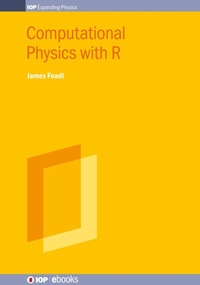
Computational Physics with R
Description

Computational Physics with R provides a comprehensive introduction to computational methods in physics, designed for students and researchers who wish to use R as their primary programming environment. While computational physics is often taught with languages such as C++, Python, or Fortran, this book fills a unique gap by adopting R, a language widely known for statistical computing and data visualisation, and demonstrating its effectiveness in tackling core problems in physics. The book adopts a strongly pedagogical approach: it emphasizes step-by-step construction of algorithms, reproducible code, and guided exercises with fully worked solutions. The book is both a teaching resource and a reference for practical problem-solving in physics.
Key Features:
- First book on Computational Physics using the R programming language.
- The book can also be used as a thorough introduction to the R language for physicists.
- The book is accessible at an advanced undergraduate level.
- The book can be used both as introduction to fundamental Computational Physics and as reference to advanced Computational Physics.
- The book can be used as text book for a one- or two-semester courses on Computational Physics.
- Each section ends with a few recommended computing exercises and suggested computing projects. Solutions to both are included.
- Each chapter opens with learning objectives and closes with an end-of-chapter summary.
More details
Other editions
Additional editions
Person
Dr James Foadi is a mathematical and computational physicist with over 20 years of experience in the development of mathematical and statistical methods for Structural Biology. He has researched and taught in various universities across the UK and held a research position at the Diamond Light Source synchrotron for 10 years. For the past couple of years, Dr Foadi has focussed most of his working activity on the teaching of mathematics at the University of Bath.
Content
Preface
Author biography
Part I Introduction to computational physics and the R platform
1 Introduction to computational physics
2 Introduction to the R platform
Part II Core computational physics
3 Interpolation
4 Computation using matrices
5 Data fitting
6 Numerical solution of nonlinear equations
7 Differentiation and integration
8 Ordinary differential equations
Part III Computational physics with R
9 Monte Carlo methods
10 Differential equations with deSolve
11 An overview of machine learning
Part IV Appendices
Appendix A: Mathematical proofs
Appendix B: A short (and quick) introduction to matrices
Appendix C: Some statistical concepts and theory
Appendix D: The IEEE 754 standard for floating-point arithmetic
Appendix E: The IEEE standard to binary rounding
Appendix F: Legendre Polynomials
Appendix G: The eigenvalue problem in ordinary differential equations
Appendix H: List of functions in package comphy
