

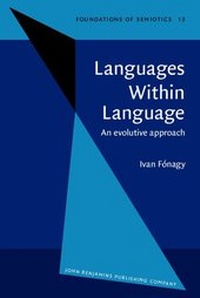
Languages Within Language
An evolutive approach
1st Edition
Published on 31. December 2001
XIV, 828 pages
978-90-272-7505-9 (ISBN)
Description

There is little hope of reconstructing by means of comparative or typological studies a lingua adamica essentially different from present-day languages. The distant preverbal past is however still present in live speech. Phonetic, syntactic and semantic rule transgressions, far from being products of a deficient output, are governed by a universal iconic apparatus, a sort of 'anti-grammar' or 'proto-grammar' which enables the speaker and the poet to express preconscious and subconscious mental contents that could not be conveyed by means of the grammar of any language. Secondary messages, generated by the proto-grammar are integrated into the primary grammatical message. The two messages whose structural and semantic divergence represents a chronological distance of hundreds of thousands of years, constitute a dialectic unity which characterize natural languages. The evolutive approach offers a different, perhaps better understanding of questions related to dynamic synchrony, vocal and verbal style, poetic language, language change.Chapters on: Diversity of the lexicon; Dual encoding: vocal style; Syntactic gesturing; Syntactic regressions; Prosodic expression of emotions; Poetry and vocal art; Situation and meaning; A hidden presence: verbal magic; Playing with language: joke and metaphor; Metaphor: a research instrument; Dynamics of poetic language; Semantic structure of possessive constructions; Semantic structure of punctuation marks; Why gestures?; Between acts and words; Language within language: dynamics, change and evolution.
More details
Other editions
Additional editions
Book
12/2001
John Benjamins Publishing Co
€159.00
Shipment within 10-15 days
Content
- LANGUAGES WITHIN LANGUAGE
- Editorial page
- Title page
- Copyright page
- Table of contents
- List of figures
- List of tables
- Acknowledgments
- 1. Diversity of the lexicon
- 1. Arbitrary vs. iconic signs
- 2. Degrees of fuzziness
- 3. Semantic and pragmatic meaning
- 2. Dual encoding
- Vocal style
- 1. Oral gesturing
- 2. Vocal style
- 3. Motivation and convention
- 4. Semantic aspects of statistical deviation
- 5. Unconscious vocal messages
- 6. Vocal personality
- 3. Syntactic gesturing
- 1. Expressive word order
- 2. Impressive word order
- 3. Syntactic portrayal
- 4. Fancy and motivation
- 4. Syntactic regressions
- 1. Genesis of articulated sentences
- 2. Ontogeny and psychogenesis
- 3. Primal verbal categories
- 4. Functional variety of syntactic regressions
- 5. Vocal expression of emotions
- 1. Static and dynamic distinctive features
- 2. How is vocal gesturing to be interpreted?
- 3. Intonation and music
- 4. Emotions, attitudes, and moods
- 5. Melodic metaphors: Dynamics and evolution
- 6. Complex melodic patterns
- 6. Poetry and vocal art
- 1. Melody of poetic texts
- 2. Interpretation of creative vocal messages
- 7. Situation and meaning
- 1. The status of bound utterances
- 2. Semantic erosion
- 3. Pragmatic abstraction
- 4. bound utterances: The praxis
- 5. Utterances in the making
- 6. The cliché: A contribution to multi-channel communication
- 8. Fading and dynamics
- 1. Transfer of bound utterances
- 2. Bound utterances as a source of lexical change
- 3. Bound utterances inducing grammatical changes
- 4. Modal particles: Change of semiotic levels
- 5. Fixation, change, and dynamic synchrony
- 9. A hidden presence: Verbal magic
- 1. Euphemism, cacophemism
- 2. Speech acts and verbal magic
- 10. Playing with language: Joke and metaphor
- 1. Syntactic and semantic structure of jokes
- 2. Poetry is also joking
- 3. Metaphor and its relatives: A parenthesis
- 4. Joke-land and Metaphoria: A tentative synthesis
- 11. The metaphor: A research instrument
- 1. Metaphors in phonetics
- 2. Preconscious bases of metaphors
- 3. Unconscious foundations
- 4. Why metaphors?
- 5. Poetic origins of scientific metaphor
- 6. On cognitive metaphor
- 12. Why poetic language?
- 1. Types of poetic redundancy
- 2. Striving for more information
- 3. Synthesis of conflicting trends
- 4. The forms of content
- 5. The content of inner form
- 6. Functions of poetic language
- 7. A missing dimension
- 13. The semantic structure of possessive constructions
- 1. Semantic diversity
- 2. Interlinguistic divergences
- 3. Interlinguistic convergences
- 4. How to reduce diversity
- 5. Paleological unity in diversity
- 6. Functions of polyvalence
- 7. An ontogenetic outlook
- 14. Semantic structure of punctuation marks
- 1. Status of punctuation marks
- 2. Iconicity and language dependence of punctuation marks
- 15. Why gestures?
- 1. Types and functions of gesture
- 2. Visual thinking
- 3. Action language
- 4. Gestures and their vicissitudes
- 16. Between acts and words
- 17. Languages within language: Dynamics and evolution
- 1. Variety of encoding
- 2. Verbal style: A content
- 3. Demotivation, remotivation: Levels of consciousness
- 4. Synchronic dynamics and change
- 5. The nature of semantic structure
- 6. From action to language
- 7. How do we progress through regression?
- References
- Indexes
- Subjects
- Citations
- Authors
