

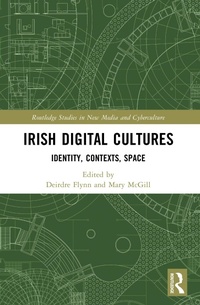
Irish Digital Cultures
Identity, Contexts, Space
Published on 10. December 2025
256 pages
978-1-040-53949-1 (ISBN)
Description

Irish Digital Cultures explores how questions of Ireland and Irishness are represented in online environments, and what these phenomena say about contemporary Irish identities both within the country and globally.
Bringing together interdisciplinary scholars and media studies professionals from across Ireland, this collection investigates how Irish life, culture and identity are impacted and evolving with the increasing reliance on digital platforms and tools. Emerging and established scholars at the cutting edge of Irish cultural research offer chapters that speak to the diversity of the digital in the Irish cultural sphere. The Culture and Identity section explores issues of representation, digital re-imaginings of 'Irishness', the discursive interplay of 'old Ireland' versus 'new Ireland' online, and Irishness as a self-brand and marketable commodity in the digital commons. From Irish gamers on YouTube to popular Irish podcast production, this section examines interconnections of culture and identity, exploring how these are reimagined and articulated in digital spaces. Building on these themes, the Contexts and Spaces section introduces scholarship on Irish cultural memory and the digital archive, protest and visibility in Irish digital spaces, artistic practice and performance, and the policing of 'Irishness' online.
This volume will interest Irish Studies researchers and scholars, particularly those working at the intersection of Media Studies, Cultural Studies, Sociology, Race, Gender, Identity, and New Media, as well as students studying Irish culture across the humanities and social sciences.
Bringing together interdisciplinary scholars and media studies professionals from across Ireland, this collection investigates how Irish life, culture and identity are impacted and evolving with the increasing reliance on digital platforms and tools. Emerging and established scholars at the cutting edge of Irish cultural research offer chapters that speak to the diversity of the digital in the Irish cultural sphere. The Culture and Identity section explores issues of representation, digital re-imaginings of 'Irishness', the discursive interplay of 'old Ireland' versus 'new Ireland' online, and Irishness as a self-brand and marketable commodity in the digital commons. From Irish gamers on YouTube to popular Irish podcast production, this section examines interconnections of culture and identity, exploring how these are reimagined and articulated in digital spaces. Building on these themes, the Contexts and Spaces section introduces scholarship on Irish cultural memory and the digital archive, protest and visibility in Irish digital spaces, artistic practice and performance, and the policing of 'Irishness' online.
This volume will interest Irish Studies researchers and scholars, particularly those working at the intersection of Media Studies, Cultural Studies, Sociology, Race, Gender, Identity, and New Media, as well as students studying Irish culture across the humanities and social sciences.
More details
Series
Language
English
Place of publication
London
United Kingdom
Publishing group
Taylor & Francis Ltd
Target group
College/higher education
Professional and scholarly
Illustrations
5 Tables, black and white; 2 Line drawings, black and white; 2 Illustrations, black and white
File size
6,25 MB
ISBN-13
978-1-040-53949-1 (9781040539491)
Copyright in bibliographic data and cover images is held by Nielsen Book Services Limited or by the publishers or by their respective licensors: all rights reserved.
Schweitzer Classification
Other editions
Additional editions
Book
approx. 12/2025
1st Edition
Routledge
€207.80
Not yet published
Persons
Deirdre Flynn is an inaugural member of Young Academy Ireland at the Royal Irish Academy and a lecturer in 21st Century Literature at MIC Limerick, Ireland. She has published widely on precarity, Irish Studies, Migration. Her most recent co-edited collection The Routledge Handbook to Motherhood on Screen, with Dr Susan Liddy was published in 2025 with Routledge.
Mary McGill is a researcher at the University of Galway's School of Law, Ireland, currently working on the Horizon Europe funded EMMELO Project: European Men, Masculinity and Extremist Leadership Online. She lectures at the Centre for Global Women's Studies in the University of Galway's School of Political Science and Sociology.
Mary McGill is a researcher at the University of Galway's School of Law, Ireland, currently working on the Horizon Europe funded EMMELO Project: European Men, Masculinity and Extremist Leadership Online. She lectures at the Centre for Global Women's Studies in the University of Galway's School of Political Science and Sociology.
Content
Introduction
Section 1: Culture and Identity
1. Podcasting, Emigration, Return Migration and 'Middle Ireland' in the Wake of the 2008 Global Financial Crisis: Jarlath Regan's An Irishman Abroad (2013-)
2. Negotiating Black and Irish Identity in the digital space
3. Jacksepticeye: Irishness, Branding and YouTube Gaming
4. Global Ireland and Digital Diversity: Creative Entrepreneurialism and the 'Soft Power' Platforming of the Diversity Ambassador
5. 'Hot Asian Boy Summer!': Performing Asian Irish Masculinities on TikTok
6. Representations of Ireland and Irishness on Alt Tech Platforms: Forty Shades of Green, but Just One Shade of White
7. Hopeful Mobilities in Irish Creator Cultures
Section 2: Contexts and Spaces
8. Developing a "critical feminist" approach to digitally preserving reproductive health activism on the island of Ireland
9. 'Whatever we did get, we fought tooth and nail for': Irish Independent and DIY Music Scenes in the Pandemic
10. Digital Dramaturgies: Irish Theatre's Pandemic Response
11. Non-human subjects, artificial intelligence, and the lyric voice in Irish poetry of the digital age: encounters with "skin-and-bone cousins"
12. Globally Spread Eco-videos and Regionalised Appeals: Digital Audiences in Ireland and Uruguay
13. "Ireland, we are at war": Conor McGregor, Mixed Martial Arts, and Far Right Populism in Ireland
14. CODA: Homegrown: Redefining digital Irish content, cultures and audience
Index
Section 1: Culture and Identity
1. Podcasting, Emigration, Return Migration and 'Middle Ireland' in the Wake of the 2008 Global Financial Crisis: Jarlath Regan's An Irishman Abroad (2013-)
2. Negotiating Black and Irish Identity in the digital space
3. Jacksepticeye: Irishness, Branding and YouTube Gaming
4. Global Ireland and Digital Diversity: Creative Entrepreneurialism and the 'Soft Power' Platforming of the Diversity Ambassador
5. 'Hot Asian Boy Summer!': Performing Asian Irish Masculinities on TikTok
6. Representations of Ireland and Irishness on Alt Tech Platforms: Forty Shades of Green, but Just One Shade of White
7. Hopeful Mobilities in Irish Creator Cultures
Section 2: Contexts and Spaces
8. Developing a "critical feminist" approach to digitally preserving reproductive health activism on the island of Ireland
9. 'Whatever we did get, we fought tooth and nail for': Irish Independent and DIY Music Scenes in the Pandemic
10. Digital Dramaturgies: Irish Theatre's Pandemic Response
11. Non-human subjects, artificial intelligence, and the lyric voice in Irish poetry of the digital age: encounters with "skin-and-bone cousins"
12. Globally Spread Eco-videos and Regionalised Appeals: Digital Audiences in Ireland and Uruguay
13. "Ireland, we are at war": Conor McGregor, Mixed Martial Arts, and Far Right Populism in Ireland
14. CODA: Homegrown: Redefining digital Irish content, cultures and audience
Index
