

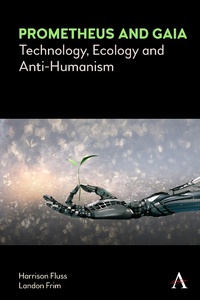
Prometheus and Gaia
Technology, Ecology and Anti-Humanism
1st Edition
Published on 1. February 2022
188 pages
978-1-83998-019-0 (ISBN)
Description

Prometheus and Gaia examines the ideological positions of Futurism and Eco-Pessimism. While these are rarely spoken about in mainstream discourse, they do have strong resonances in today's popular politics and culture. In light of existential threats posed by climate change, disruptive technologies and economic crises, many have grown weary of the "small fixes" offered by mainstream policy-makers. Radical change thus appears necessary, as Futurism and Eco-Pessimism emerge as two fundamental challenges to the status quo. The Futurist claims that the current dynamism of technology is incompatible with human limitations, while the Eco-Pessimist sees the climate crisis as symptomatic of a broader human domination over nature. What these seemingly opposite currents have in common is a shared rejection of the human frame as grounding politics; each seeks to subordinate the human in favor of a wholly alien other, either in the form of an anarchic nature or a dynamic technology. To transcend this strange coincidence of opposites, Prometheus and Gaia makes the positive case for a humanism that is rationalist without being anthropocentric.
Reviews / Votes
"This is a visionary work that illuminates a new way of thinking through our relationship with nature, technology and with each other. Fluss and Frim propose an ethics and politics that is both humane and rational, skewering the intellectual fads that dominate academic and popular debates. Tumultuous as it is original, this book defends an enlightened view of progress amid our current ecological crisis. It is as brilliant as it is timely."-Michael J. Thompson, William Paterson University, US "In the extremes of contemporary eco-politics, earth-first Gaians and technophilic Prometheans are thought to occupy enemy camps. But Fluss and Frimm show them to be two sides of the same misanthropic coin. This cajoling, hard-hitting, judicious mastery of every byway of today's eco debates is remarkable, and takes a surprising turn. Humanism, it turns out - not blustery scientism or praying for nature's revenge - proves to be the best weapon in the arsenal of those serious about saving the world."-Timothy Brennan, University of Minnesota, US "Facing climate crisis, too many intellectuals are giving in to what might be termed 'anthropessimism.' Fluss and Frim reject this dead end, offering instead a rousing, engagingly-argued and much-needed defense of the Enlightenment, human reason - and of course, human beings! With infectious enthusiasm, these astute scholars use deep readings of ancient mythology and philosophy to guide us into a more hopeful future." -Liza Featherstone, columnist, Jacobin and New Republic magazines "Confronting the climate crisis requires confronting an intimidating array of practical challenges but it also requires thinking fundamentally about humanity's relationship with nature. The apparently opposed temptations of domination of nature or humble submission to it are two sides of the same bad coin, Fluss and Frim argue. Both accelerationism and eco-pessimism, approaches with deep historical roots, share an underlying misanthropy and fatalism. Fluss and Frim propose instead the rehabilitation of an unfashionable concept, a revolutionary humanist rationalism. Complex and rigorous but nonetheless clear and even charming, Prometheus and Gaia offers us a way out of all this doom." -Doug Henwood, economic journalist and host of "Behind the News," a radio show broadcast on KPFA, Berkeley, US "This book should be of interest to anyone who wants to understand how patterns of thought, even those that are seemingly liberal or progressive, can lend themselves to anti-democratic thinking. Written in a clear, accessible, and frequently polemical style, Prometheus and Gaia demonstrates how easy it is for authoritarian thinking to make its way into popular attitudes toward technology and nature in late capitalism. In response to the many crises of the era, accelerationism and eco-pessimism have each emerged to offer humanity a way forward. Fluss and Frim offer us good reason to pause at the guidance that each offers. As they make clear, for both accelerationism and eco-pessimism, the way forward is the abdication of reason and of the ability to reason about general human welfare. Fluss and Frim make clear that there is little to gain from such proposals and much to lose."-Carolyn Culbertson, Florida Gulf Coast University, US "Prometheus and Gaia radically transform the current debate on technology and ecology by bringing down a plague on both the houses of those who celebrate the embrace of technology and those who claim to protect the sacred earth. Beneath the apparent conflicts and rivalries between these positions, identified with the mythological figures of Promethean ambition and Gaian humility, Fluss and Frim identify a common distrust of humanity and rational thought. Instead of embracing monstrous mythic images that stress human weakness, they argue the solution to our contemporary crises lies in a rational thinking of nature and humanity. This impassioned plea for reason goes beyond the limits of present thinking by expanding our thought to care for all of nature through a universal politics of solidarity".-Benjamin Noys, University of Chichester, UKMore details
Series
Edition
1st Edition
Language
English
Place of publication
London
United Kingdom
Target group
Professional and scholarly
US School Grade: College Graduate Student
File size
7,01 MB
ISBN-13
978-1-83998-019-0 (9781839980190)
Copyright in bibliographic data and cover images is held by Nielsen Book Services Limited or by the publishers or by their respective licensors: all rights reserved.
Schweitzer Classification
Other editions
Additional editions
Book
02/2022
Anthem Press
€144.10
Shipment within 3-4 weeks
E-Book
02/2022
1st Edition
Anthem Press
€39.49
Available for download
Persons
Harrison Fluss is a philosophy and political science lecturer in New York City and a corresponding editor for Historical Materialism. His writing has appeared in Jacobin Magazine and the New Republic.
Landon Frim is an assistant professor of philosophy at Florida Gulf Coast University, USA. His research focuses on the Enlightenment rationalism of Baruch Spinoza and its implications for contemporary politics.
Landon Frim is an assistant professor of philosophy at Florida Gulf Coast University, USA. His research focuses on the Enlightenment rationalism of Baruch Spinoza and its implications for contemporary politics.
Content
Introduction: Fear and Loathing in the Twenty- First Century; 1. Prometheus and Gaia; 2. Accelerationism; 3. Eco-Pessimism; 4. Coincidence of Opposites; Epilogue: Beyond the Void; Index.
