

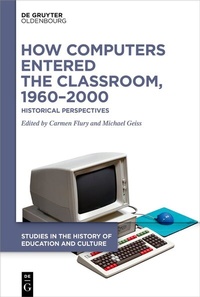
How Computers Entered the Classroom, 1960-2000
Description

In the history of education, the question of how computers were introduced into European classrooms has so far been largely neglected. This edited volume strives to address this gap. The contributions shed light on the computerization of education from a historical perspective, by attending closely to the different actors involved - such as politicians, computer manufacturers, teachers, and students -, political rationales and ideologies, as well as financial, political, or organizational structures and relations.
The case studies highlight differences in political and economic power, as well as in ideological reasoning and the priorities set by different stakeholders in the process of introducing computers into education. However, the contributions also demonstrate that simple cold war narratives fail to capture the complex dynamics and entanglements in the history of computers as an educational technology and a subject taught in schools.
The edited volume thus provides a comprehensive historical understanding of the role of education in an emerging digital society.
More details
Other editions
Additional editions
Persons
Carmen Flury and Michael Geiss , Zurich University of Teacher Education, Zurich, Switzerland.
