

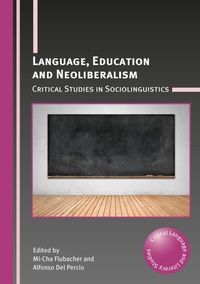
Language, Education and Neoliberalism
Critical Studies in Sociolinguistics
Published on 25. September 2017
264 pages
978-1-78309-870-5 (ISBN)
Description

This edited volume presents an empirical account of how neoliberal ideas are adopted on the ground by different actors in different educational settings, from bilingual education in the US, to migrant work programmes in Italy, to minority language teaching in Mexico. It examines language and education as objects of neoliberalization and as powerful tools and sites through which ideological principles underpinning neoliberal societies and economies are (re)produced and maintained (and with that, inequality and exclusion). This book aims to produce a complex understanding of how neoliberal rationalities are articulated within locally anchored and historical regimes of knowledge on language, education and society.
Reviews / Votes
This volume presents extensive research on the relationship between neoliberal ideology, language and education. One of the many strengths of this volume is in how a variety of methods and analytical approaches are deployed to address neoliberalism. -- Andrew Jocuns, Thammasat University, Bangkok, Thailand * LINGUIST List 29.3315 * A rich collection of empirical studies showing how important language education and language of education are as terrains for struggles around neoliberal governmentality, and illuminating debates about what neoliberalism is, how it works for individuals, groups, corporations and states, and where its contradictions lie. * Monica Heller, University of Toronto, Canada * The wide-ranging, sharply observed, and detailed ethnographic studies in this smart volume demonstrate language education policies and practices designed to promote subjectivities and values working more to the advantage of global capitalism than to students. The volume also demonstrates the unevenness of such neoliberal language projects: their shortcuts, failures, broken promises - and actors' points of resistance. * Bonnie Urcuioli, Hamilton College, USA * This book opens up a ground-breaking space for understanding how neoliberalism has permeated education worldwide and consequently affects the way people make sense of, and invest in, language and multilingualism. It captures and engages readers in the complexities of the triple resignification of education, of language and of the self. Essential reading for all those troubled by present challenges. * Luisa Martin Rojo, Autonomous University of Madrid, Spain * This book offers much food for thought for anyone interested in how language education is embedded in larger economic, political, social, and cultural processes. -- David Block, University of Lleida, Spain * ELT Journal Volume 72, Issue 4, October 2018 *More details
Series
Language
English
Place of publication
Bristol
United Kingdom
Publishing group
Channel View Publications Ltd
Target group
College/higher education
ISBN-13
978-1-78309-870-5 (9781783098705)
Copyright in bibliographic data and cover images is held by Nielsen Book Services Limited or by the publishers or by their respective licensors: all rights reserved.
Schweitzer Classification
Other editions
Additional editions
Mi-Cha Flubacher | Alfonso Del Percio
Language, Education and Neoliberalism
Critical Studies in Sociolinguistics
Book
09/2017
Multilingual Matters
€55.70
Shipment within 10-20 days
Persons
Mi-Cha Flubacher works in the Department of Linguistics, University of Vienna, Austria. Her research interests include language and work, and language and migration/integration.
Alfonso Del Percio works in the UCL Institute of Education, University College London, UK. His research interests include language and work, and language and political economy.
Alfonso Del Percio works in the UCL Institute of Education, University College London, UK. His research interests include language and work, and language and political economy.
Content
1. Alfonso Del Percio and Mi-Cha Flubacher: Language, Education and Neoliberalism
2. Shuang Gao: The Commodification of Language in Neoliberalizing China: The Cases of English and Mandarin
3. Haley De Korne: "A Treasure" And "A Legacy": Individual And Communal (Re)Valuing Of Isthmus Zapotec in Multilingual Mexico
4. Nelson Flores: From Language-As-Resource to Language-As-Struggle: Resisting the Coke-Ification of Bilingual Education
5. Joseph S.Y. Park: English As Medium of Instruction in Korean Higher Education: Language and Subjectivity as Critical Perspective on Neoliberalism
6. Jonathan Luke: Internationalization and English Language Learning In Higher Education in Canada: A Case Study Of Brazilian STEM Scholarship Students
7. Honey Tabiola and Beatriz Lorente: Neoliberalism In ELT Aid: Interrogating a USAID ELT Project in Southern Philippines
8. Alfonso Del Percio and Sarah Van Hoof: Enterprising Migrants: Language and the Shifting Politics of Activation
9. Jill Koyama: Assembling Language Policy: Challenging Standardization and Quantification in the Education of Refugee Students in A US School
10. Gregory Hadley: The Games People Play: A Critical Study of "Resource Leeching" Among "Blended" English for Academic Purpose Professionals in Neoliberal Universities
11. Martina Zimmermann and Mi-Cha Flubacher: Win-Win?! Language Regulation for Competitiveness in a University Context
12. Mary McGroarty: Neoliberal Reforms in Language Education: Major Trends, Uneven Outcomes, Open Questions
Biographical Information
2. Shuang Gao: The Commodification of Language in Neoliberalizing China: The Cases of English and Mandarin
3. Haley De Korne: "A Treasure" And "A Legacy": Individual And Communal (Re)Valuing Of Isthmus Zapotec in Multilingual Mexico
4. Nelson Flores: From Language-As-Resource to Language-As-Struggle: Resisting the Coke-Ification of Bilingual Education
5. Joseph S.Y. Park: English As Medium of Instruction in Korean Higher Education: Language and Subjectivity as Critical Perspective on Neoliberalism
6. Jonathan Luke: Internationalization and English Language Learning In Higher Education in Canada: A Case Study Of Brazilian STEM Scholarship Students
7. Honey Tabiola and Beatriz Lorente: Neoliberalism In ELT Aid: Interrogating a USAID ELT Project in Southern Philippines
8. Alfonso Del Percio and Sarah Van Hoof: Enterprising Migrants: Language and the Shifting Politics of Activation
9. Jill Koyama: Assembling Language Policy: Challenging Standardization and Quantification in the Education of Refugee Students in A US School
10. Gregory Hadley: The Games People Play: A Critical Study of "Resource Leeching" Among "Blended" English for Academic Purpose Professionals in Neoliberal Universities
11. Martina Zimmermann and Mi-Cha Flubacher: Win-Win?! Language Regulation for Competitiveness in a University Context
12. Mary McGroarty: Neoliberal Reforms in Language Education: Major Trends, Uneven Outcomes, Open Questions
Biographical Information
