

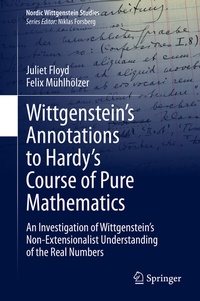
Wittgenstein's Annotations to Hardy's Course of Pure Mathematics
Description

This monograph examines the private annotations that Ludwig Wittgenstein made to his copy of G.H. Hardy's classic textbook, A Course of Pure Mathematics . Complete with actual images of the annotations, it gives readers a more complete picture of Wittgenstein's remarks on irrational numbers, which have only been published in an excerpted form and, as a result, have often been unjustly criticized.
The authors first establish the context behind the annotations and discuss the historical role of Hardy's textbook. They then go on to outline Wittgenstein's non-extensionalist point of view on real numbers, assessing his manuscripts and published remarks and discussing attitudes in play in the philosophy of mathematics since Dedekind. Next, coverage focuses on the annotations themselves. The discussion encompasses irrational numbers, the law of excluded middle in mathematics and the notion of an "improper picture," the continuum of real numbers, and Wittgenstein's attitude toward functions and limits.
Reviews / Votes
"The book goes far beyond their edition, providing access to important topics in the philosophy of mathematics seen from the special Wittgensteinian perspective." (Volker Peckhaus, zbMATH 1529.01002, 2024)
"There are some books that one learns from them what one expected or hoped to learn; but then there are books that go well beyond the brief laid out in their titles, and the book . is one such. Called Wittgenstein's Annotations to Hardy's Course of Pure Mathematics, the book is actually an extensive and deeply informed examination of Wittgenstein's philosophy of mathematics in all of its aspects . ." (Juliette Kennedy, Philosophia Mathematica, Vol. 30 (2), 2022)
"The book is very rich in information for the Wittgenstein scholar as well as for students of Wittgenstein's commentaries on the development of mathematics." (Michael Otte, Mathematical Reviews, May, 2022)
More details
Other editions
Additional editions
Persons
Felix Mühlhölzer is Professor of Philosophy at the Georg-August-University of Göttingen since 1997. Before, he taught at the University of Munich from 1989 to 1993 and was Professor of Philosophy of Science and Logic at Dresden University of Technology until 1997. He has published on topics in philosophy of science, especially on space and time, and in philosophy of language. Since 2001 he has written primarily on later Wittgenstein's philosophy of mathematics. His recent works include Braucht die Mathematik eine Grundlegung? Ein Kommentar des Teils III von Wittgensteins "Bemerkungen über die Grundlagen der Mathematik" (2010) and Wissenschaft (2011).He is currently working on a book titled Wittgenstein über Zahlen und Mengen. Mit einem Kommentar des Teils II von Wittgensteins 'Bemerkungen über die Philosophie der Mathematik.
