

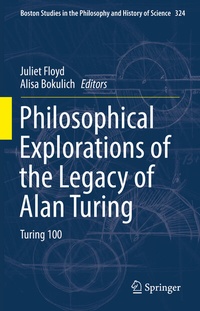
Philosophical Explorations of the Legacy of Alan Turing
Description

Chapters "Turing and Free Will: A New Take on an Old Debate" and "Turing and the History of Computer Music" are available open access under a Creative Commons Attribution 4.0 International License via link.springer.com.
Reviews / Votes
"The book provides, probably for the first time, not only all the elements necessary for assessing the full importance of Turing's legacy but also fundamental lines of thought for connecting his work with new research perspectives. It will be an indispensable reference for understanding and developing all the concepts and ideas introduced by Turing." (Jean-Marc Ginoux, Isis, Vol. 110 (4), 2019)
More details
Other editions
Additional editions
Persons
Alisa Bokulich is Associate Professor of Philosophy at Boston University and Director of the Center for Philosophy & History of Science, where she organizes the Boston Colloquium for Philosophy of Science. She is Associate Member ofHarvard University's History of Science Department and a Series Editor for Boston Studies in the Philosophy & History of Science. Her research focuses on issues in philosophy of science, including history and philosophy of quantum mechanics, and philosophy of the geosciences. She is author of the book Reexamining the Quantum-Classical Relation: Beyond Reductionism and Pluralism (Cambridge UP, 2008) and co-editor of three additional books.
Content
Chapter 1. Introduction (Juliet Floyd).- Part I. Logic and Mathematics to Philosophy.- Chapter 2. Turing, the Mathematician (Daniele Mundici and Wilfried Sieg).- Chapter 3. Turing, Gödel and the "Bright Abyss" (Juliette Kennedy).- Chapter 4. Justified True Belief: Plato, Gettier and Turing (Rohit Parikh and Adriana Renero).- Chapter 5. Turing on "Common Sense": Cambridge Resonances (Juliet Floyd).- Part II. The Universal Machine: From Music to Morphogenesis.- Chapter 6. Universality is Ubiquitous (Martin Davis).- Chapter 7. The Early History of Voice Encryption (Craig Bauer).- Chapter 8. Turing and the History of Computer Music (B. Jack Copeland and Jason Long).- Chapter 9. Exploring the Frontiers of Computation: Measurement Based Quantum Computers and the Mechanistic View of Computation (Armond Duwell).- Chapter 10. Embodying Computation at Higher Types (S. Barry Cooper).- Part III. Human, Machine, and Mind.- Chapter 11. On Computing Machinery and Intelligence (Patrick Henry Winston).- Chapter 12. From Ockham to Turing --- and Back Again (Michael Rescorla).- Chapter 13. Turing and Free Will: A New Take on An Old Debate (Diane Proudfoot).- Chapter 14. Turing and the Integration of Human and Machine Intelligence (Susan G. Sterrett).- Chapter 15. Is there a Church-Turing thesis for social algorithms? (Rohit Parikh).
