

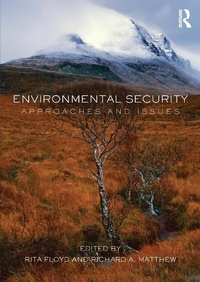
Environmental Security
Approaches and Issues
1st Edition
Published on 4. January 2013
320 pages
978-1-136-26675-1 (ISBN)
Description

Economic development, population growth and poor resource management have combined to alter the planet's natural environment in dramatic and alarming ways. For over twenty years, considerable research and debate have focused on clarifying or disputing linkages between various forms of environmental change and various understandings of security. At one extreme lie sceptics who contend that the linkages are weak or even non-existent; they are simply attempts to harness the resources of the security arena to an environmental agenda. At the other extreme lie those who believe that these linkages may be the most important drivers of security in the 21st century; indeed, the very future of humankind may be at stake.
This book brings together contributions from a range of disciplines to present a critical and comprehensive overview of the research and debate linking environmental factors to security. It provides a framework for representing and understanding key areas of intellectual convergence and disagreement, clarifying achievements of the research as well as identifying its weaknesses and gaps. Part I explores the various ways environmental change and security have been linked, and provides principal critiques of this linkage. Part II explores the linkage through analysis of key issue areas such as climate change, energy, water, food, population, and development. Finally, the book concludes with a discussion of the value of this subfield of security studies, and with some ideas about the questions it might profitably address in the future.
This volume is the first to provide a comprehensive overview of the field. With contributions from around the world, it combines established and emerging scholars to offer a platform for the next wave of research and policy activity. It is invaluable for both students and practitioners interested in international relations, environment studies and human geography.
This book brings together contributions from a range of disciplines to present a critical and comprehensive overview of the research and debate linking environmental factors to security. It provides a framework for representing and understanding key areas of intellectual convergence and disagreement, clarifying achievements of the research as well as identifying its weaknesses and gaps. Part I explores the various ways environmental change and security have been linked, and provides principal critiques of this linkage. Part II explores the linkage through analysis of key issue areas such as climate change, energy, water, food, population, and development. Finally, the book concludes with a discussion of the value of this subfield of security studies, and with some ideas about the questions it might profitably address in the future.
This volume is the first to provide a comprehensive overview of the field. With contributions from around the world, it combines established and emerging scholars to offer a platform for the next wave of research and policy activity. It is invaluable for both students and practitioners interested in international relations, environment studies and human geography.
Reviews / Votes
"This is an important volume that provides a comprehensive overview of research on environmental security. Its coverage of the diverse theoretical and empirical approaches to environmental security is unique and very helpful, as is its systematic examination of key issues areas, including climate change, energy, food, gender, population, and water." Professor Jon Barnett, Department of Resource Management and Geography, The University of Melbourne, Australia."For decades a debate has raged over the nature of the links between environmental stress and various forms of security. Scholarship on the topic has now fragmented into many specialized subfields that rarely engage with each other. Environmental Security is a comprehensive, accessible, and current survey of this research landscape-an essential guide to a vitally important and enormously complex topic, for students and established researchers alike." Professor Thomas Homer-Dixon, Balsillie School of International Affairs, Waterloo, Canada.
"This anthology arrives at a critical time when pundits, policymakers and Western defense interests are increasingly linking climate change to security threats, especially in the Global South. What do past debates about environmental security have to teach us about present controversies? By presenting and analyzing a wide range of perspectives, Environmental Security is a valuable scholarly contribution, equally useful in the classroom and the policy arena." Betsy Hartmann, Professor of Development Studies and Director of the Population and Development Program, Hampshire College, USA.
"This timely volume provides a critical and comprehensive overview of the growing field of environmental security studies. The rich collection discusses the pros and cons and bridges the deep divisions regarding the concepts of security, conflict and peacebuilding. The authors address the research gaps and analyse specific issues of water, food, population, gender and climate change." Juergen Scheffran, Adjunct Associate Professor and Senior Research Scientist in the Program in Arms Control, Disarmament and International Security at the University of Illinois, USA.
"Surprisingly, this is the first multidisciplinary volume on the developing field of environmental security dealing with the interaction between economic development, population growth and resource management - of which the food security book reviewed below is an example." - David Lorimer, Network Review
More details
Language
English
Place of publication
London
United Kingdom
Publishing group
Taylor & Francis Ltd
Target group
College/higher education
Professional and scholarly
Illustrations
20 s/w Abbildungen, 6 s/w Tabellen, 20 s/w Zeichnungen
6 Tables, black and white; 20 Line drawings, black and white; 20 Illustrations, black and white
File size
4,45 MB
ISBN-13
978-1-136-26675-1 (9781136266751)
Copyright in bibliographic data and cover images is held by Nielsen Book Services Limited or by the publishers or by their respective licensors: all rights reserved.
Schweitzer Classification
Other editions
New editions
E-Book
01/2026
2nd Edition
Routledge
€55.49
Available for download
E-Book
06/2021
2nd Edition
Routledge
€52.49
Available for download
Additional editions
Book
12/2012
1st Edition
Routledge
€231.40
Shipment within 15-20 days
Book
12/2012
1st Edition
Routledge
€84.10
Shipment within 15-20 days
Persons
Rita Floyd is a Birmingham Fellow in Conflict and Security at the Department of Political Science and International Studies at the University of Birmingham, UK.
Richard A. Matthew is a Professor in the Schools of Social Ecology and Social Science at the University of California at Irvine, and founding Director of the Center for Unconventional Security Affairs (www.cusa.uci.edu).
Richard A. Matthew is a Professor in the Schools of Social Ecology and Social Science at the University of California at Irvine, and founding Director of the Center for Unconventional Security Affairs (www.cusa.uci.edu).
Content
Environmental Security Studies: An Introduction Chapter 1. Analyst, Theory and Security: A New Framework for Understanding Environmental Security Studies Chapter 2. The Evolution of qualitative Environment-Conflict Research: Moving Towards Consensus Chapter 3. Environmental Security and the Resource Curse Chapter 4. A Political Ecology of Environmental Security Chapter 5. From Conflict to Cooperation? Environmental Cooperation as a Tool for Peace-building Chapter 6. Environmental Dimensions of Human Security Chapter 7. Ecological Security: A Conceptual Framework Chapter 8. Gender and Environmental Security Chapter 9. Understanding Water Security Chapter 10. Conservation, Science and Peace-building in South-eastern Europe Chapter 11. Population and National Security Chapter 12. Environmental Security and Sustainable Development Chapter 13. Ensuring Food Security: Meeting Challenges from Malnutrition, Food Safety and Global Environmental Change Chapter 14. Challenging Inequality and Injustice: A Critical Approach to Energy Security Chapter 15. Climate Change and Security Chapter 16. Whither Environmental Security Studies? An Afterword
