

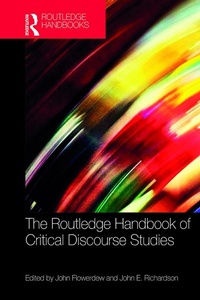
The Routledge Handbook of Critical Discourse Studies
Published on 6. July 2017
656 pages
978-1-317-57650-1 (ISBN)
Description

The Routledge Handbook of Critical Discourse Studies provides a state-of-the-art overview of the important and rapidly developing field of Critical Discourse Studies (CDS). Forty-one chapters from leading international scholars cover the central theories, concepts, contexts and applications of CDS and how they have developed, encompassing:
approaches
analytical methods
interdisciplinarity
social divisions and power
domains and media.
Including methodologies to assist those undertaking their own critical research of discourse, this Handbook is key reading for all those engaged in the study and research of Critical Discourse Analysis within English Language and Linguistics, Communication, Media Studies and related areas.
approaches
analytical methods
interdisciplinarity
social divisions and power
domains and media.
Including methodologies to assist those undertaking their own critical research of discourse, this Handbook is key reading for all those engaged in the study and research of Critical Discourse Analysis within English Language and Linguistics, Communication, Media Studies and related areas.
Reviews / Votes
"This Handbook is well written and organized, and its significant contribution to the development of CDS is undeniable, for it reflects the major theoretical and methodological achievements and serves as an indispensable guide for researchers and advanced students to conduct their specific research projects in CDS, sociolinguistics, pragmatics, politics, (social) media studies, communication and other neighboring disciplines."- Yunhua Xiang, College of Foreign Languages, Jilin University, P.R. China
More details
Series
Language
English
Place of publication
London
United Kingdom
Publishing group
Taylor & Francis Ltd
Target group
College/higher education
Illustrations
15 s/w Tabellen
15 Tables, black and white
File size
7,10 MB
ISBN-13
978-1-317-57650-1 (9781317576501)
Copyright in bibliographic data and cover images is held by Nielsen Book Services Limited or by the publishers or by their respective licensors: all rights reserved.
Schweitzer Classification
Other editions
Additional editions
John Flowerdew | John Richardson
The Routledge Handbook of Critical Discourse Studies
Book
04/2020
1st Edition
Routledge
€75.30
Shipment within 15-20 days

Book
08/2017
Routledge
Unfortunately, price unknown
Available (delivery time upon request)
John Flowerdew | John Richardson
The Routledge Handbook of Critical Discourse Studies
Book
07/2017
1st Edition
Routledge
€341.69
Shipment within 10-20 days
Persons
John Flowerdew is Emeritus Professor at City University of Hong Kong and a visiting professor at Lancaster University. He has authored and co-authored several books including: Advances in Discourse Studies (with V. K. Bhatia and R. Jones, 2008), Critical Discourse Analysis in Historiography (2012), Discourse in English Language Education (2013), and Discourse in Context (2014). He serves on the editorial boards of a range of international journals, including Critical Discourse Studies, Journal of Pragmatics, Journal of Language and Politics, and Journal of English for Specific Purposes.
John E Richardson is a Reader in Critical Discourse Studies at Loughborough University. He is Editor of the international journal Critical Discourse Studies and has authored or edited several books including: Analysing Media Discourses (2011), Analysing Fascist Discourse (2013), Advances in Critical Discourse Studies (with M. Krzyzanowksi, D. Machin, and R. Wodak, 2014), and British Fascism: A Discourse-Historic Analysis (forthcoming).
John E Richardson is a Reader in Critical Discourse Studies at Loughborough University. He is Editor of the international journal Critical Discourse Studies and has authored or edited several books including: Analysing Media Discourses (2011), Analysing Fascist Discourse (2013), Advances in Critical Discourse Studies (with M. Krzyzanowksi, D. Machin, and R. Wodak, 2014), and British Fascism: A Discourse-Historic Analysis (forthcoming).
Content
1. Approaches
Norman Fairclough: CDA as dialectical reasoning
Teun van Dijk: Socio-cognitive approach
Martin Reisigl: Discourse Historical Approach
Per Ledin & David Machin: Multi-modal Critical Discourse Analysis
Christopher Hart: Cognitive Linguistic Critical Discourse Studies
Piotr Cap: Spatial Cognition
Nicholas Subtirelu & Paul Baker: Corpus-based approaches
Dalia Gavriely: Cultural Critical Discourse Analysis
Tom Bartlett: Positive Discourse Analysis
2. Analytical methods
Meriel Bloor and Thomas Bloor: Systemic Functional Linguistics
John Flowerdew: Critical Discourse Studies and context
Michal Krzyzanowski: Ethnography and Critical Discourse Studies
Alexandra Polyzou: Pragmatics
Carl Ng: Metaphor
Manfred Keinpointer: Rhetoric and argumentation
Isabela Fairclough: Deliberative discourse
3. Interdisciplinarity
Bernhard Forchtner: Critical Discourse Studies & Social Theory
Nico Carpentier: Discourse-theoretical analysis (DTA)
Sean Phelan: Critical Discourse Analysis & Media Studies
Mariana Achugar: Critical Discourse Analysis and History
Laura Filardo Llamas & Michael Boyd: Critical Discourse Analysis & Politics
Crispin Thurlow: Critical discourse studies in/of applied contexts
4. Social Divisions and Power
David Block: Class and class warfare
Susana Martinez Guillem: Race/Ethnicity
Michelle Lazar: Feminist Critical Discourse Studies
Heiko Motschenbacher: Sexuality in Critical Discourse Studies
Ruth Wodak: Discourses about Nationalism
Christian Chun: Neoliberalism, globalization and Critical Discourse Studies
Aditi Bhatia: The Discursive Construction of Terrorism and Violence
John E Richardson: Fascist discourse
5. Domains and Media
Rebecca Rogers: Critical Discourse Analysis and Educational Discourses
Jothie Rajah: Legal discourse
Arran Stibbe: Critical Discourse Analysis and Ecology
Darren Kelsey: Journalism
Felicitas Macgilchrist: Textbooks
Alon Lischinsky: Critical Discourse Studies and branding
Theo van Leeuwen: The critical analysis of musical discourse
Emilia Djonov & Theo van Leeuwen: Software
Majid KhosraviNik: Social Media & 'Web 2.0'
Goran Eriksson: Critical Discourse Analysis of reality television
John Bateman: Critical Discourse Analysis and film
Norman Fairclough: CDA as dialectical reasoning
Teun van Dijk: Socio-cognitive approach
Martin Reisigl: Discourse Historical Approach
Per Ledin & David Machin: Multi-modal Critical Discourse Analysis
Christopher Hart: Cognitive Linguistic Critical Discourse Studies
Piotr Cap: Spatial Cognition
Nicholas Subtirelu & Paul Baker: Corpus-based approaches
Dalia Gavriely: Cultural Critical Discourse Analysis
Tom Bartlett: Positive Discourse Analysis
2. Analytical methods
Meriel Bloor and Thomas Bloor: Systemic Functional Linguistics
John Flowerdew: Critical Discourse Studies and context
Michal Krzyzanowski: Ethnography and Critical Discourse Studies
Alexandra Polyzou: Pragmatics
Carl Ng: Metaphor
Manfred Keinpointer: Rhetoric and argumentation
Isabela Fairclough: Deliberative discourse
3. Interdisciplinarity
Bernhard Forchtner: Critical Discourse Studies & Social Theory
Nico Carpentier: Discourse-theoretical analysis (DTA)
Sean Phelan: Critical Discourse Analysis & Media Studies
Mariana Achugar: Critical Discourse Analysis and History
Laura Filardo Llamas & Michael Boyd: Critical Discourse Analysis & Politics
Crispin Thurlow: Critical discourse studies in/of applied contexts
4. Social Divisions and Power
David Block: Class and class warfare
Susana Martinez Guillem: Race/Ethnicity
Michelle Lazar: Feminist Critical Discourse Studies
Heiko Motschenbacher: Sexuality in Critical Discourse Studies
Ruth Wodak: Discourses about Nationalism
Christian Chun: Neoliberalism, globalization and Critical Discourse Studies
Aditi Bhatia: The Discursive Construction of Terrorism and Violence
John E Richardson: Fascist discourse
5. Domains and Media
Rebecca Rogers: Critical Discourse Analysis and Educational Discourses
Jothie Rajah: Legal discourse
Arran Stibbe: Critical Discourse Analysis and Ecology
Darren Kelsey: Journalism
Felicitas Macgilchrist: Textbooks
Alon Lischinsky: Critical Discourse Studies and branding
Theo van Leeuwen: The critical analysis of musical discourse
Emilia Djonov & Theo van Leeuwen: Software
Majid KhosraviNik: Social Media & 'Web 2.0'
Goran Eriksson: Critical Discourse Analysis of reality television
John Bateman: Critical Discourse Analysis and film
