

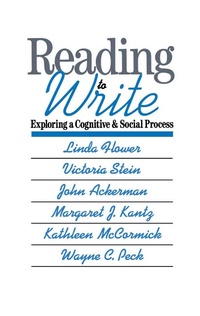
Reading-to-Write
Exploring a Cognitive and Social Process
1st Edition
Published on 20. September 1990
280 pages
978-0-19-534514-8 (ISBN)
Description

The Social and Cognitive Studies in Writing and Literacy Series, is devoted to books that bridge research, theory, and practice, exploring social and cognitive processes in writing and expanding our knowledge of literacy as an active constructive process--as students move from high school to college.
This descriptive study of reading-to-write examines a critical point in every college student's academic performance: when he or she is faced with the task of reading a source, integrating personal ideas, and creating an individual text with a self-defined purpose. Offering an unusually comprehensive view of this process, the authors chart a group of freshmen as they study and write in their dormitories, recording their "think-aloud" strategies for reading, writing, and revising, their interpretation of the task, and their broader social, cultural, and contextual understanding of college writing. Flower, Stein, and colleagues convincingly conclude that the legacy of schooling in general makes the transition to college difficult and, more important, that the assumptions students hold and the strategies they use in undertaking this task play a significant role in their academic performance. Embracing a broad range of perspectives from rhetoric, composition, literacy research, literary and cultural theory, and cognitive psychology, this rigorous analysis treats reading-to-write as both a cognitive and social process. It will interest researchers and theoreticians in rhetoric and writing, teachers working with students in transition from high school to college, and educators involved in the links between cognition and the social process.
More details
Other editions
Additional editions
Linda Flower | Victoria Stein | John Ackerman
Reading-to-Write
Exploring a Cognitive and Social Process
Book
11/1990
Oxford University Press Inc
€241.00
Shipment within 15-20 days
Content
- Intro
- Contents
- Introduction: Studying Cognition in Context
- Appendix I: Reading-to-Write Assignment on Time Management
- Appendix II: Excerpt from Task Representation Lecture
- I: Reading-to-Write: Understanding the Task
- 1. The Role of Task Representation in Reading-to-Write
- Task Representation in Reading-to-Write: The Exploratory Study
- The Power of the Organizing Plan
- How a Task Representation Is Created
- Costs, Benefits, Cognition, and Growth
- Taking Metacognitive Control: Awareness versus Standard Strategies
- Appendix III: Protocol Instructions
- Appendix IV: Reading-to-Write Assignment on Revision
- 2. Promises of Coherence, Weak Content, and Strong Organization: An Analysis of the Students' Texts
- Rationale for the Two Taxonomies
- Promises of Coherence: What Were Those Essays Doing?
- Appendix V: Essay Categories and Instructions to Judges
- Appendix VI: Essays Using the Interpret-for-a-Purpose Organizing Plan
- Appendix VII: Inter-rater Agreement on Elaborated Taxonomy
- 3. Students' Self-Analyses and Judges' Perceptions: Where Do They Agree?
- The Study
- What Our Students Reported
- Conclusions with Implications for Teaching
- Appendix VIII: Self-Analysis Checklist
- Appendix IX: Total Number of Selections with Percentages from the Self-Analysis Checklist
- II: Reading-to-Write: Cognitive Perspectives
- 4. Exploring the Cognition of Reading-to-Write
- An Examination of Cognitive Processes
- The Cognition of Reading-to-Write: A Case Study Perspective
- Looking for Patterns: The Quantitative Analysis
- Appendix X: Summary Statistics
- Appendix XI: Pearson Correlation Matrix
- Appendix XII: Multiple Regression Results
- Appendix XIII: Multiple Regression Results
- 5. Elaboration: Using What You Know
- The Role of Elaboration in Reading-to-Write
- The Protocol Study
- Conclusion
- 6. The Effects of Prompts on Revision: A Glimpse of the Gap Between Planning and Performance
- Procedure
- Key Observations
- The Effect of Prompts on Organizing Plans
- Protocol Analysis
- Negotiation Within an Instructional Setting
- Writers Revise Differently
- III: Reading-to-Write: Social Perspectives
- 7. Translating Context into Action
- Locating Context: In Writers, In a Culture
- The Students' Opening Moves: Origins in a Literate Culture
- Asking Questions of a Legacy
- 8. The Cultural Imperatives Underlying Cognitive Acts
- The Need to Place Student Writing in Broader Cultural Contexts
- Learning to Recognize Assumptions Underlying Students' Writing
- Developing Complementarities Between Rhetorical and Literary Theories: Reading for Absences
- Ideology and Students' Writing
- The Invisibility of Ideology in the Educational System
- Three Ideological Assumptions Guiding Students' Writing
- Appendix XIV: Interview Questions for Students
- IV: Uniting Cognition and Context
- 9. Negotiating Academic Discourse
- A Conceptual Framework
- Developing an Organizing Idea
- The Tacit Transition to Academic Discourse
- References
- Index
- A
- B
- C
- D
- E
- F
- G
- H
- I
- K
- L
- M
- N
- O
- P
- Q
- R
- S
- T
- V
- W
