

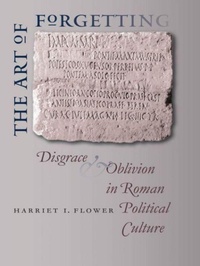
The Art of Forgetting
Disgrace and Oblivion in Roman Political Culture
Published on 1. February 2011
424 pages
978-0-8078-7746-3 (ISBN)
Description

Elite Romans periodically chose to limit or destroy the memory of a leading citizen who was deemed an unworthy member of the community. Sanctions against memory could lead to the removal or mutilation of portraits and public inscriptions. Harriet Flower provides the first chronological overview of the development of this Roman practice — an instruction to forget — from archaic times into the second century A.D. Flower explores Roman memory sanctions against the background of Greek and Hellenistic cultural influence and in the context of the wider Mediterranean world. Combining literary texts, inscriptions, coins, and material evidence, this richly illustrated study contributes to a deeper understanding of Roman political culture.
More details
Other editions
Additional editions
Software
06/2014
University of North Carolina Press
€136.34
Shipment within 15-20 days
Book
02/2011
The University of North Carolina Press
€50.70
Shipment within 15-20 days
Person
Harriet I. Flower is professor of classics at Princeton University. She is author of Ancestor Masks and Aristocratic Power in Roman Culture and editor of The Cambridge Companion to the Roman Republic.
Content
- Intro
- Contents
- Preface
- Acknowledgments
- CHAPTER I: Clementis' Hat: The Politics of Memory Sanctions and the Shape of Forgetting
- PART I: THE ROMAN REPUBLIC AND GREEK PRECEDENTS
- CHAPTER II: Did the Greeks Have Memory Sanctions?
- Greek Laws and Memory Sanctions
- Amnesty: (Re)Shaping Civic Memory
- Erasing Greek Public Inscriptions
- Hellenistic Memory Sanctions in Context
- Philip V of Macedon: The Romans Visit Athens in 200 B.C.
- CHAPTER III: The Origins of Memory Sanctions in Roman Political Culture
- The Three Early Republican Traitors
- Memory and the Political Culture of the Nobiles
- Memoria and Oblivio
- Influences on Roman Memory Sanctions
- Disgrace and the Manlii
- CHAPTER IV: Punitive Memory Sanctions I: The Breakdown of the Republican Consensus
- The Invention of Punitive Memory Sanctions in 121 B.C.
- Sextus Titius' Portrait of L. Appuleius Saturninus
- CHAPTER V: Punitive Memory Sanctions II: The Republic of Sulla
- Sulla's New Republic
- Playing with Fire: Cicero, Catiline, and Clodius
- Clementia Caesaris: Divus Iulius and the Memory of the Liberators
- Punitive Sanctions in the Politics of the Late Republic
- PART II: THE PRINCIPATE FROM OCTAVIAN TO ANTONINUS PIUS
- CHAPTER VI: Memory Games: Disgrace and Rehabilitation in the Early Principate
- Marcus Antonius
- Senatorial Self-Representation under Augustus: L. Munatius Plancus and M. Licinius Crassus
- C. Cornelius Gallus, the Poet
- "Opposition" to Augustus?
- Maiestas under Tiberius: The Case of Cn. Calpurnius Piso
- Memoriae Agrippinae
- The Erasure of C. Asinius Gallus
- Gaius' Ghost and the Memory of the Caesars
- CHAPTER VII: Public Sanctions against Women: A Julio-Claudian Innovation
- Julia, Augusti f.
- Disgrace in A.D. 8
- Livi(ll)a and the Fall of Sejanus
- The Memory of Messalina
- Agrippina, Mother of Nero
- Tacitus' Julio-Claudian Women
- CHAPTER VIII: The Memory of Nero, imperator scaenicus
- Nero the Enemy
- Nero on Stage in A.D. 68
- Neronians after Nero
- Nero's Inscriptions
- Remembering and Forgetting in the Grove of Dea Dia
- The Image of Flavian Rome
- Epilogue: Fannius' Dream
- CHAPTER IX: The Shadow of Domitian and the Limits of Disgrace
- Nerva's Coup and the Disgrace of Domitian
- Domitianic Epigraphy: Patterns and Pitfalls
- Domitian at Puteoli and Misenum
- Praising Trajan/Blaming Domitian
- The Memory World of Pliny's Letters
- Memory and Transitions of Power in the First Century A.D.: 69/96
- Hadrian's Legacy
- CHAPTER X: Conclusion: Roman Memory Spaces
- Notes
- Bibliography
- Index
- A
- B
- C
- D
- E
- F
- G
- H
- I
- J
- K
- L
- M
- N
- O
- P
- Q
- R
- S
- T
- U
- V
- W
- Z
