

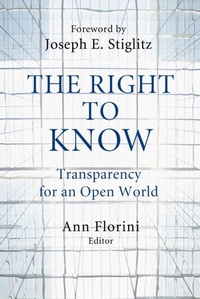
The Right to Know
Transparency for an Open World
1st Edition
Published on 25. September 2015
376 pages
978-0-231-51207-7 (ISBN)
Description

The Right to Know is a timely and compelling consideration of a vital question: What information should governments and other powerful organizations disclose? Excessive secrecy corrodes democracy, facilitates corruption, and undermines good public policymaking, but keeping a lid on military strategies, personal data, and trade secrets is crucial to the protection of the public interest.
Over the past several years, transparency has swept the world. India and South Africa have adopted groundbreaking national freedom of information laws. China is on the verge of promulgating new openness regulations that build on the successful experiments of such major municipalities as Shanghai. From Asia to Africa to Europe to Latin America, countries are struggling to overcome entrenched secrecy and establish effective disclosure policies. More than seventy now have or are developing major disclosure policies or laws. But most of the world's nearly 200 nations do not have coherent disclosure laws; implementation of existing rules often proves difficult; and there is no consensus about what disclosure standards should apply to the increasingly powerful private sector.
As governments and corporations battle with citizens and one another over the growing demand to submit their secrets to public scrutiny, they need new insights into whether, how, and when greater openness can serve the public interest, and how to bring about beneficial forms of greater disclosure. The Right to Know distills the lessons of many nations' often bitter experience and provides careful analysis of transparency's impact on governance, business regulation, environmental protection, and national security. Its powerful lessons make it a critical companion for policymakers, executives, and activists, as well as students and scholars seeking a better understanding of how to make information policy serve the public interest.
Over the past several years, transparency has swept the world. India and South Africa have adopted groundbreaking national freedom of information laws. China is on the verge of promulgating new openness regulations that build on the successful experiments of such major municipalities as Shanghai. From Asia to Africa to Europe to Latin America, countries are struggling to overcome entrenched secrecy and establish effective disclosure policies. More than seventy now have or are developing major disclosure policies or laws. But most of the world's nearly 200 nations do not have coherent disclosure laws; implementation of existing rules often proves difficult; and there is no consensus about what disclosure standards should apply to the increasingly powerful private sector.
As governments and corporations battle with citizens and one another over the growing demand to submit their secrets to public scrutiny, they need new insights into whether, how, and when greater openness can serve the public interest, and how to bring about beneficial forms of greater disclosure. The Right to Know distills the lessons of many nations' often bitter experience and provides careful analysis of transparency's impact on governance, business regulation, environmental protection, and national security. Its powerful lessons make it a critical companion for policymakers, executives, and activists, as well as students and scholars seeking a better understanding of how to make information policy serve the public interest.
All prices
More details
Other editions
Additional editions
Book
05/2007
Columbia University Press
€37.50
Article not available at the moment
Persons
Ann Florini is the founding director of the Centre on Asia and Globalization at the Lee Kuan Yew School of Public Policy, National University of Singapore. She is also a senior fellow at the Brookings Institution in Washington, D.C., where her work explores new approaches to global governance.
Content
Foreword, by Joseph E. Stiglitz
Introduction: The Battle Over Transparency, by Ann Florini
Part 1: National Stories
1. India: Grassroots Initiatives, by Shekhar Singh
2. Toward a More Open China?, by Jamie P. Horsley
3. Open Government in China: Practice and Problems, by Hanhua Zhou
4. Central and Eastern Europe: Starting from Scratch, by Ivan Szekely
5. The Challenging Case of Nigeria, by Ayo Obe
Part 2: Themes
6. Making the Law Work: The Challenges of Implementation, by Laura Neuman and Richard Calland
7. Prizing Open the Profit-Making World, by Richard Calland
8. The Struggle for Openness in the International Financial Institutions, by Thomas Blanton
9. Transparency and Environmental Governance, by Vivek Ramkumar and Elena Petkova
10. Transparency in the Security Sector, by Alasdair Roberts
Conclusion: Whither Transparency?, by Ann Florini
Contributors
Index
Introduction: The Battle Over Transparency, by Ann Florini
Part 1: National Stories
1. India: Grassroots Initiatives, by Shekhar Singh
2. Toward a More Open China?, by Jamie P. Horsley
3. Open Government in China: Practice and Problems, by Hanhua Zhou
4. Central and Eastern Europe: Starting from Scratch, by Ivan Szekely
5. The Challenging Case of Nigeria, by Ayo Obe
Part 2: Themes
6. Making the Law Work: The Challenges of Implementation, by Laura Neuman and Richard Calland
7. Prizing Open the Profit-Making World, by Richard Calland
8. The Struggle for Openness in the International Financial Institutions, by Thomas Blanton
9. Transparency and Environmental Governance, by Vivek Ramkumar and Elena Petkova
10. Transparency in the Security Sector, by Alasdair Roberts
Conclusion: Whither Transparency?, by Ann Florini
Contributors
Index

