

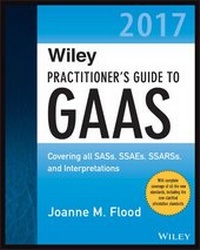
Wiley Practitioner's Guide to GAAS 2017
Covering all SASs, SSAEs, SSARSs, and Interpretations
Published on 14. February 2017
1040 pages
978-1-119-37375-9 (ISBN)
Description

The clearest, easiest-to-use guide to understanding all the clarified standards, including the new attestation standards--fully updated!
This comprehensive guide to understanding Generally Accepted Auditing Standards (GAAS) is not just about auditing. It addresses the toughest part of an accountant's job--identifying, interpreting, and applying the many audit, attest, review, compilation, and preparation standards relevant to a particular engagement.
Wiley Practitioner's Guide to GAAS 2017 offers a clear and accessible distillation of the official language of GAAS, Statements on Standards for Attestation Engagements (SSAEs), and Statements on Standards for Accounting and Review Services (SSARSs)--as well as advice on exactly how to remain fully compliant with each.
Wiley Practitioner's Guide to GAAS 2017 is organized according to the logical arrangement of the clarified standards, presenting each section individually, and explaining how it is related to the engagement process. Guidance is offered on the entire process, in the form of practice notes, checklists, questionnaires, and real-world examples, illustrating how the fundamental requirements of each section are applied.
Other key features include:
* A brief identification of each auditing, SSAE, and SSARS section, with effective dates and tips on how to apply it
* Highlights of new requirements in the clarified attestation standards
* Concise listing and descriptions of each section's specific mandates, including definitions
* Easy-to-read capsule summary of interpretations, plus selected technical alerts
* Helpful techniques for remaining compliant with each standard
New in GAAS 2017:
In 2016, the AICPA's Auditing Standards Board completed a major stage of its clarity project and issued SSAE No. 18. The new guidance is effective for reports dated May 1, 2017. SSAE No. 18 replaces the attestation standards, introducing major new requirements that will change practice. In this transition year, guidance on the extant attestation standards is also included. Wiley Practitioner's Guide to GAAS 2017 is completely updated to reflect all the clarified standards and provide valuable implementation information.
This comprehensive guide to understanding Generally Accepted Auditing Standards (GAAS) is not just about auditing. It addresses the toughest part of an accountant's job--identifying, interpreting, and applying the many audit, attest, review, compilation, and preparation standards relevant to a particular engagement.
Wiley Practitioner's Guide to GAAS 2017 offers a clear and accessible distillation of the official language of GAAS, Statements on Standards for Attestation Engagements (SSAEs), and Statements on Standards for Accounting and Review Services (SSARSs)--as well as advice on exactly how to remain fully compliant with each.
Wiley Practitioner's Guide to GAAS 2017 is organized according to the logical arrangement of the clarified standards, presenting each section individually, and explaining how it is related to the engagement process. Guidance is offered on the entire process, in the form of practice notes, checklists, questionnaires, and real-world examples, illustrating how the fundamental requirements of each section are applied.
Other key features include:
* A brief identification of each auditing, SSAE, and SSARS section, with effective dates and tips on how to apply it
* Highlights of new requirements in the clarified attestation standards
* Concise listing and descriptions of each section's specific mandates, including definitions
* Easy-to-read capsule summary of interpretations, plus selected technical alerts
* Helpful techniques for remaining compliant with each standard
New in GAAS 2017:
In 2016, the AICPA's Auditing Standards Board completed a major stage of its clarity project and issued SSAE No. 18. The new guidance is effective for reports dated May 1, 2017. SSAE No. 18 replaces the attestation standards, introducing major new requirements that will change practice. In this transition year, guidance on the extant attestation standards is also included. Wiley Practitioner's Guide to GAAS 2017 is completely updated to reflect all the clarified standards and provide valuable implementation information.
More details
Other editions
Additional editions
Joanne M. Flood
Wiley Practitioner's Guide to GAAS 2017
Covering all SASs, SSAEs, SSARSs, and Interpretations
Book
04/2017
Wiley
€83.90
Article exhausted; check for reprint
Person
Joanne Flood, MBA, CPA, Rockville Center, NY has accounting experience within both a Big 4 international firm and a small firm. She has worked as a senior manager in the AICPA's Professional Development group. Joanne received her MBA in Accounting Summa Cum Laude from Adelphi University.
While in public accounting, she worked on major clients in retail, manufacturing, and finance and on small business clients in construction, manufacturing, and professional services. At the AICPA, she managed the development and wrote courses in the accounting and auditing product line. She also wrote and produced training materials in a wide variety of media, including print, video, and audio, and pioneered the AICPA's elearning product line.
While in public accounting, she worked on major clients in retail, manufacturing, and finance and on small business clients in construction, manufacturing, and professional services. At the AICPA, she managed the development and wrote courses in the accounting and auditing product line. She also wrote and produced training materials in a wide variety of media, including print, video, and audio, and pioneered the AICPA's elearning product line.
Content
1 - Wiley Practitioner's Guide to GAAS 2017 [Seite 1]
2 - Contents [Seite 7]
3 - Preface [Seite 11]
4 - About the Author [Seite 13]
5 - Organization and Key Changes [Seite 15]
6 - AU-C 200: Overall Objectives of the Independent Auditor and the Conduct of an Audit in Accordance with Generally Accepted Auditing Standards [Seite 17]
6.1 - AU-C Original Pronouncements [Seite 17]
6.2 - Technical Alert [Seite 17]
6.3 - AU-C 200 Definitions of Terms [Seite 17]
6.4 - Objectives of AU-C Section 200 [Seite 20]
6.5 - Requirements [Seite 20]
6.5.1 - Management's Responsibilities [Seite 20]
6.5.2 - Auditor's Responsibilities [Seite 20]
6.5.3 - Ethical Requirements [Seite 21]
6.5.4 - Professional Skepticism and Judgment [Seite 22]
6.6 - Complying With Gaas [Seite 22]
6.6.1 - GAAS and the GAAS Hierarchy [Seite 23]
7 - AU-C 210: Terms of Engagement [Seite 25]
7.1 - AU-C Original Pronouncement [Seite 25]
7.2 - Applicability [Seite 25]
7.3 - AU-C 210 Definitions of Terms [Seite 25]
7.4 - Objectives [Seite 25]
7.5 - Fundamental Requirements [Seite 26]
7.5.1 - Engagement Acceptance [Seite 26]
7.6 - Illustration [Seite 29]
8 - AU-C 220: Quality Control for an Engagement Conducted in Accordance with Generally Accepted Auditing Standards [Seite 31]
8.1 - AU-C Original Pronouncements [Seite 31]
8.2 - Applicability [Seite 31]
8.3 - AU-C 220 Definitions of Terms [Seite 31]
8.4 - Objectives of AU-C Section 220 [Seite 32]
8.5 - Requirements [Seite 33]
8.5.1 - Quality Control Standards [Seite 33]
8.5.2 - System of Quality Control [Seite 33]
8.5.3 - Elements of Quality Control [Seite 33]
8.5.4 - Independence2 [Seite 34]
8.5.5 - Acceptance and Continuance of Client Relationships [Seite 34]
8.5.6 - Assignment of Engagement Teams [Seite 34]
8.5.7 - Engagement Performance [Seite 35]
9 - AU-C 230: Audit Documentation [Seite 37]
9.1 - AU-C Original Pronouncements [Seite 37]
9.2 - AU-C 230 Definitions of Terms [Seite 37]
9.3 - Objectives of AU-C Section 230 [Seite 37]
9.4 - Requirements [Seite 38]
9.4.1 - Requirement for Audit Documentation [Seite 38]
9.4.2 - Form, Content, and Extent of Audit Documentation [Seite 38]
9.4.3 - Ownership and Confidentiality [Seite 40]
9.4.4 - Standardization of Audit Documentation [Seite 40]
9.4.5 - Preparation of Audit Documentation [Seite 40]
9.4.6 - Quality of Audit Documentation [Seite 42]
9.4.7 - Audit Documentation Deficiencies [Seite 42]
9.4.8 - Documentation Requirements in Other Sections [Seite 42]
9.5 - Interpretations [Seite 43]
9.6 - AU-C Illustrations [Seite 43]
10 - AU-C 240: Consideration of Fraud in a Financial Statement Audit [Seite 47]
10.1 - AU-C Original Pronouncements [Seite 47]
10.2 - AU-C 240 Definitions of Terms [Seite 47]
10.3 - Objectives of AU-C Section 240 [Seite 47]
10.4 - Requirements [Seite 47]
10.4.1 - Description and Characteristics of Fraud [Seite 47]
10.4.2 - Basic Requirement [Seite 48]
10.4.3 - Professional Skepticism [Seite 48]
10.4.4 - Engagement Team Discussion about Fraud (Brainstorming) [Seite 48]
10.4.5 - Obtaining Information Needed to Identify Fraud Risks [Seite 49]
10.4.6 - Identifying Fraud Risks [Seite 52]
10.4.7 - Assessing Identified Risks [Seite 53]
10.4.8 - Responding to the Results of the Assessment [Seite 53]
10.4.9 - Evaluating Audit Evidence [Seite 58]
10.4.10 - Communication about Possible Fraud to Management and Those Charged with Governance [Seite 60]
10.4.11 - Documentation [Seite 63]
10.4.12 - Antifraud Programs and Controls [Seite 63]
10.5 - AU-C Illustrations [Seite 64]
11 - AU-C 250: Consideration of Laws and Regulations in an Audit of Financial Statements [Seite 75]
11.1 - AU-C Original Pronouncement [Seite 75]
11.2 - AU-C 250 Definition of Term [Seite 75]
11.3 - Objectives of AU Section 250 [Seite 75]
11.4 - Requirements [Seite 76]
11.4.1 - Auditor's Responsibilities [Seite 76]
11.4.2 - Categories of Laws and Regulations [Seite 76]
11.4.3 - Audit Procedures [Seite 76]
11.4.4 - Response to Identified or Suspected Noncompliance with Laws and Regulations [Seite 77]
11.4.5 - Evaluation of Detected or Suspected Noncompliance with Laws and Regulations [Seite 78]
11.4.6 - Reporting Identified or Suspected Noncompliance [Seite 78]
11.4.7 - Documentation [Seite 79]
12 - AU-C 260: The Auditor's Communication with Those Charged with Governance [Seite 81]
12.1 - AU-C Original Pronouncements [Seite 81]
12.2 - AU-C Definitions of Terms [Seite 81]
12.3 - Objectives of AU-C Section 260 [Seite 81]
12.4 - Requirements [Seite 82]
12.4.1 - Auditor's General Responsibility [Seite 82]
12.4.2 - Those Charged with Governance [Seite 82]
12.4.3 - Matters to Be Communicated [Seite 82]
12.4.4 - Communication Process [Seite 84]
12.4.5 - Qualitative Aspects of Accounting Practices [Seite 85]
12.4.6 - Other AU-C Sections [Seite 86]
13 - AU-C 265: Communicating Internal Control Related Matters Identified in an Audit [Seite 87]
13.1 - AU-C Original Pronouncements [Seite 87]
13.2 - Technical Alert [Seite 87]
13.3 - AU-C Definitions of Terms [Seite 87]
13.4 - Objectives [Seite 88]
13.5 - Requirements [Seite 88]
13.5.1 - Determining Whether Deficiencies in Internal Control Have Been Identified [Seite 88]
13.5.2 - Determination of Deficiency Severity [Seite 88]
13.5.3 - Risk Factors [Seite 88]
13.5.4 - Indicators of Material Weakness [Seite 90]
13.5.5 - Communication of Internal Control Related Matters [Seite 90]
13.6 - Interpretations [Seite 91]
13.7 - AU-C 265 Illustrations [Seite 92]
14 - AU-C 300: Planning an Audit [Seite 97]
14.1 - AU-C Original Pronouncements [Seite 97]
14.2 - Objective of AU-C Section 300 [Seite 97]
14.3 - Requirements [Seite 97]
14.3.1 - Preliminary Engagement Activities [Seite 97]
14.3.2 - Matters to Consider in Developing an Audit Strategy [Seite 99]
15 - AU-C 315: Understanding the Entity and Its Environment and Assessing the Risks of Material Misstatement [Seite 103]
15.1 - AU-C Original Pronouncements [Seite 103]
15.2 - Technical Alert [Seite 103]
15.3 - Definitions of Terms [Seite 103]
15.4 - Objectives of AU-C Section 315 [Seite 104]
15.5 - Overview [Seite 104]
15.6 - Requirements [Seite 105]
15.6.1 - Risk Assessment Procedures [Seite 105]
15.6.2 - Understanding the Entity and Its Environment, Including Internal Control [Seite 107]
15.6.3 - Assessing the Risk of Material Misstatement [Seite 112]
15.6.4 - Documentation [Seite 114]
15.6.5 - Examples of Matters to Consider When Obtaining an Understanding of the Entity and Its Environment [Seite 115]
15.6.6 - The Economy [Seite 115]
15.6.7 - The Client's Industry [Seite 115]
15.6.8 - The Client's Business: New Client [Seite 116]
15.6.9 - The Client's Business: Continuing Client [Seite 119]
15.6.10 - Using a Risk-Based, Top-Down Approach to Evaluate Internal Control [Seite 120]
15.6.11 - Effect of IT on Internal Control [Seite 122]
15.7 - Illustrations [Seite 125]
16 - AU-C 320: Materiality in Planning and Performing an Audit [Seite 131]
16.1 - AU-C Pronouncement [Seite 131]
16.2 - Definition of Term [Seite 131]
16.3 - Objective of AU-C Section 320 [Seite 131]
16.4 - Overview [Seite 131]
16.4.1 - Materiality and Audit Risk [Seite 132]
16.5 - Requirements [Seite 132]
16.5.1 - Determining Materiality and Performance Materiality [Seite 132]
16.5.1.1 - Determining the Base [Seite 133]
16.5.1.2 - Nature of a Materiality Benchmark [Seite 134]
16.5.2 - Revision of Materiality [Seite 134]
16.5.3 - Documentation Requirements [Seite 134]
17 - AU-C 330: Performing Audit Procedures in Response to Assessed Risks and Evaluating the Audit Evidence Obtained [Seite 135]
17.1 - AU-C Original Pronouncement [Seite 135]
17.2 - Definitions of Terms [Seite 135]
17.3 - Objective of AU-C Section 330 [Seite 135]
17.4 - Overview [Seite 135]
17.5 - Requirements [Seite 136]
17.5.1 - Overall Responses [Seite 136]
17.5.2 - Designing the Nature, Timing, and Extent of Further Audit Procedures [Seite 137]
17.5.3 - Tests of Controls [Seite 138]
17.5.4 - Substantive Procedures [Seite 140]
17.5.5 - Evaluating the Sufficiency and Appropriateness of the Audit Evidence Obtained [Seite 141]
17.5.6 - Documentation [Seite 142]
17.5.7 - Testing at Interim Dates [Seite 142]
17.5.8 - Designing Audit Procedures [Seite 144]
17.5.9 - Tests of Internal Control Operating Effectiveness [Seite 145]
17.5.10 - Types of Tests [Seite 150]
17.5.11 - Examples of Evidential Matter That May Support the Specific Assertions Embodied in Financial Statements [Seite 156]
18 - AU-C 402: Audit Considerations Relating to an Entity Using a Service Organization [Seite 165]
18.1 - AU-C Original Pronouncements [Seite 165]
18.2 - Technical Alert [Seite 165]
18.3 - Definitions of Terms [Seite 165]
18.4 - Objectives of AU-C Section 402 [Seite 166]
18.5 - Overview [Seite 167]
18.6 - Scope [Seite 167]
18.7 - Requirements [Seite 168]
18.7.1 - Types of Service Auditor's Reports [Seite 169]
18.7.2 - Reports on Controls Placed in Operation (Type 1) [Seite 170]
18.7.3 - Report on Controls Placed in Operation and Tests of Operating Effectiveness (Type 2) [Seite 170]
18.7.4 - Considerations in Using a Service Auditor's Report [Seite 170]
19 - AU-C 450: Evaluation of Misstatements Identified during the Audit [Seite 175]
19.1 - AU-C Original Pronouncement [Seite 175]
19.2 - Definitions of Terms [Seite 175]
19.3 - Objectives of AU-C Section 450 [Seite 175]
19.3.1 - The Nature and Causes of Misstatements [Seite 175]
19.4 - Requirements [Seite 176]
19.4.1 - Accumulation of Misstatements [Seite 176]
19.4.2 - Communication and Correction of Misstatements to Management [Seite 176]
19.4.3 - Evaluating the Effect of Uncorrected Misstatements [Seite 176]
19.4.4 - The Qualitative Characteristics of Misstatements [Seite 177]
19.4.5 - Prior Period Misstatements [Seite 177]
19.4.6 - Misstatement Worksheet [Seite 178]
19.4.7 - Documentation Requirements [Seite 178]
20 - AU-C 500: Audit Evidence [Seite 179]
20.1 - AU-C Original Pronouncements [Seite 179]
20.2 - Definitions of Terms [Seite 179]
20.3 - Objective [Seite 179]
20.4 - Scope [Seite 179]
20.5 - Requirements [Seite 180]
20.5.1 - General Guides to Appropriateness of Evidence [Seite 180]
20.5.2 - Using a Management's Specialist [Seite 180]
20.5.3 - General Guides to Sufficiency of Evidence [Seite 180]
20.5.4 - Audit Procedures for Obtaining Audit Evidence [Seite 180]
20.6 - Interpretations [Seite 181]
21 - AU-C 501: Audit Evidence-Specific Considerations for Selected Items [Seite 183]
21.1 - AU-C Original Pronouncement [Seite 183]
21.2 - Definitions of Terms [Seite 183]
21.3 - Objectives of Au Section 501 [Seite 183]
21.4 - Requirements-Investments in Securities and Derivative Instruments [Seite 183]
21.4.1 - Required Risk Assessment in Planning [Seite 184]
21.4.2 - Assessing Inherent Risk for an Assertion about a Derivative Instrument or a Security [Seite 184]
21.4.3 - Control Risk Assessment [Seite 185]
21.4.4 - The Effect of a Service Organization on Audit Approaches and Procedures for Securities and Derivative Instruments [Seite 186]
21.4.5 - Designing Auditing Procedures [Seite 188]
21.4.6 - Importance of Identifying and Testing Controls [Seite 188]
21.4.7 - Designing Substantive Procedures Based on Risk Assessment [Seite 189]
21.4.8 - Completeness Assertion for Derivatives [Seite 189]
21.4.9 - Valuation [Seite 189]
21.4.10 - Additional Considerations Related to Gathering Evidential Matter about Hedging Activities [Seite 192]
21.4.11 - Special Skill or Knowledge Might Be Needed to Plan or Perform Auditing Procedures Related to Derivatives or Securities [Seite 193]
21.5 - Illustrations-Investments in Securities and Derivative Instruments [Seite 194]
21.6 - Requirements-Inventory Existence and Condition [Seite 196]
21.6.1 - Timing and Extent of Inventory Observation [Seite 196]
21.6.2 - Inventory Held by a Third Party [Seite 197]
21.6.3 - Steps in the Observation of Inventory [Seite 197]
21.6.4 - Planning the Physical Inventory [Seite 198]
21.6.5 - Taking the Physical Inventory [Seite 199]
21.6.6 - Outside Inventory-Taking Firm [Seite 201]
21.6.7 - Inventory Observation Checklist [Seite 201]
21.7 - AU-C Illustrations-Inventory Observation [Seite 201]
21.8 - Requirements-Litigation, Claims, and Assessments Involving the Entity [Seite 206]
21.8.1 - Accounting Considerations [Seite 206]
21.8.2 - Audit Procedures other than Inquiry of Lawyers [Seite 207]
21.8.3 - Inquiry of Client's Lawyer [Seite 208]
21.8.4 - Evaluation of Lawyer's Response [Seite 209]
21.8.5 - Refusal of Attorney to Respond [Seite 210]
21.8.6 - Lawyer on Board of Directors [Seite 211]
21.8.7 - Litigation Not Investigated by Lawyer [Seite 211]
21.8.8 - Litigation with Insurance Company [Seite 211]
21.8.9 - Reliance on House or Inside Counsel [Seite 212]
21.8.10 - Review of Interim Financial Information [Seite 212]
21.9 - AU-C Illustration-Litigation, Claims, and Assessments [Seite 213]
21.10 - Requirements-Segment Reporting [Seite 215]
22 - AU-C 505: External Confirmations [Seite 217]
22.1 - AU-C Original Pronouncement [Seite 217]
22.2 - Definitions of Terms [Seite 217]
22.3 - Objective of Au-C Section 505 [Seite 217]
22.4 - Requirements [Seite 217]
22.4.1 - Related AU-C 330 Requirements [Seite 217]
22.4.2 - Results of Confirmation Procedures [Seite 218]
22.4.3 - Management's Refusal to Allow Confirmations [Seite 218]
22.4.4 - Designing the Confirmation Request [Seite 219]
22.4.5 - The Respondent [Seite 220]
22.4.6 - Timing of Confirmation Request [Seite 220]
22.4.7 - Confirming Prior to Year-End [Seite 220]
22.4.8 - Use of Negative Form of Confirmation Request [Seite 220]
22.4.9 - Steps in Confirmation of Accounts Receivable [Seite 221]
22.4.10 - Control of Confirmations [Seite 223]
22.4.11 - Nonresponse to Confirmation Requests [Seite 224]
22.4.12 - Nondelivery of Confirmation Request [Seite 224]
22.4.13 - Confirmation Responses Not Expected [Seite 225]
22.4.14 - Evaluating the Results [Seite 226]
22.4.15 - Confirmation Checklist [Seite 226]
22.5 - AU-C Illustrations [Seite 226]
23 - AU-C 510: Opening Balances-Initial Audit Engagements, Including Reaudit Engagements [Seite 233]
23.1 - AU-C Original Pronouncement [Seite 233]
23.2 - Applicability [Seite 233]
23.3 - Definitions of Terms [Seite 233]
23.4 - Objectives of AU-C Section 510 [Seite 234]
23.5 - Requirements [Seite 234]
23.6 - Illustrations [Seite 235]
24 - AU-C 520: Analytical Procedures [Seite 241]
24.1 - AU-C Original Pronouncement [Seite 241]
24.2 - AU-C Definition of Term [Seite 241]
24.3 - Objectives of AU-C Section 520 [Seite 241]
24.4 - Overview [Seite 241]
24.4.1 - How to Use Analytical Procedures [Seite 241]
24.5 - Requirements [Seite 242]
24.5.1 - Analytical Procedures [Seite 242]
24.5.2 - Substantive Tests [Seite 248]
24.5.3 - Overall Review [Seite 249]
24.5.4 - Documentation [Seite 250]
24.5.5 - Permanent File for Analytical Procedures [Seite 251]
24.6 - AU-C Illustrations [Seite 251]
25 - AU-C 530: Audit Sampling [Seite 255]
25.1 - AU-C Original Pronouncement [Seite 255]
25.2 - AU-C Definitions of Terms [Seite 255]
25.3 - Objectives of AU-C Section 530 [Seite 256]
25.4 - Overview [Seite 256]
25.5 - Requirements [Seite 256]
25.5.1 - Examined 100% [Seite 257]
25.5.2 - Sample Selection [Seite 257]
25.5.3 - Stratification [Seite 257]
25.5.4 - Unexamined Sample Items [Seite 257]
25.5.5 - Sample Size: Substantive Test [Seite 257]
25.5.6 - Sample Size: Test of Controls [Seite 258]
25.5.7 - Projection of Misstatements [Seite 258]
25.5.8 - Aggregation of Misstatements [Seite 258]
25.5.9 - Qualitative Aspects [Seite 258]
25.5.10 - Relating Balance Sheet and Income Statement Sampling [Seite 258]
25.6 - Nonsampling Techniques [Seite 258]
25.6.1 - Distinguishing Sampling from Other Audit Tests [Seite 258]
25.7 - Nonstatistical Audit Sampling Techniques [Seite 259]
25.7.1 - Introduction [Seite 259]
25.7.2 - Methods of Sample Selection [Seite 260]
25.7.3 - Tests of Controls [Seite 261]
25.7.4 - Substantive Tests [Seite 263]
25.8 - Statistical Audit Sampling Techniques [Seite 266]
25.8.1 - Introduction [Seite 266]
25.8.2 - Calculating Sample Size [Seite 266]
25.8.3 - Risk and Confidence in Substantive Tests of Details [Seite 269]
25.8.4 - Statistical Evaluation of a Sample in Substantive Tests of Details [Seite 270]
25.8.5 - Calculating Confidence Limits [Seite 270]
25.8.6 - Equal-Probability Sampling: Attributes Evaluation [Seite 271]
25.8.7 - Dollar Value Evaluation [Seite 271]
25.8.8 - Equal-Probability Sampling: Variables Evaluation [Seite 272]
26 - AU-C 540: Auditing Accounting Estimates, Including Fair Value Accounting Estimates and Related Disclosures [Seite 279]
26.1 - AU-C Original Pronouncement [Seite 279]
26.2 - Definitions of Terms [Seite 279]
26.3 - Objective of AU-C Section 540 [Seite 279]
26.4 - Overview [Seite 280]
26.5 - Requirements [Seite 280]
26.5.1 - Risk Assessment Procedures [Seite 280]
26.5.2 - Engaging a Specialist [Seite 281]
26.5.3 - Management's Intent and Ability [Seite 281]
26.5.4 - Use of Collateral in Evaluating Fair Value [Seite 282]
26.5.5 - Auditor's Responsibility [Seite 282]
26.5.6 - Identifying Circumstances That Require Material Accounting Estimates [Seite 282]
26.5.7 - Evaluating Reasonableness [Seite 283]
26.5.8 - Testing the Entity's Estimates and Disclosures [Seite 285]
26.6 - Illustration [Seite 287]
26.6.1 - Responding to the Assessed Risks of Material Misstatement [Seite 288]
26.6.2 - Disclosures [Seite 289]
26.6.3 - Written Representations [Seite 289]
26.6.4 - Communication with Audit Committees [Seite 289]
26.6.5 - Documentation [Seite 290]
26.6.6 - Management's Responsibilities [Seite 290]
27 - AU-C 550: Related Parties [Seite 291]
27.1 - AU-C Original Pronouncements [Seite 291]
27.2 - Definitions of Terms [Seite 291]
27.3 - Objectives of AU Section 550 [Seite 291]
27.4 - Requirements [Seite 292]
27.4.1 - Accounting Considerations [Seite 292]
27.4.2 - Audit Procedures [Seite 293]
27.4.3 - Written Representations [Seite 298]
27.5 - Illustration [Seite 299]
28 - AU-C 560: Subsequent Events and Subsequently Discovered Facts [Seite 303]
28.1 - AU-C Original Pronouncement [Seite 303]
28.2 - Definitions of Terms [Seite 303]
28.3 - Objectives of AU-C Section 560 [Seite 303]
28.4 - Overview [Seite 304]
28.5 - Requirements [Seite 304]
28.5.1 - Subsequent Events [Seite 304]
28.5.2 - Accounting Considerations [Seite 305]
28.5.3 - Application Techniques [Seite 305]
28.5.4 - Subsequently Discovered Facts Known to the Auditor before the Report Release Date [Seite 307]
28.5.5 - Subsequently Discovered Facts Known to the Auditor after the Report Release Date [Seite 308]
28.5.6 - Reissuance of Predecessor Auditor's Report [Seite 311]
28.6 - Illustration [Seite 312]
29 - AU-C 570: The Auditor's Consideration of an Entity's Ability to Continue as a Going Concern [Seite 317]
29.1 - AU-C Original Pronouncement [Seite 317]
29.2 - AU-C Definition of Term [Seite 317]
29.3 - Objectives of AU-C Section 570 [Seite 317]
29.4 - Requirements [Seite 317]
29.4.1 - Auditor's Responsibility [Seite 317]
29.4.2 - Procedures Required [Seite 318]
29.4.3 - Specific Procedures [Seite 318]
29.4.4 - Indications of Going Concern Problems [Seite 319]
29.4.5 - Consideration of Management's Plans [Seite 319]
29.4.6 - Plans to Dispose of Assets [Seite 320]
29.4.7 - Plans to Borrow Money or Restructure Debt [Seite 321]
29.4.8 - Plans to Reduce or Delay Expenditures [Seite 322]
29.4.9 - Plans to Increase Ownership Equity [Seite 322]
29.4.10 - Consideration of Management Forecasts [Seite 322]
29.4.11 - Prospective Financial Information [Seite 324]
29.4.12 - Auditor Conclusions-Substantial Doubt Exists [Seite 324]
29.4.13 - Effects on the Auditor's Report [Seite 325]
29.4.14 - Auditor Conclusions-Substantial Doubt Has Been Alleviated [Seite 325]
29.4.15 - Inadequate Disclosure [Seite 326]
29.4.16 - Eliminating a Going Concern Explanatory Paragraph from a Reissued Report [Seite 326]
29.4.17 - Documentation Requirements [Seite 326]
29.5 - Illustration [Seite 327]
29.6 - Interpretations [Seite 330]
29.6.1 - Interpretation No. 1, ``Definition of Substantial Doubt about an Entity's Ability to Continue as a Going Concern´´ (Issued January 2015) [Seite 331]
29.6.2 - Interpretation No. 2, ``Definition of Reasonable Period of Time´´ (Issued January 2014 [Seite 331]
29.6.3 - Interpretation No. 3, ``Interim Financial Information´´ (Issued January 2015) [Seite 331]
29.6.4 - Interpretation No. 4, ``Consideration of Financial Statements Effects´´ (Issued January 2015) [Seite 332]
30 - AU-C 580: Written Representations [Seite 333]
30.1 - AU-C Original Pronouncement [Seite 333]
30.2 - AU-C Definition of Term [Seite 333]
30.3 - Objectives of AU-C Section 580 [Seite 333]
30.4 - Requirements [Seite 333]
30.4.1 - Reliance on Management Representations [Seite 333]
30.4.2 - Obtaining Written Representations [Seite 334]
30.4.3 - Tailoring the Representation Letter [Seite 335]
30.4.4 - Materiality Considerations [Seite 335]
30.4.5 - Addressing and Dating the Letter [Seite 336]
30.4.6 - Signing the Letter [Seite 336]
30.4.7 - Doubt about Reliability of Written Representation [Seite 336]
30.4.8 - Requested Representation Letter Not Provided [Seite 336]
30.4.9 - Representations Required by Other AU-C Sections [Seite 336]
30.4.10 - Auditor's Relationship with a Small or Nonpublic Client [Seite 337]
30.4.11 - Explicitly Addressing Materiality in the Written Representations [Seite 338]
30.5 - Au-C 580 Illustrations [Seite 338]
31 - AU-C 585: Consideration of Omitted Procedures after the Report Release Date [Seite 347]
31.1 - AU-C Original Pronouncement [Seite 347]
31.2 - Definition of Term [Seite 347]
31.3 - Overview [Seite 347]
31.3.1 - Professional Disagreements [Seite 347]
31.3.2 - No Substitute for Omitted Procedures [Seite 347]
31.3.3 - Distinction from Section 560 [Seite 347]
31.4 - Objectives of AU Section 585 [Seite 348]
31.5 - Scope [Seite 348]
31.6 - Requirements [Seite 348]
31.6.1 - Importance of Omitted Procedures [Seite 348]
31.6.2 - Applying Omitted Procedures [Seite 349]
31.6.3 - Inability to Apply Omitted Procedures [Seite 349]
31.6.4 - Determining Importance of Omitted Procedures [Seite 350]
31.7 - Illustration [Seite 351]
32 - AU-C 600: Special Considerations-Audits of Group Financial Statements (Including the Work of Component Auditors) [Seite 353]
32.1 - AU-C Original Pronouncements [Seite 353]
32.2 - Technical Alert [Seite 353]
32.3 - Introduction [Seite 353]
32.4 - AU-C 600 Definitions of Terms [Seite 354]
32.5 - Objectives of AU-C Section 600 [Seite 355]
32.6 - Overview [Seite 355]
32.7 - Requirements [Seite 356]
32.7.1 - Identifying Components [Seite 357]
32.8 - Interpretations [Seite 359]
32.8.1 - Interpretation No. 1, ``Auditor of Participating Employer in a Governmental Pension Plan,´´ of AU-C Section 600, Special Considerations-Audits of Group Financial Statements (Including the Work of Component Auditors) (Issued April 2014) [Seite 360]
32.9 - Illustrations [Seite 360]
32.9.1 - Appendix A. Understanding the Group, Its Components, and Their Environments-Examples of Matters about Which the Group Engagement Team Obtains an Understanding [Seite 361]
32.9.2 - Appendix B. Examples of Conditions or Events That May Indicate Risks of Material Misstatement of the Group Financial Statements [Seite 363]
32.9.3 - Appendix C. Required and Additional Matters Included in the Group Engagement Team's Letter of Instruction [Seite 363]
32.9.4 - Exhibit A. Illustrations of Auditor's Reports on Group Financial Statements [Seite 365]
32.9.5 - Exhibit B. Illustrative Component Auditor's Confirmation Letter [Seite 371]
32.9.6 - Exhibit C. Sources of Information [Seite 372]
33 - AU-C 610: Using the Work of Internal Auditors [Seite 373]
33.1 - AU-C Original Pronouncement [Seite 373]
33.2 - Objectives of AU-C Section 610 [Seite 373]
33.3 - Applicability of AU-C Section 610 [Seite 373]
33.4 - Definitions of Terms [Seite 374]
33.5 - Overview [Seite 374]
33.5.1 - Section 315 and Understanding Internal Control [Seite 374]
33.5.2 - Responsibility of the External Auditor [Seite 374]
33.5.3 - Uses of the Internal Audit Function [Seite 376]
33.6 - Requirements [Seite 376]
33.6.1 - Effect of Use of Internal Auditors' Work on the Audit [Seite 376]
33.6.2 - Determining Whether Internal Audit Can Be Used to Obtain Evidence [Seite 376]
33.6.3 - Deciding to Use the Internal Audit Function [Seite 377]
33.6.4 - Procedures When Using the Internal Audit Function [Seite 378]
33.6.5 - Determining Whether Internal Audit Can Be Used to Provide Direct Assistance [Seite 378]
33.6.6 - Evaluating and Testing Effectiveness of Internal Auditors' Work [Seite 379]
33.6.7 - Documentation [Seite 380]
33.7 - Illustrations [Seite 381]
34 - AU-C 620: Using the Work of an Auditor's Specialist [Seite 387]
34.1 - AU-C Original Pronouncement [Seite 387]
34.2 - AU-C Definitions of Terms [Seite 387]
34.3 - Objectives of AU-C Section 620 [Seite 387]
34.4 - Requirements [Seite 387]
34.4.1 - Qualifications of a Specialist [Seite 387]
34.4.2 - Agreement with the Specialist [Seite 388]
34.4.3 - Work of a Specialist [Seite 388]
34.4.4 - Relationship to Client [Seite 388]
34.4.5 - Evaluating Findings [Seite 388]
34.4.6 - Effect on Audit Report [Seite 389]
34.4.7 - Report Reference to Specialist [Seite 389]
34.4.8 - Examples of Use of a Specialist [Seite 389]
34.4.9 - Specialist Related to Client [Seite 389]
34.4.10 - Specialist Employed by CPA Firm [Seite 390]
34.4.11 - Tests of Data Used by the Specialist [Seite 390]
34.4.12 - Need to Refer to Audit Guides [Seite 391]
34.5 - AU-C Interpretations [Seite 391]
34.5.1 - The Use of Legal Interpretations as Audit Evidence to Support Management's Assertion That a Transfer of Financial Assets Has Met the Isolation Criterion in Paragraphs 7-14 of Financial Accounting Standards Board Codification 860-10-40 (December 2001) [Seite 391]
34.6 - Illustrations [Seite 394]
35 - AU-C 700: Forming an Opinion and Reporting on Financial Statements [Seite 397]
35.1 - AU-C Original Pronouncement [Seite 397]
35.2 - Technical Alert [Seite 397]
35.3 - AU-C Definitions of Terms [Seite 397]
35.4 - Objectives of AU-C Section 700 [Seite 398]
35.5 - Requirements: Forming an Opinion [Seite 398]
35.6 - Requirements: Auditor's Standard Report [Seite 399]
35.6.1 - Components of Auditor's Standard Report [Seite 399]
35.6.2 - Addressee [Seite 400]
35.7 - Requirements: Reports on Comparative Financial Statements [Seite 401]
35.7.1 - General [Seite 401]
35.7.2 - Change of Opinion [Seite 401]
35.7.3 - Reissuance of Predecessor Auditor's Report [Seite 401]
35.7.4 - Predecessor Auditor's Report Not Presented [Seite 402]
35.8 - Interpretations [Seite 403]
35.8.1 - Interpretation No. 1, ``Reporting on Financial Statements Prepared on a Liquidation Basis of Accounting´´ (Issued December 1984 [Seite 403]
35.8.2 - Interpretation No. 2, ``Sustainability Financial Statements under Federal Financial Accounting Standards-Auditor Reporting´´ (Issued October 2015) [Seite 403]
35.9 - AU-C 700 Illustrations (Source: AU-C 700.58) [Seite 403]
36 - AU-C 705: Modifications to the Opinion in the Independent Auditor's Report [Seite 411]
36.1 - AU-C Original Pronouncements [Seite 411]
36.2 - AU-C Definitions of Terms [Seite 411]
36.3 - Objective of AU-C Section 705 [Seite 411]
36.4 - Requirements [Seite 412]
36.4.1 - Types of Modified Opinions [Seite 412]
36.4.2 - Modified Opinion Format [Seite 412]
36.4.3 - Disclaimer of Opinion [Seite 413]
36.4.4 - Inability to Obtain Sufficient Appropriate Audit Evidence [Seite 413]
36.4.5 - Adverse Opinions [Seite 415]
36.4.6 - Departure from the Applicable Financial Reporting Framework [Seite 415]
36.5 - AU-C 705 Illustrations (Source: AU-C 705.A32) [Seite 416]
37 - AU-C 706: Emphasis-of-Matter Paragraphs and Other-Matter Paragraphs in the Independent Auditor's Report [Seite 429]
37.1 - AU-C Original Pronouncement [Seite 429]
37.2 - AU-C Definitions of Terms [Seite 429]
37.3 - Objectives of AU-C Section 706.04 [Seite 429]
37.4 - Requirements [Seite 430]
37.4.1 - Emphasis-of-Matter and Other-Matter Paragraphs [Seite 430]
37.4.2 - Emphasis-of-Matter Paragraph [Seite 430]
37.4.3 - Other Matters in the Auditor's Report [Seite 431]
37.4.4 - Communication [Seite 431]
37.5 - AU-C 706 Illustrations [Seite 431]
38 - AU-C 708: Consistency of Financial Statements [Seite 437]
38.1 - AU-C Original Pronouncement [Seite 437]
38.2 - AU-C Definition of Term [Seite 437]
38.3 - Objectives of AU-C Section 708 [Seite 437]
38.4 - Requirements [Seite 437]
38.4.1 - Consistency Implication of Auditor's Standard Report [Seite 437]
38.4.2 - Periods to Which Consistency Standard Relates [Seite 438]
38.4.3 - Changes Affecting Consistency [Seite 438]
38.4.4 - Changes Not Affecting Consistency [Seite 439]
38.4.5 - First-Year Audits [Seite 439]
39 - AU-C 720: Other Information in Documents Containing Audited Financial Statements [Seite 441]
39.1 - AU-C Original Pronouncements [Seite 441]
39.2 - AU-C Effective Date and Summary of Changes [Seite 441]
39.3 - AU-C Definitions of Terms [Seite 441]
39.4 - Objective of AU-C Section 720 [Seite 441]
39.5 - Requirements [Seite 442]
39.6 - Illustration [Seite 443]
40 - AU-C 725: Supplementary Information in Relation to Financial Statements as a Whole [Seite 445]
40.1 - AU-C Original Pronouncements [Seite 445]
40.2 - AU-C Definition of Term [Seite 445]
40.3 - Objective of AU-C Section 725 [Seite 445]
40.4 - Requirements [Seite 445]
40.4.1 - Opinion on Supplementary Information [Seite 447]
40.5 - Interpretation [Seite 447]
40.5.1 - Supplementary Information in Relation to the Financial Statements as a Whole: Auditing Interpretations of Section 725 (Issued July 2011 [Seite 447]
40.6 - AU-C 725 Illustrations [Seite 448]
41 - AU-C 730: Required Supplementary Information [Seite 451]
41.1 - AU-C Original Pronouncements [Seite 451]
41.2 - AU-C Definitions of Terms [Seite 451]
41.3 - Objectives of AU-C Section 730 [Seite 452]
41.4 - Requirements [Seite 452]
41.4.1 - Procedures [Seite 452]
41.4.2 - Coordination with Other Audit Areas [Seite 452]
41.4.3 - Reporting on Supplementary Information [Seite 453]
41.5 - AU-C 730 Illustrations [Seite 454]
42 - AU-C 800: Special Considerations-Audits of Financial Statements Prepared in Accordance with Special Purpose Frameworks [Seite 457]
42.1 - AU-C Original Pronouncements [Seite 457]
42.2 - AU-C Definitions of Terms [Seite 457]
42.3 - Objectives of AU-C Section 800 [Seite 458]
42.4 - Scope [Seite 458]
42.5 - Requirements [Seite 458]
42.5.1 - Precondition for an Audit [Seite 458]
42.5.2 - Components of Auditor's Standard Report [Seite 458]
42.6 - AU-C 800 Illustrations (Source: AU-C 800.A36) [Seite 459]
43 - AU-C 805: Special Considerations-Audits of Single Financial Statements and Specific Elements, Accounts, or Items of a Financial Statement [Seite 467]
43.1 - AU-C Original Pronouncement [Seite 467]
43.2 - AU-C Definitions of Terms [Seite 467]
43.3 - Objectives of AU-C Section 805 [Seite 467]
43.4 - Scope [Seite 468]
43.5 - Requirements [Seite 468]
43.5.1 - Examples and Other Services [Seite 468]
43.5.2 - Application of GAAS [Seite 468]
43.5.3 - Financial Reporting Framework [Seite 468]
43.5.4 - Scope of Audit and Level of Materiality [Seite 468]
43.5.5 - The Auditor's Report [Seite 469]
43.6 - Interpretation [Seite 470]
43.6.1 - Special Considerations-Audits of Single Financial Statements and Specific Elements, Accounts, or Items of a Financial Statement: Auditing Interpretations of Section 805 [Seite 470]
43.7 - Illustrations of Auditor's Reports on a Single Financial Statement and a Specific Element of a Financial Statement (Source: Au-C 805.25) [Seite 470]
44 - AU-C 806: Reporting on Compliance with Aspects of Contractual Agreements or Regulatory Requirements in Connection with Audited Financial Statements [Seite 479]
44.1 - AU-C Original Pronouncements [Seite 479]
44.2 - AU-C Definitions of Terms [Seite 479]
44.3 - Objective of AU-C Section 806 [Seite 479]
44.4 - Scope [Seite 479]
44.5 - Requirements [Seite 480]
44.5.1 - Agreements Requiring Compliance Reports [Seite 480]
44.5.2 - Request for Assurance [Seite 480]
44.5.3 - Separate Auditor's Report [Seite 480]
44.5.4 - Assurance Given in Auditor's Report on the Financial Statements [Seite 481]
44.6 - AU-C 806 Illustrations (Source: AU-C 806.A8) [Seite 481]
45 - AU-C 810: Engagements to Report on Summary Financial Statements [Seite 487]
45.1 - AU-C Original Pronouncement [Seite 487]
45.2 - Definitions of Terms [Seite 487]
45.3 - Objectives of Au-U Section 810 [Seite 487]
45.4 - Scope [Seite 487]
45.5 - Requirements [Seite 488]
45.5.1 - Engagement Acceptance [Seite 488]
45.5.2 - Procedures [Seite 488]
45.6 - AU-C 810 Illustrations (Source: AU-C 810.A22) [Seite 490]
46 - AU-C 905: Alert That Restricts the Use of the Auditor's Written Communication [Seite 497]
46.1 - AU-C Original Pronouncement [Seite 497]
46.2 - AU-C Definition of Term [Seite 497]
46.3 - Objectives of AU-C Section 905 [Seite 497]
46.4 - Requirements [Seite 497]
46.4.1 - Reports Required to Be Restricted [Seite 497]
46.4.2 - Required Restricted-Use Report Language [Seite 498]
46.4.3 - Adding Other Specified Parties [Seite 498]
46.4.4 - Limiting Report Distribution [Seite 498]
46.4.5 - Inclusion of a Separate Restricted-Use Communication and a Separate General-Use Communication in the Same Document [Seite 498]
46.4.6 - Combined Communication Covering Both Restricted-Use and General-Use Subject Matter or Presentations [Seite 499]
46.5 - AU-C 905 Illustrations [Seite 499]
47 - AU-C 910: Financial Statements Prepared in Accordance with a Financial Reporting Framework Generally Accepted in Another Country [Seite 503]
47.1 - AU-C Original Pronouncement [Seite 503]
47.2 - Technical Alert [Seite 503]
47.3 - Au-C Definitions of Terms [Seite 503]
47.4 - Objectives of AU-C Section 910 [Seite 503]
47.5 - Scope [Seite 503]
47.6 - Requirements [Seite 504]
47.6.1 - Terms of Engagement [Seite 504]
47.6.2 - Compliance with Foreign Auditing Standards [Seite 504]
47.6.3 - Reporting [Seite 505]
47.7 - AU-C 910 Illustrations (Source: AU-C 910.A11) [Seite 505]
48 - AU-C 915: Reports on Application of Requirements of an Applicable Financial Reporting Framework [Seite 509]
48.1 - AU-C Original Pronouncements [Seite 509]
48.2 - Applicability [Seite 509]
48.3 - AU-C Definitions of Terms [Seite 510]
48.4 - Objective of AU-C Section 915 [Seite 510]
48.5 - Requirements [Seite 511]
48.5.1 - Engagement Acceptance [Seite 511]
48.5.2 - Applicability to Proposals [Seite 511]
48.5.3 - Engagement, Acceptance, Planning, and Performance [Seite 512]
48.5.4 - Reporting Standards [Seite 513]
48.5.5 - Documentation [Seite 513]
48.6 - AU-C 915 Illustration (Source: AU-C 915.A8) [Seite 514]
49 - AU-C 920: Letters for Underwriters and Certain Other Requesting Parties [Seite 515]
49.1 - AU-C Original Pronouncements [Seite 515]
49.2 - Applicability [Seite 515]
49.3 - AU-C Definitions of Terms [Seite 516]
49.4 - Objectives of AU-C Section 920 [Seite 517]
49.5 - Scope [Seite 517]
49.6 - Requirements: General [Seite 518]
49.6.1 - Engagement Acceptance [Seite 518]
49.6.2 - Representation Letter [Seite 518]
49.6.3 - Reports to Other Parties [Seite 518]
49.6.4 - Communications with Underwriter [Seite 518]
49.6.5 - Draft Comfort Letter [Seite 518]
49.6.6 - Auditor of the Group Financial Statements [Seite 519]
49.6.7 - Shelf Registration [Seite 519]
49.6.8 - Issuance of Letters or Reports under Other Standards [Seite 520]
49.7 - Requirements: Format and Contents of Comfort Letters [Seite 520]
49.7.1 - Dating of Comfort Letter [Seite 520]
49.7.2 - Addressee [Seite 520]
49.7.3 - Introductory Paragraph [Seite 520]
49.7.4 - Independence [Seite 521]
49.7.5 - Compliance as to Form with SEC Requirements [Seite 522]
49.8 - Requirements: Commenting in a Comfort Letter on Information Other Than Audited Financial Statements [Seite 522]
49.8.1 - General [Seite 522]
49.8.2 - Knowledge of Internal Control [Seite 523]
49.8.3 - Unaudited Interim Financial Information [Seite 523]
49.8.4 - Capsule Financial Information [Seite 523]
49.8.5 - Pro Forma Financial Information [Seite 524]
49.8.6 - Financial Forecasts [Seite 524]
49.8.7 - Subsequent Changes [Seite 525]
49.8.8 - Tables, Statistics, and Other Financial Information [Seite 525]
49.9 - Requirements: Other Matters [Seite 527]
49.9.1 - Concluding Paragraph [Seite 527]
49.9.2 - Disclosure of Subsequently Discovered Matters [Seite 527]
49.10 - AU-C 920 Illustrations [Seite 527]
50 - AU-C 925: Filings with the US Securities and Exchange Commission under the Securities Act of 1933 [Seite 553]
50.1 - AU-C Original Pronouncement [Seite 553]
50.2 - AU-C Definitions of Terms [Seite 553]
50.3 - Objectives of AU-C Section 925 [Seite 553]
50.4 - Requirements [Seite 553]
50.4.1 - Accountant's Responsibility [Seite 553]
50.4.2 - Accountant's Report: Review of Interim Financial Information [Seite 554]
50.4.3 - Subsequent Events Procedures [Seite 554]
50.4.4 - Response to Subsequent Events and Subsequently Discovered Facts: Audited Financial Statements [Seite 556]
50.4.5 - Response to Subsequent Events and Subsequently Discovered Facts: Unaudited Financial Statements or Unaudited Interim Financial Information [Seite 556]
50.5 - AU-C 925 Illustration [Seite 557]
51 - AU-C 930: Interim Financial Information [Seite 559]
51.1 - AU-C Original Pronouncement [Seite 559]
51.2 - AU-C Definition of Term [Seite 559]
51.3 - Objective of AU-C Section 930 [Seite 559]
51.4 - Scope [Seite 559]
51.5 - Requirements: Review Procedures [Seite 560]
51.5.1 - Understanding with Client [Seite 560]
51.6 - Techniques for Application [Seite 560]
51.6.1 - Engagement Letter [Seite 561]
51.6.2 - Knowledge of the Entity's Business and Internal Control [Seite 562]
51.6.3 - Required Review Procedures [Seite 563]
51.6.4 - Inquiries Concerning Litigation, Claims, and Assessments [Seite 565]
51.6.5 - Inquiries Concerning Going Concern Issues [Seite 565]
51.6.6 - Extension of Interim Review Procedures [Seite 566]
51.6.7 - Timing of Review Procedures and Coordination with the Audit [Seite 566]
51.6.8 - Written Representations from Management [Seite 566]
51.6.9 - Evaluating the Results of Interim Review Procedures [Seite 568]
51.6.10 - Subsequent Discovery of Facts Existing at the Date of Report [Seite 568]
51.6.11 - Other Information [Seite 569]
51.6.12 - Successor Auditors [Seite 569]
51.6.13 - Additional Guidance [Seite 569]
51.6.14 - Documentation [Seite 569]
51.7 - Requirements: Communication With Management and Those Charged With Governance [Seite 570]
51.7.1 - Required Communications [Seite 570]
51.7.2 - Reportable Conditions [Seite 570]
51.7.3 - Communications to Management [Seite 570]
51.7.4 - Lack of Appropriate Management Response [Seite 570]
51.7.5 - Oral Communication [Seite 570]
51.7.6 - Lack of Appropriate Response from Those Charged with Governance [Seite 570]
51.7.7 - Fraud or Illegal Acts [Seite 571]
51.7.8 - Significant Deficiencies or Material Weaknesses [Seite 571]
51.8 - Requirements: Auditor's Report [Seite 571]
51.8.1 - Description of Interim Financial Information [Seite 571]
51.8.2 - Date of Report and Addressee [Seite 571]
51.8.3 - Form of Auditor's Review Report [Seite 571]
51.8.4 - Reference to Report of Another Auditor [Seite 572]
51.8.5 - Modification of the Review Report [Seite 572]
51.8.6 - Client Representation about Auditor's Review [Seite 573]
51.9 - Requirements: Interim Financial Information Accompanying Audited Financial Statements [Seite 573]
51.9.1 - Presentation of Interim Financial Information [Seite 573]
51.9.2 - The Auditor's Report [Seite 573]
51.10 - Interpretations [Seite 574]
51.11 - AU-C 930 Illustrations [Seite 574]
51.11.1 - Illustrative Management Representation Letters for a Review of Interim Financial Information (AU-C 930.A56) [Seite 574]
51.11.2 - Illustrations of Auditor's Review Reports on Interim Financial Information (Source: AU-C 930.A57) [Seite 577]
51.11.3 - Illustrations of Example Modifications to the Auditor's Review Report Due to Departures from the Applicable Financial Reporting Framework (AU-C 930.A58) [Seite 582]
52 - AU-C 935: Compliance Audits [Seite 585]
52.1 - AU-C Original Pronouncements [Seite 585]
52.2 - Technical Alert [Seite 585]
52.3 - AU-C 935 Definitions of Terms [Seite 585]
52.4 - Objectives of AU-C Section 935 [Seite 587]
52.5 - Scope [Seite 587]
52.6 - Requirements [Seite 588]
52.6.1 - Application of AU-C Sections to a Compliance Audit [Seite 588]
52.6.2 - Sources of Information Regarding Compliance Requirements [Seite 588]
52.6.3 - Suggested Audit Procedures [Seite 588]
52.6.4 - Management's Responsibilities [Seite 588]
52.6.5 - The Compliance Audit Process Flow [Seite 588]
52.6.6 - Material Noncompliance Risks [Seite 590]
52.6.7 - Reporting Requirements [Seite 591]
52.6.8 - Documentation [Seite 593]
52.6.9 - Reissuance of the Compliance Report [Seite 593]
52.7 - AU-C Illustrations [Seite 594]
53 - AU-C 940: An Audit of Internal Control over Financial Reporting That Is Integrated with an Audit of Financial Statements [Seite 597]
53.1 - AU-C Original Pronouncement [Seite 597]
53.2 - Technical Alert [Seite 597]
53.3 - AU-C 940 Definitions of Terms [Seite 597]
53.4 - AU-C 940 Objectives [Seite 598]
53.5 - Scope [Seite 598]
53.6 - Requirements [Seite 599]
53.6.1 - Required Conditions for Engagement Acceptance [Seite 599]
53.6.2 - Evidence Supporting Management's Assessment [Seite 599]
53.6.3 - Integrating the Controls Examination with the Financial Statement Audit [Seite 599]
53.6.4 - Risk Assessment [Seite 600]
53.6.5 - Using the Work of Others [Seite 600]
53.6.6 - Planning the Engagement [Seite 600]
53.6.7 - Use a Top-Down Approach [Seite 601]
53.6.8 - Testing Controls [Seite 602]
53.6.9 - Evaluating Control Deficiencies [Seite 604]
53.6.10 - Forming an Opinion [Seite 605]
53.7 - Reporting Requirements [Seite 607]
53.7.1 - Adverse Opinions [Seite 608]
53.7.2 - Other Topics [Seite 610]
53.8 - Illustrations [Seite 611]
53.8.1 - Illustrative Auditor's Reports (AU-C 940.A165) [Seite 611]
53.8.2 - Illustrative Written Communication of Significant Deficiencies and Material Weaknesses (AU-C 940.A156) [Seite 620]
53.8.3 - Illustrative Management Report (AU-C 940.A157) [Seite 621]
54 - AT-C: Preface [Seite 623]
54.1 - Technical Alert [Seite 623]
54.1.1 - AT-C Organization [Seite 623]
54.1.2 - Organization of Each Section [Seite 623]
54.1.3 - Structure of the Clarified Attestation Standards [Seite 624]
54.1.4 - Significant Changes [Seite 624]
54.2 - At-C Preface [Seite 624]
54.2.1 - Attestation Engagement Purpose and Premise [Seite 624]
54.2.2 - Responsibilities of the Responsible Party [Seite 625]
54.2.3 - Responsibilities of the Practitioner [Seite 625]
54.2.4 - Performance Requirements [Seite 625]
54.2.5 - Reporting [Seite 625]
54.3 - Appendix [Seite 626]
54.3.1 - Definitions of Terms [Seite 626]
55 - AT-C 105: Concepts Common to All Attestation Engagements [Seite 637]
55.1 - Original Pronouncement [Seite 637]
55.2 - Applicability and Written Assertion [Seite 637]
55.3 - Objectives [Seite 637]
55.4 - Definitions of Terms [Seite 638]
55.5 - Requirements [Seite 638]
55.5.1 - Quality Control [Seite 638]
55.5.2 - Compliance with Relevant AT-C Sections [Seite 638]
55.5.3 - Report Format Dictated by Law or Regulation [Seite 638]
55.5.4 - Professional Requirements in the Attestation Standards [Seite 638]
55.5.5 - Preconditions for an Attestation Engagement [Seite 638]
55.5.6 - Change in Terms of Engagement [Seite 639]
55.5.7 - Using the Work of an Other Practitioner [Seite 640]
55.5.8 - Quality Control [Seite 640]
55.5.9 - Professional Skepticism and Professional Judgment [Seite 641]
55.6 - Interpretations [Seite 641]
55.6.1 - Responding to Requests for Reports on Matters Relating to Solvency (Issued May 1988 [Seite 641]
55.6.2 - Applicability of Attestation Standards to Litigation Services (July 1990 [Seite 641]
55.6.3 - Providing Access to or Copies of Engagement Documentation to a Regulator (May 1996 [Seite 642]
56 - AT-C 205: Examination Engagements [Seite 643]
56.1 - Overview [Seite 643]
56.2 - Objectives [Seite 643]
56.3 - Definitions of Terms [Seite 643]
56.4 - Requirements [Seite 643]
56.4.1 - Independence [Seite 643]
56.4.2 - Terms of Engagement [Seite 644]
56.4.3 - Written Assertion [Seite 646]
56.4.4 - Planning the Engagement [Seite 647]
56.4.5 - Risk Assessment Procedures [Seite 647]
56.4.6 - Materiality [Seite 647]
56.4.7 - Risks of Material Misstatement [Seite 647]
56.4.8 - Responding to Risk of Material Misstatement [Seite 648]
56.4.9 - Tests of Controls [Seite 648]
56.4.10 - Other Procedures [Seite 648]
56.4.11 - Analytical Procedures [Seite 648]
56.4.12 - Procedures Regarding Estimates [Seite 648]
56.4.13 - Sampling [Seite 649]
56.4.14 - Fraud, Laws, and Regulations [Seite 649]
56.4.15 - Responding to Fraud or Noncompliance [Seite 649]
56.4.16 - Evaluating the Reliability of the Entity's Information [Seite 649]
56.4.17 - Using the Work of a Practitioner's Specialist [Seite 650]
56.4.18 - Using Internal Auditors [Seite 650]
56.4.19 - Direct Assistance [Seite 650]
56.4.20 - Considering Subsequent Events and Subsequently Discovered Facts [Seite 651]
56.4.21 - Written Representations [Seite 651]
56.4.22 - Other Information [Seite 653]
56.4.23 - Forming an Opinion [Seite 653]
56.4.24 - The Report [Seite 654]
56.4.25 - Illustration: Practitioner's Examination Report on Subject Matter [Seite 654]
56.4.26 - Restricted Use Paragraph [Seite 655]
56.4.27 - Modified Opinions [Seite 656]
56.4.28 - Communicating with the Responsible and Engaging Partners [Seite 657]
56.4.29 - Documentation [Seite 657]
56.5 - Interpretations [Seite 658]
56.5.1 - Reporting on Attestation Engagements Performed in Accordance with Government Auditing Standards (December 2004 [Seite 658]
56.5.2 - Reporting on the Design of Internal Control (Issued December 2008 [Seite 658]
56.6 - Illustrations (At-C 205.A121) [Seite 659]
57 - AT-C 210: Review Engagements [Seite 665]
57.1 - Original Pronouncement [Seite 665]
57.2 - Applicability [Seite 665]
57.3 - Definitions of Terms [Seite 665]
57.4 - Objectives of Section 215 [Seite 665]
57.5 - Requirements [Seite 666]
57.5.1 - Terms of Engagement [Seite 666]
57.5.2 - Written Assertion [Seite 668]
57.5.3 - Planning the Engagement [Seite 669]
57.5.4 - Materiality [Seite 669]
57.5.5 - Procedures [Seite 669]
57.5.6 - Analytical Procedures [Seite 669]
57.5.7 - Inquiries [Seite 670]
57.5.8 - Fraud, Laws, and Regulations [Seite 670]
57.5.9 - Responding to Fraud or Noncompliance [Seite 670]
57.5.10 - Evaluating the Reliability of the Entity's Information [Seite 670]
57.5.11 - Using the Work of a Practitioner's Specialist or Internal Auditor [Seite 670]
57.5.12 - Evaluating the Results of Procedures [Seite 671]
57.5.13 - Considering Subsequent Events and Subsequently Discovered Facts [Seite 671]
57.5.14 - Written Representations [Seite 671]
57.5.15 - Other Information [Seite 673]
57.5.16 - Forming a Conclusion [Seite 673]
57.5.17 - The Report [Seite 673]
57.5.18 - Restricted Use Paragraph [Seite 675]
57.5.19 - Modified Opinions [Seite 676]
57.5.20 - Documentation [Seite 676]
57.6 - Illustrations-Illustrative Practitioner'S Review Reports [Seite 677]
58 - AT-C 215 Agreed-Upon Procedures Engagements [Seite 681]
58.1 - Original Pronouncement [Seite 681]
58.2 - Applicability [Seite 681]
58.3 - Definitions of Terms [Seite 681]
58.4 - Objectives of AT-C Section 215 [Seite 681]
58.5 - Requirements [Seite 681]
58.5.1 - Independence [Seite 681]
58.5.2 - Preconditions [Seite 682]
58.5.3 - Terms of Engagement [Seite 682]
58.5.4 - Requesting a Written Assertion [Seite 685]
58.5.5 - Procedures [Seite 685]
58.5.6 - Involvement of a Practitioner's External Specialist [Seite 686]
58.5.7 - Involvement of Internal Auditors or Other Practitioners [Seite 686]
58.5.8 - The Practitioner's Report [Seite 686]
58.5.9 - Restrictions on the Performance of Procedures [Seite 687]
58.5.10 - Adding Specified Parties [Seite 687]
58.5.11 - Knowledge of Outside Matters [Seite 688]
58.6 - Interpretation [Seite 688]
58.6.1 - Third-Party Due Diligence Services Related to Asset-Backed Securitizations: SEC Release No. 34-72936 [Seite 688]
58.7 - Illustrations [Seite 689]
58.7.1 - Exhibit-Illustrative Practitioner's Agreed-Upon Procedures Reports (AT-C 215.A48) [Seite 689]
59 - AT-C 305: Prospective Financial Information [Seite 693]
59.1 - Original Pronouncement [Seite 693]
59.2 - Applicability [Seite 693]
59.3 - Definitions of Terms [Seite 693]
59.4 - Objectives-Examination Engagements [Seite 694]
59.5 - Objectivies-Agreed-Upon Procedures Engagements [Seite 694]
59.6 - Requirements: Examination of Prospective Financial Statements [Seite 694]
59.6.1 - Preconditions for an Examination Engagement [Seite 694]
59.6.2 - Training and Proficiency [Seite 695]
59.6.3 - Requesting a Written Assertion [Seite 695]
59.6.4 - Procedures [Seite 695]
59.6.5 - Written Representations [Seite 697]
59.6.6 - Report [Seite 698]
59.6.7 - Modified Opinions [Seite 700]
59.6.8 - Modification of Standard Examination Report [Seite 701]
59.7 - Requirements: Applying Agreed-Upon Procedures to Prospective Financial Statements [Seite 702]
59.7.1 - Preconditions for an Agreed-Upon Procedures Engagement [Seite 702]
59.8 - Illustration [Seite 704]
60 - AT-C 310: Reporting on Pro Forma Financial Information [Seite 707]
60.1 - Original Pronouncement [Seite 707]
60.2 - Applicability [Seite 707]
60.3 - Definition of Terms [Seite 708]
60.4 - Objectives of an Examination Engagement [Seite 708]
60.5 - Objectives of a Review Engagement [Seite 708]
60.6 - Requirements [Seite 708]
60.6.1 - Preconditions for Examination and Review Engagements [Seite 708]
60.6.2 - Procedures for Examinations and Review Engagements [Seite 709]
60.6.3 - Request for a Written Assertion [Seite 710]
60.6.4 - Request for a Written Representation [Seite 710]
60.6.5 - Form of Report on Pro Forma Financial Information [Seite 710]
60.6.6 - Practitioner's Examination Report on Pro Forma Financial Information: Unmodified Opinion [Seite 710]
60.6.7 - Practitioner's Review Report: Unmodified Conclusion [Seite 713]
60.7 - Illustrations [Seite 716]
61 - AT-C 315: Compliance Attestation [Seite 721]
61.1 - Original Pronouncement [Seite 721]
61.2 - Applicability [Seite 721]
61.3 - Definitions of Terms [Seite 721]
61.4 - Objectives of an Examination Engagement [Seite 722]
61.5 - Objectives of an Agreed-Upon Procedures Engagement [Seite 722]
61.6 - Requirements-Examination Engagements [Seite 722]
61.6.1 - Preconditions for Examination Engagements [Seite 722]
61.6.2 - Written Assertion-Examination Engagements [Seite 722]
61.6.3 - Reasonable Assurance-Examination Engagement [Seite 722]
61.6.4 - Procedures-Examination Engagements [Seite 723]
61.6.5 - Written Representations-Examination Engagements [Seite 724]
61.6.6 - Practitioner's Examination Report [Seite 724]
61.7 - Illustration [Seite 725]
61.7.1 - Modified Opinions [Seite 726]
61.8 - Requirements: Agreed-Upon Procedures Engagement [Seite 726]
61.8.1 - Preconditions for an Agreed-Upon Engagement [Seite 726]
61.8.2 - Understanding with Specified Parties [Seite 727]
61.8.3 - The Agreed-Upon Procedures Report [Seite 727]
61.9 - Illustrations [Seite 728]
62 - AT-C 320: Reporting on an Examination of Controls at a Service Organization Relevant to User Entities' Internal Control over Financial Reporting [Seite 731]
62.1 - Original Pronouncement [Seite 731]
62.2 - Applicability [Seite 731]
62.3 - Definitions of Terms [Seite 731]
62.4 - Objectives of At-C Section 320 [Seite 732]
62.5 - Requirements [Seite 732]
62.5.1 - Management and Those Charged with Governance [Seite 732]
62.5.2 - Preconditions [Seite 732]
62.5.3 - Request to Change the Scope of the Engagement [Seite 733]
62.5.4 - Requesting a Written Assertion [Seite 733]
62.5.5 - Assessing the Suitability of the Criteria [Seite 733]
62.5.6 - Materiality [Seite 734]
62.5.7 - Obtaining an Understanding of the Service Organization's System and Assessing the Risk of Material Misstatement [Seite 734]
62.5.8 - Using the Work of the Internal Audit Function [Seite 734]
62.5.9 - Obtaining Evidence Regarding Management's Description of the Service Organization's System [Seite 734]
62.5.10 - Obtaining Evidence Regarding the Design of Controls [Seite 735]
62.5.11 - Obtaining Evidence Regarding the Operating Effectiveness of Controls [Seite 735]
62.5.12 - Evaluating the Reliability of Information Produced by the Service Organization [Seite 735]
62.5.13 - Nature and Causes of Deviations [Seite 735]
62.5.14 - Subsequent Events [Seite 736]
62.5.15 - Written Representations [Seite 736]
62.5.16 - The Service Auditor's Type 2 Report [Seite 736]
62.5.17 - Other Matters in the Report [Seite 740]
62.5.18 - Modified Opinions [Seite 742]
62.5.19 - Other Communication Responsibilities [Seite 742]
62.6 - Illustration [Seite 742]
63 - AT-C Section 395: (Designated for AT Section 701) Management's Discussion and Analysis (MD&A)-A Summary1,2 [Seite 747]
63.1 - Original Pronouncement [Seite 747]
63.2 - Technical Alert [Seite 747]
63.3 - Applicability [Seite 747]
63.4 - Definition of Term [Seite 748]
63.5 - Objectives of At Section 395 [Seite 748]
63.6 - Requirements: Examination [Seite 748]
63.6.1 - Acceptance [Seite 748]
63.6.2 - Performance [Seite 749]
63.6.3 - Reporting [Seite 749]
63.7 - Requirements: Review [Seite 749]
63.7.1 - Acceptance [Seite 749]
63.7.2 - Performance [Seite 750]
63.7.3 - Reporting [Seite 750]
63.8 - Illustrations [Seite 750]
64 - AT 20: Defining Professional Requirements in Statements on Standards for Attest Engagements [Seite 755]
64.1 - Original Pronouncement [Seite 755]
64.2 - Technical Alert [Seite 755]
64.3 - Defining Professional Requirements in Statements on Standards for Attestation Engagements [Seite 755]
65 - AT 50: SSAE Hierarchy [Seite 757]
65.1 - Original Pronouncement [Seite 757]
65.2 - Technical Alert [Seite 757]
65.3 - Attestation Standards [Seite 757]
65.4 - Attestation Interpretations [Seite 758]
65.5 - Other Attestation Publications [Seite 759]
66 - AT 101: Attest Engagements [Seite 761]
66.1 - Original Pronouncements [Seite 761]
66.2 - Technical Alert [Seite 761]
66.3 - Applicability [Seite 761]
66.4 - Definitions of Terms [Seite 761]
66.5 - Objectives of Section 101 [Seite 762]
66.6 - Requirements [Seite 764]
66.6.1 - Attestation Standards [Seite 764]
66.6.2 - Relationship to Quality Control Standards [Seite 771]
66.6.3 - Attest Documentation [Seite 771]
66.6.4 - Establishing an Understanding with the Client [Seite 772]
66.6.5 - Representation Letter [Seite 772]
66.6.6 - Other Information in a Client-Prepared Document Containing the Practitioner's Attest Report [Seite 773]
66.6.7 - Subsequent Events [Seite 774]
66.7 - Interpretations [Seite 774]
66.7.1 - Defense Industry Questionnaire on Business Ethics and Conduct (Issued August 1987 [Seite 774]
66.7.2 - Responding to Requests for Reports on Matters Relating to Solvency (Issued May 1988 [Seite 775]
66.7.3 - Applicability of Attestation Standards to Litigation Services (July 1990 [Seite 775]
66.7.4 - Providing Access to, or Photocopies of, Working Papers to a Regulator (May 1996 [Seite 775]
66.7.5 - Attest Engagements on Financial Information Included in XBRL Instance Documents (September 2003) [Seite 775]
66.7.6 - Reporting on Attestation Engagements Performed in Accordance with Government Auditing Standards (December 2004 [Seite 776]
66.7.7 - Reporting on the Design of Internal Control (December 2008) [Seite 776]
66.7.8 - Including a Description of Tests of Controls or Other Procedures, and the Results Thereof, in an Examination Report (July 2010) [Seite 777]
66.8 - Illustrations: Examination Reports [Seite 777]
66.9 - Illustrations: Review Reports [Seite 783]
67 - AT 201: Agreed-Upon Procedures Engagements1,2 [Seite 785]
67.1 - Original Pronouncement [Seite 785]
67.2 - Technical Alert [Seite 785]
67.3 - Applicability [Seite 785]
67.4 - Definitions of Terms [Seite 786]
67.5 - Objectives of At Section 201 [Seite 786]
67.6 - Requirements [Seite 787]
67.6.1 - Standards [Seite 787]
67.6.2 - Subject Matter [Seite 787]
67.6.3 - Assertion [Seite 787]
67.6.4 - Acceptance of Engagement [Seite 787]
67.6.5 - Involvement of a Specialist [Seite 788]
67.6.6 - Involvement of Internal Auditors or Others [Seite 788]
67.6.7 - Elements of Practitioner's Report [Seite 788]
67.6.8 - Dating of Report [Seite 789]
67.6.9 - Adding Specified Parties [Seite 789]
67.6.10 - Restrictions on the Performance of Procedures [Seite 790]
67.6.11 - Representation Letter [Seite 790]
67.6.12 - Knowledge of Outside Matters [Seite 790]
67.6.13 - Change from Another Engagement (Attest or Nonattest) to an Agreed-Upon Procedures Engagement [Seite 790]
67.7 - Interpretation [Seite 790]
67.7.1 - Third-Party Due Diligence Services Related to Asset-Backed Securitizations: SEC Release No. 34-72936 [Seite 790]
67.8 - Techniques for Application [Seite 791]
67.8.1 - Meaning of Independence [Seite 791]
67.8.2 - Engagement Letter [Seite 791]
67.8.3 - Communication with Specified Parties [Seite 792]
67.8.4 - Procedures to Be Performed [Seite 792]
67.8.5 - Representation Letter [Seite 793]
67.8.6 - Report on Agreed-Upon Procedures in a Document Containing Financial Statements [Seite 793]
67.9 - Illustrations [Seite 793]
68 - AT 301: Financial Forecasts and Projections [Seite 797]
68.1 - Original Pronouncement [Seite 797]
68.2 - Technical Alert [Seite 797]
68.3 - Applicability [Seite 797]
68.4 - Definitions of Terms [Seite 798]
68.5 - Objectives of At Section 301 [Seite 799]
68.6 - Requirements: General [Seite 800]
68.6.1 - Partial Presentations [Seite 801]
68.7 - Requirements: Compilation of Prospective Financial Statements [Seite 801]
68.7.1 - Standards [Seite 801]
68.7.2 - Practitioner's Report [Seite 802]
68.8 - Requirements: Examination of Prospective Financial Statements [Seite 803]
68.8.1 - Standards [Seite 803]
68.8.2 - Accountant's Report [Seite 803]
68.8.3 - Modifications of Practitioner's Opinion [Seite 804]
68.8.4 - Modification of Standard Examination Report [Seite 805]
68.9 - Requirements: Applying Agreed-Upon Procedures to Prospective Financial Statements (See Also At Section 201) [Seite 805]
68.9.1 - General [Seite 805]
68.10 - Requirements: Other [Seite 806]
68.10.1 - Practitioner-Submitted Document [Seite 806]
68.10.2 - Client-Prepared Document [Seite 807]
68.11 - Interpretations [Seite 808]
68.12 - Illustrations [Seite 808]
68.13 - Appendices [Seite 815]
68.13.1 - Appendix B: Training and Proficiency, Planning and Procedures Applicable to Compilations [Seite 816]
68.13.2 - Appendix C: Training and Proficiency, Planning, and Procedures Applicable to Examinations [Seite 819]
69 - AT 401: Reporting on Pro Forma Financial Information [Seite 825]
69.1 - Original Pronouncement [Seite 825]
69.2 - Technical Alert [Seite 825]
69.3 - Applicability [Seite 825]
69.4 - Definition of Term [Seite 825]
69.5 - Objectives of At Section 401 [Seite 825]
69.5.1 - Use of Pro Forma Information [Seite 826]
69.6 - Requirements [Seite 826]
69.6.1 - Conditions for Reporting and the Accountant's Objectives [Seite 826]
69.6.2 - Engagement Objectives [Seite 827]
69.6.3 - Procedures [Seite 827]
69.6.4 - Form of Report on Pro Forma Financial Information [Seite 828]
69.7 - Interpretations [Seite 830]
69.8 - Techniques for Application [Seite 830]
69.8.1 - Presentation of Pro Forma Financial Information [Seite 830]
69.8.2 - Nonaudit and Nonreview Clients [Seite 830]
69.8.3 - Most Recent Year Historical Financial Statements [Seite 830]
69.8.4 - Compiled Historical Financial Statements [Seite 831]
69.8.5 - Qualified Report on Historical Financial Statements [Seite 831]
69.9 - Illustrations [Seite 831]
70 - AT 501: An Examination of an Entity's Internal Control over Financial Reporting That Is Integrated with an Audit of Its Financial Statements [Seite 839]
70.1 - Original Pronouncement [Seite 839]
70.2 - Technical Alert [Seite 839]
70.3 - Applicability [Seite 839]
70.4 - Definitions of Terms [Seite 840]
70.5 - Objectives of At Section 501 [Seite 841]
70.6 - Requirements [Seite 843]
70.6.1 - Required Conditions for Engagement Acceptance [Seite 843]
70.6.2 - Planning the Engagement [Seite 844]
70.6.3 - Testing Controls [Seite 846]
70.6.4 - Forming an Opinion [Seite 848]
70.6.5 - Evaluating Control Deficiencies [Seite 849]
70.7 - Reporting Requirements [Seite 850]
70.7.1 - Other Topics [Seite 852]
70.8 - Interpretations [Seite 854]
70.8.1 - Reporting under Section 112 of the Federal Deposit Insurance Corporation Improvement Act (Issued September 2010) [Seite 854]
70.9 - Illustrations [Seite 854]
71 - AT 601: Compliance Attestation [Seite 863]
71.1 - Original Pronouncement [Seite 863]
71.2 - Technical Alert [Seite 863]
71.3 - Applicability [Seite 863]
71.4 - Definitions of Terms [Seite 864]
71.5 - Objectives of At Section 601 [Seite 864]
71.6 - Requirements: General (Applicable to Both Agreed-Upon Procedures and Examination Engagements) [Seite 865]
71.6.1 - General [Seite 865]
71.6.2 - Criteria [Seite 865]
71.6.3 - Prohibited Engagements [Seite 865]
71.6.4 - Using the Work of a Specialist [Seite 865]
71.6.5 - Management's Representations [Seite 865]
71.6.6 - Other Information in a Client-Prepared Document [Seite 866]
71.7 - Requirements: Agreed-Upon Procedures Engagement [Seite 866]
71.7.1 - Conditions for Acceptance [Seite 866]
71.7.2 - Understanding with Specified Parties [Seite 867]
71.7.3 - Understanding the Specified Compliance Requirements [Seite 867]
71.7.4 - Scope Restrictions [Seite 867]
71.7.5 - Subsequent Events [Seite 867]
71.7.6 - Practitioner's Report [Seite 868]
71.8 - Requirements: Examination Engagement [Seite 868]
71.8.1 - Conditions for Engagement Performance [Seite 868]
71.8.2 - Extent of Evidence [Seite 869]
71.8.3 - Assessment of Inherent Risk [Seite 869]
71.8.4 - Assessment of Control Risk [Seite 869]
71.8.5 - Engagement Procedures [Seite 870]
71.8.6 - Subsequent Events [Seite 870]
71.8.7 - Practitioner's Report [Seite 870]
71.8.8 - Report Modifications [Seite 871]
71.9 - Interpretations [Seite 871]
71.10 - Techniques for Application [Seite 871]
71.10.1 - Planning the Engagement-General [Seite 871]
71.10.2 - Agreed-Upon Procedures Engagement [Seite 871]
71.10.3 - Planning the Examination Engagement [Seite 872]
71.10.4 - Examination Procedures [Seite 872]
71.10.5 - Materiality [Seite 873]
71.11 - Illustrations [Seite 873]
72 - AT 701: Management's Discussion and Analysis (MD&A)-A Summary [Seite 877]
72.1 - Original Pronouncement [Seite 877]
72.2 - Technical Alert [Seite 877]
72.3 - Applicability [Seite 877]
72.4 - Definition of Term [Seite 878]
72.5 - Objectives of At Section 701 [Seite 878]
72.6 - Requirements: Examination [Seite 878]
72.6.1 - Acceptance [Seite 878]
72.6.2 - Performance [Seite 879]
72.6.3 - Reporting [Seite 879]
72.7 - Requirements: Review [Seite 879]
72.7.1 - Acceptance [Seite 879]
72.7.2 - Performance [Seite 880]
72.7.3 - Reporting [Seite 880]
72.8 - Interpretations [Seite 880]
72.9 - Illustrations [Seite 880]
73 - AT 801: Reporting on Controls at a Service Organization [Seite 885]
73.1 - Original Pronouncement [Seite 885]
73.2 - Technical Alert [Seite 885]
73.3 - Applicability [Seite 885]
73.4 - Definitions of Terms [Seite 885]
73.5 - Objectives of At Section 801 [Seite 886]
73.6 - Requirements [Seite 887]
73.6.1 - Management and Those Charged with Governance [Seite 887]
73.6.2 - Acceptance and Continuance [Seite 887]
73.6.3 - Assessing the Suitability of the Criteria [Seite 887]
73.6.4 - Obtaining an Understanding of the Service Organization's System [Seite 888]
73.6.5 - Obtaining Evidence Regarding Management's Description of the Service Organization's System [Seite 888]
73.6.6 - Obtaining Evidence Regarding the Design of Controls [Seite 888]
73.6.7 - Obtaining Evidence Regarding the Operating Effectiveness of Controls [Seite 888]
73.6.8 - Using the Work of the Internal Audit Function [Seite 889]
73.6.9 - Written Representations [Seite 890]
73.6.10 - Other Information [Seite 890]
73.6.11 - Subsequent Events [Seite 890]
73.6.12 - Documentation [Seite 891]
73.6.13 - Preparing the Service Auditor's Report [Seite 891]
73.6.14 - Other Communication Responsibilities [Seite 895]
73.7 - Illustrations [Seite 895]
74 - AR-C 60: General Principles for Engagements Performed in Accordance with Statements on Standards for Accounting and Review Services [Seite 907]
74.1 - Original Pronouncement [Seite 907]
74.2 - Technical Alert [Seite 907]
74.3 - Objectives and Limitations of SSARS Engagements [Seite 907]
74.4 - Fundamental Requirements [Seite 908]
74.4.1 - Conduct of the Engagement in Accordance with SSARS [Seite 908]
74.4.2 - Quality Control in a SSARS Engagement [Seite 908]
74.4.3 - Acceptance and Continuance of Client Relationships and Engagements [Seite 909]
74.5 - Appendix-Definitions of Terms for AR-C Sections 60 Through 90 (Source: AR-C 60-90) [Seite 910]
75 - AR-C 70: Preparation of Financial Statements [Seite 915]
75.1 - Original Pronouncement [Seite 915]
75.2 - Objectives and Limitations of Preparation Engagements [Seite 915]
75.3 - Technical Alert [Seite 915]
75.4 - Definitions of Terms [Seite 916]
75.5 - Determining the Type of Engagement [Seite 916]
75.6 - Requirements [Seite 917]
75.6.1 - Quality Control in a Preparation Engagement [Seite 918]
75.6.2 - Acceptance and Continuance of Client Relationships and Preparation Engagements [Seite 918]
75.6.3 - Independence [Seite 918]
75.6.4 - Engagement Terms [Seite 918]
75.6.5 - Preparing Financial Statements [Seite 919]
75.6.6 - Documentation Requirements [Seite 919]
75.7 - Illustration (AR-C 70.A20) [Seite 919]
76 - AR-C 80: Compilation Engagements [Seite 923]
76.1 - Original Pronouncements [Seite 923]
76.2 - Objectives and Limitations of Preparation Engagements [Seite 923]
76.3 - Technical Alert [Seite 923]
76.4 - Definitions of Terms [Seite 924]
76.5 - Requirements [Seite 924]
76.5.1 - Independence [Seite 924]
76.5.2 - Acceptance and Continuance of Client Relationships [Seite 924]
76.5.3 - Establishing an Understanding [Seite 925]
76.5.4 - Compilation Performance Requirements [Seite 925]
76.5.5 - Documentation in a Compilation Engagement [Seite 926]
76.5.6 - Reporting on the Financial Statements [Seite 927]
76.6 - Illustrations [Seite 933]
76.6.1 - Checklist for a Compilation Engagement [Seite 933]
77 - AR-C 90: Review of Financial Statements [Seite 947]
77.1 - Original Pronouncement [Seite 947]
77.2 - Objectives and Limitations of Review Engagements [Seite 947]
77.3 - Technical Alert [Seite 948]
77.3.1 - SSARS No. 21 [Seite 948]
77.3.2 - Interpretation-Section 9090 [Seite 948]
77.4 - Definitions of Terms [Seite 949]
77.5 - Requirements [Seite 949]
77.5.1 - Materiality [Seite 950]
77.5.2 - Independence [Seite 951]
77.5.3 - Acceptance and Continuance of Client Relationships [Seite 951]
77.5.4 - Establishing an Understanding with the Client [Seite 951]
77.5.5 - Communication with Management and Those Charged with Governance [Seite 953]
77.5.6 - Review Performance Requirements [Seite 954]
77.5.7 - Written Representations [Seite 956]
77.5.8 - Documentation in a Review Engagement [Seite 957]
77.5.9 - Reporting on the Financial Statements [Seite 958]
77.6 - Illustrations: Review Engagement [Seite 963]
78 - AR-C 120: Compilation of Pro Forma Financial Information [Seite 985]
78.1 - Original Pronouncements [Seite 985]
78.2 - Applicability [Seite 985]
78.3 - Technical Alert [Seite 985]
78.4 - Objectives of AR-C Section 120 [Seite 985]
78.5 - Requirements [Seite 985]
78.5.1 - General Guidance [Seite 985]
78.5.2 - Acceptance and Continuance of Client Relationships [Seite 986]
78.6 - Illustrations [Seite 988]
79 - Appendix A: Cross-References to SASs, SSAEs, and SSARSs [Seite 991]
80 - Appendix B: List of AICPA Audit and Accounting Guides and AICPA Statements of Position-Auditing and Attestation1 [Seite 993]
81 - Appendix C: Other Auditing Publications1 [Seite 995]
82 - Index [Seite 997]
83 - End User License Agreement [Seite 1039]
2 - Contents [Seite 7]
3 - Preface [Seite 11]
4 - About the Author [Seite 13]
5 - Organization and Key Changes [Seite 15]
6 - AU-C 200: Overall Objectives of the Independent Auditor and the Conduct of an Audit in Accordance with Generally Accepted Auditing Standards [Seite 17]
6.1 - AU-C Original Pronouncements [Seite 17]
6.2 - Technical Alert [Seite 17]
6.3 - AU-C 200 Definitions of Terms [Seite 17]
6.4 - Objectives of AU-C Section 200 [Seite 20]
6.5 - Requirements [Seite 20]
6.5.1 - Management's Responsibilities [Seite 20]
6.5.2 - Auditor's Responsibilities [Seite 20]
6.5.3 - Ethical Requirements [Seite 21]
6.5.4 - Professional Skepticism and Judgment [Seite 22]
6.6 - Complying With Gaas [Seite 22]
6.6.1 - GAAS and the GAAS Hierarchy [Seite 23]
7 - AU-C 210: Terms of Engagement [Seite 25]
7.1 - AU-C Original Pronouncement [Seite 25]
7.2 - Applicability [Seite 25]
7.3 - AU-C 210 Definitions of Terms [Seite 25]
7.4 - Objectives [Seite 25]
7.5 - Fundamental Requirements [Seite 26]
7.5.1 - Engagement Acceptance [Seite 26]
7.6 - Illustration [Seite 29]
8 - AU-C 220: Quality Control for an Engagement Conducted in Accordance with Generally Accepted Auditing Standards [Seite 31]
8.1 - AU-C Original Pronouncements [Seite 31]
8.2 - Applicability [Seite 31]
8.3 - AU-C 220 Definitions of Terms [Seite 31]
8.4 - Objectives of AU-C Section 220 [Seite 32]
8.5 - Requirements [Seite 33]
8.5.1 - Quality Control Standards [Seite 33]
8.5.2 - System of Quality Control [Seite 33]
8.5.3 - Elements of Quality Control [Seite 33]
8.5.4 - Independence2 [Seite 34]
8.5.5 - Acceptance and Continuance of Client Relationships [Seite 34]
8.5.6 - Assignment of Engagement Teams [Seite 34]
8.5.7 - Engagement Performance [Seite 35]
9 - AU-C 230: Audit Documentation [Seite 37]
9.1 - AU-C Original Pronouncements [Seite 37]
9.2 - AU-C 230 Definitions of Terms [Seite 37]
9.3 - Objectives of AU-C Section 230 [Seite 37]
9.4 - Requirements [Seite 38]
9.4.1 - Requirement for Audit Documentation [Seite 38]
9.4.2 - Form, Content, and Extent of Audit Documentation [Seite 38]
9.4.3 - Ownership and Confidentiality [Seite 40]
9.4.4 - Standardization of Audit Documentation [Seite 40]
9.4.5 - Preparation of Audit Documentation [Seite 40]
9.4.6 - Quality of Audit Documentation [Seite 42]
9.4.7 - Audit Documentation Deficiencies [Seite 42]
9.4.8 - Documentation Requirements in Other Sections [Seite 42]
9.5 - Interpretations [Seite 43]
9.6 - AU-C Illustrations [Seite 43]
10 - AU-C 240: Consideration of Fraud in a Financial Statement Audit [Seite 47]
10.1 - AU-C Original Pronouncements [Seite 47]
10.2 - AU-C 240 Definitions of Terms [Seite 47]
10.3 - Objectives of AU-C Section 240 [Seite 47]
10.4 - Requirements [Seite 47]
10.4.1 - Description and Characteristics of Fraud [Seite 47]
10.4.2 - Basic Requirement [Seite 48]
10.4.3 - Professional Skepticism [Seite 48]
10.4.4 - Engagement Team Discussion about Fraud (Brainstorming) [Seite 48]
10.4.5 - Obtaining Information Needed to Identify Fraud Risks [Seite 49]
10.4.6 - Identifying Fraud Risks [Seite 52]
10.4.7 - Assessing Identified Risks [Seite 53]
10.4.8 - Responding to the Results of the Assessment [Seite 53]
10.4.9 - Evaluating Audit Evidence [Seite 58]
10.4.10 - Communication about Possible Fraud to Management and Those Charged with Governance [Seite 60]
10.4.11 - Documentation [Seite 63]
10.4.12 - Antifraud Programs and Controls [Seite 63]
10.5 - AU-C Illustrations [Seite 64]
11 - AU-C 250: Consideration of Laws and Regulations in an Audit of Financial Statements [Seite 75]
11.1 - AU-C Original Pronouncement [Seite 75]
11.2 - AU-C 250 Definition of Term [Seite 75]
11.3 - Objectives of AU Section 250 [Seite 75]
11.4 - Requirements [Seite 76]
11.4.1 - Auditor's Responsibilities [Seite 76]
11.4.2 - Categories of Laws and Regulations [Seite 76]
11.4.3 - Audit Procedures [Seite 76]
11.4.4 - Response to Identified or Suspected Noncompliance with Laws and Regulations [Seite 77]
11.4.5 - Evaluation of Detected or Suspected Noncompliance with Laws and Regulations [Seite 78]
11.4.6 - Reporting Identified or Suspected Noncompliance [Seite 78]
11.4.7 - Documentation [Seite 79]
12 - AU-C 260: The Auditor's Communication with Those Charged with Governance [Seite 81]
12.1 - AU-C Original Pronouncements [Seite 81]
12.2 - AU-C Definitions of Terms [Seite 81]
12.3 - Objectives of AU-C Section 260 [Seite 81]
12.4 - Requirements [Seite 82]
12.4.1 - Auditor's General Responsibility [Seite 82]
12.4.2 - Those Charged with Governance [Seite 82]
12.4.3 - Matters to Be Communicated [Seite 82]
12.4.4 - Communication Process [Seite 84]
12.4.5 - Qualitative Aspects of Accounting Practices [Seite 85]
12.4.6 - Other AU-C Sections [Seite 86]
13 - AU-C 265: Communicating Internal Control Related Matters Identified in an Audit [Seite 87]
13.1 - AU-C Original Pronouncements [Seite 87]
13.2 - Technical Alert [Seite 87]
13.3 - AU-C Definitions of Terms [Seite 87]
13.4 - Objectives [Seite 88]
13.5 - Requirements [Seite 88]
13.5.1 - Determining Whether Deficiencies in Internal Control Have Been Identified [Seite 88]
13.5.2 - Determination of Deficiency Severity [Seite 88]
13.5.3 - Risk Factors [Seite 88]
13.5.4 - Indicators of Material Weakness [Seite 90]
13.5.5 - Communication of Internal Control Related Matters [Seite 90]
13.6 - Interpretations [Seite 91]
13.7 - AU-C 265 Illustrations [Seite 92]
14 - AU-C 300: Planning an Audit [Seite 97]
14.1 - AU-C Original Pronouncements [Seite 97]
14.2 - Objective of AU-C Section 300 [Seite 97]
14.3 - Requirements [Seite 97]
14.3.1 - Preliminary Engagement Activities [Seite 97]
14.3.2 - Matters to Consider in Developing an Audit Strategy [Seite 99]
15 - AU-C 315: Understanding the Entity and Its Environment and Assessing the Risks of Material Misstatement [Seite 103]
15.1 - AU-C Original Pronouncements [Seite 103]
15.2 - Technical Alert [Seite 103]
15.3 - Definitions of Terms [Seite 103]
15.4 - Objectives of AU-C Section 315 [Seite 104]
15.5 - Overview [Seite 104]
15.6 - Requirements [Seite 105]
15.6.1 - Risk Assessment Procedures [Seite 105]
15.6.2 - Understanding the Entity and Its Environment, Including Internal Control [Seite 107]
15.6.3 - Assessing the Risk of Material Misstatement [Seite 112]
15.6.4 - Documentation [Seite 114]
15.6.5 - Examples of Matters to Consider When Obtaining an Understanding of the Entity and Its Environment [Seite 115]
15.6.6 - The Economy [Seite 115]
15.6.7 - The Client's Industry [Seite 115]
15.6.8 - The Client's Business: New Client [Seite 116]
15.6.9 - The Client's Business: Continuing Client [Seite 119]
15.6.10 - Using a Risk-Based, Top-Down Approach to Evaluate Internal Control [Seite 120]
15.6.11 - Effect of IT on Internal Control [Seite 122]
15.7 - Illustrations [Seite 125]
16 - AU-C 320: Materiality in Planning and Performing an Audit [Seite 131]
16.1 - AU-C Pronouncement [Seite 131]
16.2 - Definition of Term [Seite 131]
16.3 - Objective of AU-C Section 320 [Seite 131]
16.4 - Overview [Seite 131]
16.4.1 - Materiality and Audit Risk [Seite 132]
16.5 - Requirements [Seite 132]
16.5.1 - Determining Materiality and Performance Materiality [Seite 132]
16.5.1.1 - Determining the Base [Seite 133]
16.5.1.2 - Nature of a Materiality Benchmark [Seite 134]
16.5.2 - Revision of Materiality [Seite 134]
16.5.3 - Documentation Requirements [Seite 134]
17 - AU-C 330: Performing Audit Procedures in Response to Assessed Risks and Evaluating the Audit Evidence Obtained [Seite 135]
17.1 - AU-C Original Pronouncement [Seite 135]
17.2 - Definitions of Terms [Seite 135]
17.3 - Objective of AU-C Section 330 [Seite 135]
17.4 - Overview [Seite 135]
17.5 - Requirements [Seite 136]
17.5.1 - Overall Responses [Seite 136]
17.5.2 - Designing the Nature, Timing, and Extent of Further Audit Procedures [Seite 137]
17.5.3 - Tests of Controls [Seite 138]
17.5.4 - Substantive Procedures [Seite 140]
17.5.5 - Evaluating the Sufficiency and Appropriateness of the Audit Evidence Obtained [Seite 141]
17.5.6 - Documentation [Seite 142]
17.5.7 - Testing at Interim Dates [Seite 142]
17.5.8 - Designing Audit Procedures [Seite 144]
17.5.9 - Tests of Internal Control Operating Effectiveness [Seite 145]
17.5.10 - Types of Tests [Seite 150]
17.5.11 - Examples of Evidential Matter That May Support the Specific Assertions Embodied in Financial Statements [Seite 156]
18 - AU-C 402: Audit Considerations Relating to an Entity Using a Service Organization [Seite 165]
18.1 - AU-C Original Pronouncements [Seite 165]
18.2 - Technical Alert [Seite 165]
18.3 - Definitions of Terms [Seite 165]
18.4 - Objectives of AU-C Section 402 [Seite 166]
18.5 - Overview [Seite 167]
18.6 - Scope [Seite 167]
18.7 - Requirements [Seite 168]
18.7.1 - Types of Service Auditor's Reports [Seite 169]
18.7.2 - Reports on Controls Placed in Operation (Type 1) [Seite 170]
18.7.3 - Report on Controls Placed in Operation and Tests of Operating Effectiveness (Type 2) [Seite 170]
18.7.4 - Considerations in Using a Service Auditor's Report [Seite 170]
19 - AU-C 450: Evaluation of Misstatements Identified during the Audit [Seite 175]
19.1 - AU-C Original Pronouncement [Seite 175]
19.2 - Definitions of Terms [Seite 175]
19.3 - Objectives of AU-C Section 450 [Seite 175]
19.3.1 - The Nature and Causes of Misstatements [Seite 175]
19.4 - Requirements [Seite 176]
19.4.1 - Accumulation of Misstatements [Seite 176]
19.4.2 - Communication and Correction of Misstatements to Management [Seite 176]
19.4.3 - Evaluating the Effect of Uncorrected Misstatements [Seite 176]
19.4.4 - The Qualitative Characteristics of Misstatements [Seite 177]
19.4.5 - Prior Period Misstatements [Seite 177]
19.4.6 - Misstatement Worksheet [Seite 178]
19.4.7 - Documentation Requirements [Seite 178]
20 - AU-C 500: Audit Evidence [Seite 179]
20.1 - AU-C Original Pronouncements [Seite 179]
20.2 - Definitions of Terms [Seite 179]
20.3 - Objective [Seite 179]
20.4 - Scope [Seite 179]
20.5 - Requirements [Seite 180]
20.5.1 - General Guides to Appropriateness of Evidence [Seite 180]
20.5.2 - Using a Management's Specialist [Seite 180]
20.5.3 - General Guides to Sufficiency of Evidence [Seite 180]
20.5.4 - Audit Procedures for Obtaining Audit Evidence [Seite 180]
20.6 - Interpretations [Seite 181]
21 - AU-C 501: Audit Evidence-Specific Considerations for Selected Items [Seite 183]
21.1 - AU-C Original Pronouncement [Seite 183]
21.2 - Definitions of Terms [Seite 183]
21.3 - Objectives of Au Section 501 [Seite 183]
21.4 - Requirements-Investments in Securities and Derivative Instruments [Seite 183]
21.4.1 - Required Risk Assessment in Planning [Seite 184]
21.4.2 - Assessing Inherent Risk for an Assertion about a Derivative Instrument or a Security [Seite 184]
21.4.3 - Control Risk Assessment [Seite 185]
21.4.4 - The Effect of a Service Organization on Audit Approaches and Procedures for Securities and Derivative Instruments [Seite 186]
21.4.5 - Designing Auditing Procedures [Seite 188]
21.4.6 - Importance of Identifying and Testing Controls [Seite 188]
21.4.7 - Designing Substantive Procedures Based on Risk Assessment [Seite 189]
21.4.8 - Completeness Assertion for Derivatives [Seite 189]
21.4.9 - Valuation [Seite 189]
21.4.10 - Additional Considerations Related to Gathering Evidential Matter about Hedging Activities [Seite 192]
21.4.11 - Special Skill or Knowledge Might Be Needed to Plan or Perform Auditing Procedures Related to Derivatives or Securities [Seite 193]
21.5 - Illustrations-Investments in Securities and Derivative Instruments [Seite 194]
21.6 - Requirements-Inventory Existence and Condition [Seite 196]
21.6.1 - Timing and Extent of Inventory Observation [Seite 196]
21.6.2 - Inventory Held by a Third Party [Seite 197]
21.6.3 - Steps in the Observation of Inventory [Seite 197]
21.6.4 - Planning the Physical Inventory [Seite 198]
21.6.5 - Taking the Physical Inventory [Seite 199]
21.6.6 - Outside Inventory-Taking Firm [Seite 201]
21.6.7 - Inventory Observation Checklist [Seite 201]
21.7 - AU-C Illustrations-Inventory Observation [Seite 201]
21.8 - Requirements-Litigation, Claims, and Assessments Involving the Entity [Seite 206]
21.8.1 - Accounting Considerations [Seite 206]
21.8.2 - Audit Procedures other than Inquiry of Lawyers [Seite 207]
21.8.3 - Inquiry of Client's Lawyer [Seite 208]
21.8.4 - Evaluation of Lawyer's Response [Seite 209]
21.8.5 - Refusal of Attorney to Respond [Seite 210]
21.8.6 - Lawyer on Board of Directors [Seite 211]
21.8.7 - Litigation Not Investigated by Lawyer [Seite 211]
21.8.8 - Litigation with Insurance Company [Seite 211]
21.8.9 - Reliance on House or Inside Counsel [Seite 212]
21.8.10 - Review of Interim Financial Information [Seite 212]
21.9 - AU-C Illustration-Litigation, Claims, and Assessments [Seite 213]
21.10 - Requirements-Segment Reporting [Seite 215]
22 - AU-C 505: External Confirmations [Seite 217]
22.1 - AU-C Original Pronouncement [Seite 217]
22.2 - Definitions of Terms [Seite 217]
22.3 - Objective of Au-C Section 505 [Seite 217]
22.4 - Requirements [Seite 217]
22.4.1 - Related AU-C 330 Requirements [Seite 217]
22.4.2 - Results of Confirmation Procedures [Seite 218]
22.4.3 - Management's Refusal to Allow Confirmations [Seite 218]
22.4.4 - Designing the Confirmation Request [Seite 219]
22.4.5 - The Respondent [Seite 220]
22.4.6 - Timing of Confirmation Request [Seite 220]
22.4.7 - Confirming Prior to Year-End [Seite 220]
22.4.8 - Use of Negative Form of Confirmation Request [Seite 220]
22.4.9 - Steps in Confirmation of Accounts Receivable [Seite 221]
22.4.10 - Control of Confirmations [Seite 223]
22.4.11 - Nonresponse to Confirmation Requests [Seite 224]
22.4.12 - Nondelivery of Confirmation Request [Seite 224]
22.4.13 - Confirmation Responses Not Expected [Seite 225]
22.4.14 - Evaluating the Results [Seite 226]
22.4.15 - Confirmation Checklist [Seite 226]
22.5 - AU-C Illustrations [Seite 226]
23 - AU-C 510: Opening Balances-Initial Audit Engagements, Including Reaudit Engagements [Seite 233]
23.1 - AU-C Original Pronouncement [Seite 233]
23.2 - Applicability [Seite 233]
23.3 - Definitions of Terms [Seite 233]
23.4 - Objectives of AU-C Section 510 [Seite 234]
23.5 - Requirements [Seite 234]
23.6 - Illustrations [Seite 235]
24 - AU-C 520: Analytical Procedures [Seite 241]
24.1 - AU-C Original Pronouncement [Seite 241]
24.2 - AU-C Definition of Term [Seite 241]
24.3 - Objectives of AU-C Section 520 [Seite 241]
24.4 - Overview [Seite 241]
24.4.1 - How to Use Analytical Procedures [Seite 241]
24.5 - Requirements [Seite 242]
24.5.1 - Analytical Procedures [Seite 242]
24.5.2 - Substantive Tests [Seite 248]
24.5.3 - Overall Review [Seite 249]
24.5.4 - Documentation [Seite 250]
24.5.5 - Permanent File for Analytical Procedures [Seite 251]
24.6 - AU-C Illustrations [Seite 251]
25 - AU-C 530: Audit Sampling [Seite 255]
25.1 - AU-C Original Pronouncement [Seite 255]
25.2 - AU-C Definitions of Terms [Seite 255]
25.3 - Objectives of AU-C Section 530 [Seite 256]
25.4 - Overview [Seite 256]
25.5 - Requirements [Seite 256]
25.5.1 - Examined 100% [Seite 257]
25.5.2 - Sample Selection [Seite 257]
25.5.3 - Stratification [Seite 257]
25.5.4 - Unexamined Sample Items [Seite 257]
25.5.5 - Sample Size: Substantive Test [Seite 257]
25.5.6 - Sample Size: Test of Controls [Seite 258]
25.5.7 - Projection of Misstatements [Seite 258]
25.5.8 - Aggregation of Misstatements [Seite 258]
25.5.9 - Qualitative Aspects [Seite 258]
25.5.10 - Relating Balance Sheet and Income Statement Sampling [Seite 258]
25.6 - Nonsampling Techniques [Seite 258]
25.6.1 - Distinguishing Sampling from Other Audit Tests [Seite 258]
25.7 - Nonstatistical Audit Sampling Techniques [Seite 259]
25.7.1 - Introduction [Seite 259]
25.7.2 - Methods of Sample Selection [Seite 260]
25.7.3 - Tests of Controls [Seite 261]
25.7.4 - Substantive Tests [Seite 263]
25.8 - Statistical Audit Sampling Techniques [Seite 266]
25.8.1 - Introduction [Seite 266]
25.8.2 - Calculating Sample Size [Seite 266]
25.8.3 - Risk and Confidence in Substantive Tests of Details [Seite 269]
25.8.4 - Statistical Evaluation of a Sample in Substantive Tests of Details [Seite 270]
25.8.5 - Calculating Confidence Limits [Seite 270]
25.8.6 - Equal-Probability Sampling: Attributes Evaluation [Seite 271]
25.8.7 - Dollar Value Evaluation [Seite 271]
25.8.8 - Equal-Probability Sampling: Variables Evaluation [Seite 272]
26 - AU-C 540: Auditing Accounting Estimates, Including Fair Value Accounting Estimates and Related Disclosures [Seite 279]
26.1 - AU-C Original Pronouncement [Seite 279]
26.2 - Definitions of Terms [Seite 279]
26.3 - Objective of AU-C Section 540 [Seite 279]
26.4 - Overview [Seite 280]
26.5 - Requirements [Seite 280]
26.5.1 - Risk Assessment Procedures [Seite 280]
26.5.2 - Engaging a Specialist [Seite 281]
26.5.3 - Management's Intent and Ability [Seite 281]
26.5.4 - Use of Collateral in Evaluating Fair Value [Seite 282]
26.5.5 - Auditor's Responsibility [Seite 282]
26.5.6 - Identifying Circumstances That Require Material Accounting Estimates [Seite 282]
26.5.7 - Evaluating Reasonableness [Seite 283]
26.5.8 - Testing the Entity's Estimates and Disclosures [Seite 285]
26.6 - Illustration [Seite 287]
26.6.1 - Responding to the Assessed Risks of Material Misstatement [Seite 288]
26.6.2 - Disclosures [Seite 289]
26.6.3 - Written Representations [Seite 289]
26.6.4 - Communication with Audit Committees [Seite 289]
26.6.5 - Documentation [Seite 290]
26.6.6 - Management's Responsibilities [Seite 290]
27 - AU-C 550: Related Parties [Seite 291]
27.1 - AU-C Original Pronouncements [Seite 291]
27.2 - Definitions of Terms [Seite 291]
27.3 - Objectives of AU Section 550 [Seite 291]
27.4 - Requirements [Seite 292]
27.4.1 - Accounting Considerations [Seite 292]
27.4.2 - Audit Procedures [Seite 293]
27.4.3 - Written Representations [Seite 298]
27.5 - Illustration [Seite 299]
28 - AU-C 560: Subsequent Events and Subsequently Discovered Facts [Seite 303]
28.1 - AU-C Original Pronouncement [Seite 303]
28.2 - Definitions of Terms [Seite 303]
28.3 - Objectives of AU-C Section 560 [Seite 303]
28.4 - Overview [Seite 304]
28.5 - Requirements [Seite 304]
28.5.1 - Subsequent Events [Seite 304]
28.5.2 - Accounting Considerations [Seite 305]
28.5.3 - Application Techniques [Seite 305]
28.5.4 - Subsequently Discovered Facts Known to the Auditor before the Report Release Date [Seite 307]
28.5.5 - Subsequently Discovered Facts Known to the Auditor after the Report Release Date [Seite 308]
28.5.6 - Reissuance of Predecessor Auditor's Report [Seite 311]
28.6 - Illustration [Seite 312]
29 - AU-C 570: The Auditor's Consideration of an Entity's Ability to Continue as a Going Concern [Seite 317]
29.1 - AU-C Original Pronouncement [Seite 317]
29.2 - AU-C Definition of Term [Seite 317]
29.3 - Objectives of AU-C Section 570 [Seite 317]
29.4 - Requirements [Seite 317]
29.4.1 - Auditor's Responsibility [Seite 317]
29.4.2 - Procedures Required [Seite 318]
29.4.3 - Specific Procedures [Seite 318]
29.4.4 - Indications of Going Concern Problems [Seite 319]
29.4.5 - Consideration of Management's Plans [Seite 319]
29.4.6 - Plans to Dispose of Assets [Seite 320]
29.4.7 - Plans to Borrow Money or Restructure Debt [Seite 321]
29.4.8 - Plans to Reduce or Delay Expenditures [Seite 322]
29.4.9 - Plans to Increase Ownership Equity [Seite 322]
29.4.10 - Consideration of Management Forecasts [Seite 322]
29.4.11 - Prospective Financial Information [Seite 324]
29.4.12 - Auditor Conclusions-Substantial Doubt Exists [Seite 324]
29.4.13 - Effects on the Auditor's Report [Seite 325]
29.4.14 - Auditor Conclusions-Substantial Doubt Has Been Alleviated [Seite 325]
29.4.15 - Inadequate Disclosure [Seite 326]
29.4.16 - Eliminating a Going Concern Explanatory Paragraph from a Reissued Report [Seite 326]
29.4.17 - Documentation Requirements [Seite 326]
29.5 - Illustration [Seite 327]
29.6 - Interpretations [Seite 330]
29.6.1 - Interpretation No. 1, ``Definition of Substantial Doubt about an Entity's Ability to Continue as a Going Concern´´ (Issued January 2015) [Seite 331]
29.6.2 - Interpretation No. 2, ``Definition of Reasonable Period of Time´´ (Issued January 2014 [Seite 331]
29.6.3 - Interpretation No. 3, ``Interim Financial Information´´ (Issued January 2015) [Seite 331]
29.6.4 - Interpretation No. 4, ``Consideration of Financial Statements Effects´´ (Issued January 2015) [Seite 332]
30 - AU-C 580: Written Representations [Seite 333]
30.1 - AU-C Original Pronouncement [Seite 333]
30.2 - AU-C Definition of Term [Seite 333]
30.3 - Objectives of AU-C Section 580 [Seite 333]
30.4 - Requirements [Seite 333]
30.4.1 - Reliance on Management Representations [Seite 333]
30.4.2 - Obtaining Written Representations [Seite 334]
30.4.3 - Tailoring the Representation Letter [Seite 335]
30.4.4 - Materiality Considerations [Seite 335]
30.4.5 - Addressing and Dating the Letter [Seite 336]
30.4.6 - Signing the Letter [Seite 336]
30.4.7 - Doubt about Reliability of Written Representation [Seite 336]
30.4.8 - Requested Representation Letter Not Provided [Seite 336]
30.4.9 - Representations Required by Other AU-C Sections [Seite 336]
30.4.10 - Auditor's Relationship with a Small or Nonpublic Client [Seite 337]
30.4.11 - Explicitly Addressing Materiality in the Written Representations [Seite 338]
30.5 - Au-C 580 Illustrations [Seite 338]
31 - AU-C 585: Consideration of Omitted Procedures after the Report Release Date [Seite 347]
31.1 - AU-C Original Pronouncement [Seite 347]
31.2 - Definition of Term [Seite 347]
31.3 - Overview [Seite 347]
31.3.1 - Professional Disagreements [Seite 347]
31.3.2 - No Substitute for Omitted Procedures [Seite 347]
31.3.3 - Distinction from Section 560 [Seite 347]
31.4 - Objectives of AU Section 585 [Seite 348]
31.5 - Scope [Seite 348]
31.6 - Requirements [Seite 348]
31.6.1 - Importance of Omitted Procedures [Seite 348]
31.6.2 - Applying Omitted Procedures [Seite 349]
31.6.3 - Inability to Apply Omitted Procedures [Seite 349]
31.6.4 - Determining Importance of Omitted Procedures [Seite 350]
31.7 - Illustration [Seite 351]
32 - AU-C 600: Special Considerations-Audits of Group Financial Statements (Including the Work of Component Auditors) [Seite 353]
32.1 - AU-C Original Pronouncements [Seite 353]
32.2 - Technical Alert [Seite 353]
32.3 - Introduction [Seite 353]
32.4 - AU-C 600 Definitions of Terms [Seite 354]
32.5 - Objectives of AU-C Section 600 [Seite 355]
32.6 - Overview [Seite 355]
32.7 - Requirements [Seite 356]
32.7.1 - Identifying Components [Seite 357]
32.8 - Interpretations [Seite 359]
32.8.1 - Interpretation No. 1, ``Auditor of Participating Employer in a Governmental Pension Plan,´´ of AU-C Section 600, Special Considerations-Audits of Group Financial Statements (Including the Work of Component Auditors) (Issued April 2014) [Seite 360]
32.9 - Illustrations [Seite 360]
32.9.1 - Appendix A. Understanding the Group, Its Components, and Their Environments-Examples of Matters about Which the Group Engagement Team Obtains an Understanding [Seite 361]
32.9.2 - Appendix B. Examples of Conditions or Events That May Indicate Risks of Material Misstatement of the Group Financial Statements [Seite 363]
32.9.3 - Appendix C. Required and Additional Matters Included in the Group Engagement Team's Letter of Instruction [Seite 363]
32.9.4 - Exhibit A. Illustrations of Auditor's Reports on Group Financial Statements [Seite 365]
32.9.5 - Exhibit B. Illustrative Component Auditor's Confirmation Letter [Seite 371]
32.9.6 - Exhibit C. Sources of Information [Seite 372]
33 - AU-C 610: Using the Work of Internal Auditors [Seite 373]
33.1 - AU-C Original Pronouncement [Seite 373]
33.2 - Objectives of AU-C Section 610 [Seite 373]
33.3 - Applicability of AU-C Section 610 [Seite 373]
33.4 - Definitions of Terms [Seite 374]
33.5 - Overview [Seite 374]
33.5.1 - Section 315 and Understanding Internal Control [Seite 374]
33.5.2 - Responsibility of the External Auditor [Seite 374]
33.5.3 - Uses of the Internal Audit Function [Seite 376]
33.6 - Requirements [Seite 376]
33.6.1 - Effect of Use of Internal Auditors' Work on the Audit [Seite 376]
33.6.2 - Determining Whether Internal Audit Can Be Used to Obtain Evidence [Seite 376]
33.6.3 - Deciding to Use the Internal Audit Function [Seite 377]
33.6.4 - Procedures When Using the Internal Audit Function [Seite 378]
33.6.5 - Determining Whether Internal Audit Can Be Used to Provide Direct Assistance [Seite 378]
33.6.6 - Evaluating and Testing Effectiveness of Internal Auditors' Work [Seite 379]
33.6.7 - Documentation [Seite 380]
33.7 - Illustrations [Seite 381]
34 - AU-C 620: Using the Work of an Auditor's Specialist [Seite 387]
34.1 - AU-C Original Pronouncement [Seite 387]
34.2 - AU-C Definitions of Terms [Seite 387]
34.3 - Objectives of AU-C Section 620 [Seite 387]
34.4 - Requirements [Seite 387]
34.4.1 - Qualifications of a Specialist [Seite 387]
34.4.2 - Agreement with the Specialist [Seite 388]
34.4.3 - Work of a Specialist [Seite 388]
34.4.4 - Relationship to Client [Seite 388]
34.4.5 - Evaluating Findings [Seite 388]
34.4.6 - Effect on Audit Report [Seite 389]
34.4.7 - Report Reference to Specialist [Seite 389]
34.4.8 - Examples of Use of a Specialist [Seite 389]
34.4.9 - Specialist Related to Client [Seite 389]
34.4.10 - Specialist Employed by CPA Firm [Seite 390]
34.4.11 - Tests of Data Used by the Specialist [Seite 390]
34.4.12 - Need to Refer to Audit Guides [Seite 391]
34.5 - AU-C Interpretations [Seite 391]
34.5.1 - The Use of Legal Interpretations as Audit Evidence to Support Management's Assertion That a Transfer of Financial Assets Has Met the Isolation Criterion in Paragraphs 7-14 of Financial Accounting Standards Board Codification 860-10-40 (December 2001) [Seite 391]
34.6 - Illustrations [Seite 394]
35 - AU-C 700: Forming an Opinion and Reporting on Financial Statements [Seite 397]
35.1 - AU-C Original Pronouncement [Seite 397]
35.2 - Technical Alert [Seite 397]
35.3 - AU-C Definitions of Terms [Seite 397]
35.4 - Objectives of AU-C Section 700 [Seite 398]
35.5 - Requirements: Forming an Opinion [Seite 398]
35.6 - Requirements: Auditor's Standard Report [Seite 399]
35.6.1 - Components of Auditor's Standard Report [Seite 399]
35.6.2 - Addressee [Seite 400]
35.7 - Requirements: Reports on Comparative Financial Statements [Seite 401]
35.7.1 - General [Seite 401]
35.7.2 - Change of Opinion [Seite 401]
35.7.3 - Reissuance of Predecessor Auditor's Report [Seite 401]
35.7.4 - Predecessor Auditor's Report Not Presented [Seite 402]
35.8 - Interpretations [Seite 403]
35.8.1 - Interpretation No. 1, ``Reporting on Financial Statements Prepared on a Liquidation Basis of Accounting´´ (Issued December 1984 [Seite 403]
35.8.2 - Interpretation No. 2, ``Sustainability Financial Statements under Federal Financial Accounting Standards-Auditor Reporting´´ (Issued October 2015) [Seite 403]
35.9 - AU-C 700 Illustrations (Source: AU-C 700.58) [Seite 403]
36 - AU-C 705: Modifications to the Opinion in the Independent Auditor's Report [Seite 411]
36.1 - AU-C Original Pronouncements [Seite 411]
36.2 - AU-C Definitions of Terms [Seite 411]
36.3 - Objective of AU-C Section 705 [Seite 411]
36.4 - Requirements [Seite 412]
36.4.1 - Types of Modified Opinions [Seite 412]
36.4.2 - Modified Opinion Format [Seite 412]
36.4.3 - Disclaimer of Opinion [Seite 413]
36.4.4 - Inability to Obtain Sufficient Appropriate Audit Evidence [Seite 413]
36.4.5 - Adverse Opinions [Seite 415]
36.4.6 - Departure from the Applicable Financial Reporting Framework [Seite 415]
36.5 - AU-C 705 Illustrations (Source: AU-C 705.A32) [Seite 416]
37 - AU-C 706: Emphasis-of-Matter Paragraphs and Other-Matter Paragraphs in the Independent Auditor's Report [Seite 429]
37.1 - AU-C Original Pronouncement [Seite 429]
37.2 - AU-C Definitions of Terms [Seite 429]
37.3 - Objectives of AU-C Section 706.04 [Seite 429]
37.4 - Requirements [Seite 430]
37.4.1 - Emphasis-of-Matter and Other-Matter Paragraphs [Seite 430]
37.4.2 - Emphasis-of-Matter Paragraph [Seite 430]
37.4.3 - Other Matters in the Auditor's Report [Seite 431]
37.4.4 - Communication [Seite 431]
37.5 - AU-C 706 Illustrations [Seite 431]
38 - AU-C 708: Consistency of Financial Statements [Seite 437]
38.1 - AU-C Original Pronouncement [Seite 437]
38.2 - AU-C Definition of Term [Seite 437]
38.3 - Objectives of AU-C Section 708 [Seite 437]
38.4 - Requirements [Seite 437]
38.4.1 - Consistency Implication of Auditor's Standard Report [Seite 437]
38.4.2 - Periods to Which Consistency Standard Relates [Seite 438]
38.4.3 - Changes Affecting Consistency [Seite 438]
38.4.4 - Changes Not Affecting Consistency [Seite 439]
38.4.5 - First-Year Audits [Seite 439]
39 - AU-C 720: Other Information in Documents Containing Audited Financial Statements [Seite 441]
39.1 - AU-C Original Pronouncements [Seite 441]
39.2 - AU-C Effective Date and Summary of Changes [Seite 441]
39.3 - AU-C Definitions of Terms [Seite 441]
39.4 - Objective of AU-C Section 720 [Seite 441]
39.5 - Requirements [Seite 442]
39.6 - Illustration [Seite 443]
40 - AU-C 725: Supplementary Information in Relation to Financial Statements as a Whole [Seite 445]
40.1 - AU-C Original Pronouncements [Seite 445]
40.2 - AU-C Definition of Term [Seite 445]
40.3 - Objective of AU-C Section 725 [Seite 445]
40.4 - Requirements [Seite 445]
40.4.1 - Opinion on Supplementary Information [Seite 447]
40.5 - Interpretation [Seite 447]
40.5.1 - Supplementary Information in Relation to the Financial Statements as a Whole: Auditing Interpretations of Section 725 (Issued July 2011 [Seite 447]
40.6 - AU-C 725 Illustrations [Seite 448]
41 - AU-C 730: Required Supplementary Information [Seite 451]
41.1 - AU-C Original Pronouncements [Seite 451]
41.2 - AU-C Definitions of Terms [Seite 451]
41.3 - Objectives of AU-C Section 730 [Seite 452]
41.4 - Requirements [Seite 452]
41.4.1 - Procedures [Seite 452]
41.4.2 - Coordination with Other Audit Areas [Seite 452]
41.4.3 - Reporting on Supplementary Information [Seite 453]
41.5 - AU-C 730 Illustrations [Seite 454]
42 - AU-C 800: Special Considerations-Audits of Financial Statements Prepared in Accordance with Special Purpose Frameworks [Seite 457]
42.1 - AU-C Original Pronouncements [Seite 457]
42.2 - AU-C Definitions of Terms [Seite 457]
42.3 - Objectives of AU-C Section 800 [Seite 458]
42.4 - Scope [Seite 458]
42.5 - Requirements [Seite 458]
42.5.1 - Precondition for an Audit [Seite 458]
42.5.2 - Components of Auditor's Standard Report [Seite 458]
42.6 - AU-C 800 Illustrations (Source: AU-C 800.A36) [Seite 459]
43 - AU-C 805: Special Considerations-Audits of Single Financial Statements and Specific Elements, Accounts, or Items of a Financial Statement [Seite 467]
43.1 - AU-C Original Pronouncement [Seite 467]
43.2 - AU-C Definitions of Terms [Seite 467]
43.3 - Objectives of AU-C Section 805 [Seite 467]
43.4 - Scope [Seite 468]
43.5 - Requirements [Seite 468]
43.5.1 - Examples and Other Services [Seite 468]
43.5.2 - Application of GAAS [Seite 468]
43.5.3 - Financial Reporting Framework [Seite 468]
43.5.4 - Scope of Audit and Level of Materiality [Seite 468]
43.5.5 - The Auditor's Report [Seite 469]
43.6 - Interpretation [Seite 470]
43.6.1 - Special Considerations-Audits of Single Financial Statements and Specific Elements, Accounts, or Items of a Financial Statement: Auditing Interpretations of Section 805 [Seite 470]
43.7 - Illustrations of Auditor's Reports on a Single Financial Statement and a Specific Element of a Financial Statement (Source: Au-C 805.25) [Seite 470]
44 - AU-C 806: Reporting on Compliance with Aspects of Contractual Agreements or Regulatory Requirements in Connection with Audited Financial Statements [Seite 479]
44.1 - AU-C Original Pronouncements [Seite 479]
44.2 - AU-C Definitions of Terms [Seite 479]
44.3 - Objective of AU-C Section 806 [Seite 479]
44.4 - Scope [Seite 479]
44.5 - Requirements [Seite 480]
44.5.1 - Agreements Requiring Compliance Reports [Seite 480]
44.5.2 - Request for Assurance [Seite 480]
44.5.3 - Separate Auditor's Report [Seite 480]
44.5.4 - Assurance Given in Auditor's Report on the Financial Statements [Seite 481]
44.6 - AU-C 806 Illustrations (Source: AU-C 806.A8) [Seite 481]
45 - AU-C 810: Engagements to Report on Summary Financial Statements [Seite 487]
45.1 - AU-C Original Pronouncement [Seite 487]
45.2 - Definitions of Terms [Seite 487]
45.3 - Objectives of Au-U Section 810 [Seite 487]
45.4 - Scope [Seite 487]
45.5 - Requirements [Seite 488]
45.5.1 - Engagement Acceptance [Seite 488]
45.5.2 - Procedures [Seite 488]
45.6 - AU-C 810 Illustrations (Source: AU-C 810.A22) [Seite 490]
46 - AU-C 905: Alert That Restricts the Use of the Auditor's Written Communication [Seite 497]
46.1 - AU-C Original Pronouncement [Seite 497]
46.2 - AU-C Definition of Term [Seite 497]
46.3 - Objectives of AU-C Section 905 [Seite 497]
46.4 - Requirements [Seite 497]
46.4.1 - Reports Required to Be Restricted [Seite 497]
46.4.2 - Required Restricted-Use Report Language [Seite 498]
46.4.3 - Adding Other Specified Parties [Seite 498]
46.4.4 - Limiting Report Distribution [Seite 498]
46.4.5 - Inclusion of a Separate Restricted-Use Communication and a Separate General-Use Communication in the Same Document [Seite 498]
46.4.6 - Combined Communication Covering Both Restricted-Use and General-Use Subject Matter or Presentations [Seite 499]
46.5 - AU-C 905 Illustrations [Seite 499]
47 - AU-C 910: Financial Statements Prepared in Accordance with a Financial Reporting Framework Generally Accepted in Another Country [Seite 503]
47.1 - AU-C Original Pronouncement [Seite 503]
47.2 - Technical Alert [Seite 503]
47.3 - Au-C Definitions of Terms [Seite 503]
47.4 - Objectives of AU-C Section 910 [Seite 503]
47.5 - Scope [Seite 503]
47.6 - Requirements [Seite 504]
47.6.1 - Terms of Engagement [Seite 504]
47.6.2 - Compliance with Foreign Auditing Standards [Seite 504]
47.6.3 - Reporting [Seite 505]
47.7 - AU-C 910 Illustrations (Source: AU-C 910.A11) [Seite 505]
48 - AU-C 915: Reports on Application of Requirements of an Applicable Financial Reporting Framework [Seite 509]
48.1 - AU-C Original Pronouncements [Seite 509]
48.2 - Applicability [Seite 509]
48.3 - AU-C Definitions of Terms [Seite 510]
48.4 - Objective of AU-C Section 915 [Seite 510]
48.5 - Requirements [Seite 511]
48.5.1 - Engagement Acceptance [Seite 511]
48.5.2 - Applicability to Proposals [Seite 511]
48.5.3 - Engagement, Acceptance, Planning, and Performance [Seite 512]
48.5.4 - Reporting Standards [Seite 513]
48.5.5 - Documentation [Seite 513]
48.6 - AU-C 915 Illustration (Source: AU-C 915.A8) [Seite 514]
49 - AU-C 920: Letters for Underwriters and Certain Other Requesting Parties [Seite 515]
49.1 - AU-C Original Pronouncements [Seite 515]
49.2 - Applicability [Seite 515]
49.3 - AU-C Definitions of Terms [Seite 516]
49.4 - Objectives of AU-C Section 920 [Seite 517]
49.5 - Scope [Seite 517]
49.6 - Requirements: General [Seite 518]
49.6.1 - Engagement Acceptance [Seite 518]
49.6.2 - Representation Letter [Seite 518]
49.6.3 - Reports to Other Parties [Seite 518]
49.6.4 - Communications with Underwriter [Seite 518]
49.6.5 - Draft Comfort Letter [Seite 518]
49.6.6 - Auditor of the Group Financial Statements [Seite 519]
49.6.7 - Shelf Registration [Seite 519]
49.6.8 - Issuance of Letters or Reports under Other Standards [Seite 520]
49.7 - Requirements: Format and Contents of Comfort Letters [Seite 520]
49.7.1 - Dating of Comfort Letter [Seite 520]
49.7.2 - Addressee [Seite 520]
49.7.3 - Introductory Paragraph [Seite 520]
49.7.4 - Independence [Seite 521]
49.7.5 - Compliance as to Form with SEC Requirements [Seite 522]
49.8 - Requirements: Commenting in a Comfort Letter on Information Other Than Audited Financial Statements [Seite 522]
49.8.1 - General [Seite 522]
49.8.2 - Knowledge of Internal Control [Seite 523]
49.8.3 - Unaudited Interim Financial Information [Seite 523]
49.8.4 - Capsule Financial Information [Seite 523]
49.8.5 - Pro Forma Financial Information [Seite 524]
49.8.6 - Financial Forecasts [Seite 524]
49.8.7 - Subsequent Changes [Seite 525]
49.8.8 - Tables, Statistics, and Other Financial Information [Seite 525]
49.9 - Requirements: Other Matters [Seite 527]
49.9.1 - Concluding Paragraph [Seite 527]
49.9.2 - Disclosure of Subsequently Discovered Matters [Seite 527]
49.10 - AU-C 920 Illustrations [Seite 527]
50 - AU-C 925: Filings with the US Securities and Exchange Commission under the Securities Act of 1933 [Seite 553]
50.1 - AU-C Original Pronouncement [Seite 553]
50.2 - AU-C Definitions of Terms [Seite 553]
50.3 - Objectives of AU-C Section 925 [Seite 553]
50.4 - Requirements [Seite 553]
50.4.1 - Accountant's Responsibility [Seite 553]
50.4.2 - Accountant's Report: Review of Interim Financial Information [Seite 554]
50.4.3 - Subsequent Events Procedures [Seite 554]
50.4.4 - Response to Subsequent Events and Subsequently Discovered Facts: Audited Financial Statements [Seite 556]
50.4.5 - Response to Subsequent Events and Subsequently Discovered Facts: Unaudited Financial Statements or Unaudited Interim Financial Information [Seite 556]
50.5 - AU-C 925 Illustration [Seite 557]
51 - AU-C 930: Interim Financial Information [Seite 559]
51.1 - AU-C Original Pronouncement [Seite 559]
51.2 - AU-C Definition of Term [Seite 559]
51.3 - Objective of AU-C Section 930 [Seite 559]
51.4 - Scope [Seite 559]
51.5 - Requirements: Review Procedures [Seite 560]
51.5.1 - Understanding with Client [Seite 560]
51.6 - Techniques for Application [Seite 560]
51.6.1 - Engagement Letter [Seite 561]
51.6.2 - Knowledge of the Entity's Business and Internal Control [Seite 562]
51.6.3 - Required Review Procedures [Seite 563]
51.6.4 - Inquiries Concerning Litigation, Claims, and Assessments [Seite 565]
51.6.5 - Inquiries Concerning Going Concern Issues [Seite 565]
51.6.6 - Extension of Interim Review Procedures [Seite 566]
51.6.7 - Timing of Review Procedures and Coordination with the Audit [Seite 566]
51.6.8 - Written Representations from Management [Seite 566]
51.6.9 - Evaluating the Results of Interim Review Procedures [Seite 568]
51.6.10 - Subsequent Discovery of Facts Existing at the Date of Report [Seite 568]
51.6.11 - Other Information [Seite 569]
51.6.12 - Successor Auditors [Seite 569]
51.6.13 - Additional Guidance [Seite 569]
51.6.14 - Documentation [Seite 569]
51.7 - Requirements: Communication With Management and Those Charged With Governance [Seite 570]
51.7.1 - Required Communications [Seite 570]
51.7.2 - Reportable Conditions [Seite 570]
51.7.3 - Communications to Management [Seite 570]
51.7.4 - Lack of Appropriate Management Response [Seite 570]
51.7.5 - Oral Communication [Seite 570]
51.7.6 - Lack of Appropriate Response from Those Charged with Governance [Seite 570]
51.7.7 - Fraud or Illegal Acts [Seite 571]
51.7.8 - Significant Deficiencies or Material Weaknesses [Seite 571]
51.8 - Requirements: Auditor's Report [Seite 571]
51.8.1 - Description of Interim Financial Information [Seite 571]
51.8.2 - Date of Report and Addressee [Seite 571]
51.8.3 - Form of Auditor's Review Report [Seite 571]
51.8.4 - Reference to Report of Another Auditor [Seite 572]
51.8.5 - Modification of the Review Report [Seite 572]
51.8.6 - Client Representation about Auditor's Review [Seite 573]
51.9 - Requirements: Interim Financial Information Accompanying Audited Financial Statements [Seite 573]
51.9.1 - Presentation of Interim Financial Information [Seite 573]
51.9.2 - The Auditor's Report [Seite 573]
51.10 - Interpretations [Seite 574]
51.11 - AU-C 930 Illustrations [Seite 574]
51.11.1 - Illustrative Management Representation Letters for a Review of Interim Financial Information (AU-C 930.A56) [Seite 574]
51.11.2 - Illustrations of Auditor's Review Reports on Interim Financial Information (Source: AU-C 930.A57) [Seite 577]
51.11.3 - Illustrations of Example Modifications to the Auditor's Review Report Due to Departures from the Applicable Financial Reporting Framework (AU-C 930.A58) [Seite 582]
52 - AU-C 935: Compliance Audits [Seite 585]
52.1 - AU-C Original Pronouncements [Seite 585]
52.2 - Technical Alert [Seite 585]
52.3 - AU-C 935 Definitions of Terms [Seite 585]
52.4 - Objectives of AU-C Section 935 [Seite 587]
52.5 - Scope [Seite 587]
52.6 - Requirements [Seite 588]
52.6.1 - Application of AU-C Sections to a Compliance Audit [Seite 588]
52.6.2 - Sources of Information Regarding Compliance Requirements [Seite 588]
52.6.3 - Suggested Audit Procedures [Seite 588]
52.6.4 - Management's Responsibilities [Seite 588]
52.6.5 - The Compliance Audit Process Flow [Seite 588]
52.6.6 - Material Noncompliance Risks [Seite 590]
52.6.7 - Reporting Requirements [Seite 591]
52.6.8 - Documentation [Seite 593]
52.6.9 - Reissuance of the Compliance Report [Seite 593]
52.7 - AU-C Illustrations [Seite 594]
53 - AU-C 940: An Audit of Internal Control over Financial Reporting That Is Integrated with an Audit of Financial Statements [Seite 597]
53.1 - AU-C Original Pronouncement [Seite 597]
53.2 - Technical Alert [Seite 597]
53.3 - AU-C 940 Definitions of Terms [Seite 597]
53.4 - AU-C 940 Objectives [Seite 598]
53.5 - Scope [Seite 598]
53.6 - Requirements [Seite 599]
53.6.1 - Required Conditions for Engagement Acceptance [Seite 599]
53.6.2 - Evidence Supporting Management's Assessment [Seite 599]
53.6.3 - Integrating the Controls Examination with the Financial Statement Audit [Seite 599]
53.6.4 - Risk Assessment [Seite 600]
53.6.5 - Using the Work of Others [Seite 600]
53.6.6 - Planning the Engagement [Seite 600]
53.6.7 - Use a Top-Down Approach [Seite 601]
53.6.8 - Testing Controls [Seite 602]
53.6.9 - Evaluating Control Deficiencies [Seite 604]
53.6.10 - Forming an Opinion [Seite 605]
53.7 - Reporting Requirements [Seite 607]
53.7.1 - Adverse Opinions [Seite 608]
53.7.2 - Other Topics [Seite 610]
53.8 - Illustrations [Seite 611]
53.8.1 - Illustrative Auditor's Reports (AU-C 940.A165) [Seite 611]
53.8.2 - Illustrative Written Communication of Significant Deficiencies and Material Weaknesses (AU-C 940.A156) [Seite 620]
53.8.3 - Illustrative Management Report (AU-C 940.A157) [Seite 621]
54 - AT-C: Preface [Seite 623]
54.1 - Technical Alert [Seite 623]
54.1.1 - AT-C Organization [Seite 623]
54.1.2 - Organization of Each Section [Seite 623]
54.1.3 - Structure of the Clarified Attestation Standards [Seite 624]
54.1.4 - Significant Changes [Seite 624]
54.2 - At-C Preface [Seite 624]
54.2.1 - Attestation Engagement Purpose and Premise [Seite 624]
54.2.2 - Responsibilities of the Responsible Party [Seite 625]
54.2.3 - Responsibilities of the Practitioner [Seite 625]
54.2.4 - Performance Requirements [Seite 625]
54.2.5 - Reporting [Seite 625]
54.3 - Appendix [Seite 626]
54.3.1 - Definitions of Terms [Seite 626]
55 - AT-C 105: Concepts Common to All Attestation Engagements [Seite 637]
55.1 - Original Pronouncement [Seite 637]
55.2 - Applicability and Written Assertion [Seite 637]
55.3 - Objectives [Seite 637]
55.4 - Definitions of Terms [Seite 638]
55.5 - Requirements [Seite 638]
55.5.1 - Quality Control [Seite 638]
55.5.2 - Compliance with Relevant AT-C Sections [Seite 638]
55.5.3 - Report Format Dictated by Law or Regulation [Seite 638]
55.5.4 - Professional Requirements in the Attestation Standards [Seite 638]
55.5.5 - Preconditions for an Attestation Engagement [Seite 638]
55.5.6 - Change in Terms of Engagement [Seite 639]
55.5.7 - Using the Work of an Other Practitioner [Seite 640]
55.5.8 - Quality Control [Seite 640]
55.5.9 - Professional Skepticism and Professional Judgment [Seite 641]
55.6 - Interpretations [Seite 641]
55.6.1 - Responding to Requests for Reports on Matters Relating to Solvency (Issued May 1988 [Seite 641]
55.6.2 - Applicability of Attestation Standards to Litigation Services (July 1990 [Seite 641]
55.6.3 - Providing Access to or Copies of Engagement Documentation to a Regulator (May 1996 [Seite 642]
56 - AT-C 205: Examination Engagements [Seite 643]
56.1 - Overview [Seite 643]
56.2 - Objectives [Seite 643]
56.3 - Definitions of Terms [Seite 643]
56.4 - Requirements [Seite 643]
56.4.1 - Independence [Seite 643]
56.4.2 - Terms of Engagement [Seite 644]
56.4.3 - Written Assertion [Seite 646]
56.4.4 - Planning the Engagement [Seite 647]
56.4.5 - Risk Assessment Procedures [Seite 647]
56.4.6 - Materiality [Seite 647]
56.4.7 - Risks of Material Misstatement [Seite 647]
56.4.8 - Responding to Risk of Material Misstatement [Seite 648]
56.4.9 - Tests of Controls [Seite 648]
56.4.10 - Other Procedures [Seite 648]
56.4.11 - Analytical Procedures [Seite 648]
56.4.12 - Procedures Regarding Estimates [Seite 648]
56.4.13 - Sampling [Seite 649]
56.4.14 - Fraud, Laws, and Regulations [Seite 649]
56.4.15 - Responding to Fraud or Noncompliance [Seite 649]
56.4.16 - Evaluating the Reliability of the Entity's Information [Seite 649]
56.4.17 - Using the Work of a Practitioner's Specialist [Seite 650]
56.4.18 - Using Internal Auditors [Seite 650]
56.4.19 - Direct Assistance [Seite 650]
56.4.20 - Considering Subsequent Events and Subsequently Discovered Facts [Seite 651]
56.4.21 - Written Representations [Seite 651]
56.4.22 - Other Information [Seite 653]
56.4.23 - Forming an Opinion [Seite 653]
56.4.24 - The Report [Seite 654]
56.4.25 - Illustration: Practitioner's Examination Report on Subject Matter [Seite 654]
56.4.26 - Restricted Use Paragraph [Seite 655]
56.4.27 - Modified Opinions [Seite 656]
56.4.28 - Communicating with the Responsible and Engaging Partners [Seite 657]
56.4.29 - Documentation [Seite 657]
56.5 - Interpretations [Seite 658]
56.5.1 - Reporting on Attestation Engagements Performed in Accordance with Government Auditing Standards (December 2004 [Seite 658]
56.5.2 - Reporting on the Design of Internal Control (Issued December 2008 [Seite 658]
56.6 - Illustrations (At-C 205.A121) [Seite 659]
57 - AT-C 210: Review Engagements [Seite 665]
57.1 - Original Pronouncement [Seite 665]
57.2 - Applicability [Seite 665]
57.3 - Definitions of Terms [Seite 665]
57.4 - Objectives of Section 215 [Seite 665]
57.5 - Requirements [Seite 666]
57.5.1 - Terms of Engagement [Seite 666]
57.5.2 - Written Assertion [Seite 668]
57.5.3 - Planning the Engagement [Seite 669]
57.5.4 - Materiality [Seite 669]
57.5.5 - Procedures [Seite 669]
57.5.6 - Analytical Procedures [Seite 669]
57.5.7 - Inquiries [Seite 670]
57.5.8 - Fraud, Laws, and Regulations [Seite 670]
57.5.9 - Responding to Fraud or Noncompliance [Seite 670]
57.5.10 - Evaluating the Reliability of the Entity's Information [Seite 670]
57.5.11 - Using the Work of a Practitioner's Specialist or Internal Auditor [Seite 670]
57.5.12 - Evaluating the Results of Procedures [Seite 671]
57.5.13 - Considering Subsequent Events and Subsequently Discovered Facts [Seite 671]
57.5.14 - Written Representations [Seite 671]
57.5.15 - Other Information [Seite 673]
57.5.16 - Forming a Conclusion [Seite 673]
57.5.17 - The Report [Seite 673]
57.5.18 - Restricted Use Paragraph [Seite 675]
57.5.19 - Modified Opinions [Seite 676]
57.5.20 - Documentation [Seite 676]
57.6 - Illustrations-Illustrative Practitioner'S Review Reports [Seite 677]
58 - AT-C 215 Agreed-Upon Procedures Engagements [Seite 681]
58.1 - Original Pronouncement [Seite 681]
58.2 - Applicability [Seite 681]
58.3 - Definitions of Terms [Seite 681]
58.4 - Objectives of AT-C Section 215 [Seite 681]
58.5 - Requirements [Seite 681]
58.5.1 - Independence [Seite 681]
58.5.2 - Preconditions [Seite 682]
58.5.3 - Terms of Engagement [Seite 682]
58.5.4 - Requesting a Written Assertion [Seite 685]
58.5.5 - Procedures [Seite 685]
58.5.6 - Involvement of a Practitioner's External Specialist [Seite 686]
58.5.7 - Involvement of Internal Auditors or Other Practitioners [Seite 686]
58.5.8 - The Practitioner's Report [Seite 686]
58.5.9 - Restrictions on the Performance of Procedures [Seite 687]
58.5.10 - Adding Specified Parties [Seite 687]
58.5.11 - Knowledge of Outside Matters [Seite 688]
58.6 - Interpretation [Seite 688]
58.6.1 - Third-Party Due Diligence Services Related to Asset-Backed Securitizations: SEC Release No. 34-72936 [Seite 688]
58.7 - Illustrations [Seite 689]
58.7.1 - Exhibit-Illustrative Practitioner's Agreed-Upon Procedures Reports (AT-C 215.A48) [Seite 689]
59 - AT-C 305: Prospective Financial Information [Seite 693]
59.1 - Original Pronouncement [Seite 693]
59.2 - Applicability [Seite 693]
59.3 - Definitions of Terms [Seite 693]
59.4 - Objectives-Examination Engagements [Seite 694]
59.5 - Objectivies-Agreed-Upon Procedures Engagements [Seite 694]
59.6 - Requirements: Examination of Prospective Financial Statements [Seite 694]
59.6.1 - Preconditions for an Examination Engagement [Seite 694]
59.6.2 - Training and Proficiency [Seite 695]
59.6.3 - Requesting a Written Assertion [Seite 695]
59.6.4 - Procedures [Seite 695]
59.6.5 - Written Representations [Seite 697]
59.6.6 - Report [Seite 698]
59.6.7 - Modified Opinions [Seite 700]
59.6.8 - Modification of Standard Examination Report [Seite 701]
59.7 - Requirements: Applying Agreed-Upon Procedures to Prospective Financial Statements [Seite 702]
59.7.1 - Preconditions for an Agreed-Upon Procedures Engagement [Seite 702]
59.8 - Illustration [Seite 704]
60 - AT-C 310: Reporting on Pro Forma Financial Information [Seite 707]
60.1 - Original Pronouncement [Seite 707]
60.2 - Applicability [Seite 707]
60.3 - Definition of Terms [Seite 708]
60.4 - Objectives of an Examination Engagement [Seite 708]
60.5 - Objectives of a Review Engagement [Seite 708]
60.6 - Requirements [Seite 708]
60.6.1 - Preconditions for Examination and Review Engagements [Seite 708]
60.6.2 - Procedures for Examinations and Review Engagements [Seite 709]
60.6.3 - Request for a Written Assertion [Seite 710]
60.6.4 - Request for a Written Representation [Seite 710]
60.6.5 - Form of Report on Pro Forma Financial Information [Seite 710]
60.6.6 - Practitioner's Examination Report on Pro Forma Financial Information: Unmodified Opinion [Seite 710]
60.6.7 - Practitioner's Review Report: Unmodified Conclusion [Seite 713]
60.7 - Illustrations [Seite 716]
61 - AT-C 315: Compliance Attestation [Seite 721]
61.1 - Original Pronouncement [Seite 721]
61.2 - Applicability [Seite 721]
61.3 - Definitions of Terms [Seite 721]
61.4 - Objectives of an Examination Engagement [Seite 722]
61.5 - Objectives of an Agreed-Upon Procedures Engagement [Seite 722]
61.6 - Requirements-Examination Engagements [Seite 722]
61.6.1 - Preconditions for Examination Engagements [Seite 722]
61.6.2 - Written Assertion-Examination Engagements [Seite 722]
61.6.3 - Reasonable Assurance-Examination Engagement [Seite 722]
61.6.4 - Procedures-Examination Engagements [Seite 723]
61.6.5 - Written Representations-Examination Engagements [Seite 724]
61.6.6 - Practitioner's Examination Report [Seite 724]
61.7 - Illustration [Seite 725]
61.7.1 - Modified Opinions [Seite 726]
61.8 - Requirements: Agreed-Upon Procedures Engagement [Seite 726]
61.8.1 - Preconditions for an Agreed-Upon Engagement [Seite 726]
61.8.2 - Understanding with Specified Parties [Seite 727]
61.8.3 - The Agreed-Upon Procedures Report [Seite 727]
61.9 - Illustrations [Seite 728]
62 - AT-C 320: Reporting on an Examination of Controls at a Service Organization Relevant to User Entities' Internal Control over Financial Reporting [Seite 731]
62.1 - Original Pronouncement [Seite 731]
62.2 - Applicability [Seite 731]
62.3 - Definitions of Terms [Seite 731]
62.4 - Objectives of At-C Section 320 [Seite 732]
62.5 - Requirements [Seite 732]
62.5.1 - Management and Those Charged with Governance [Seite 732]
62.5.2 - Preconditions [Seite 732]
62.5.3 - Request to Change the Scope of the Engagement [Seite 733]
62.5.4 - Requesting a Written Assertion [Seite 733]
62.5.5 - Assessing the Suitability of the Criteria [Seite 733]
62.5.6 - Materiality [Seite 734]
62.5.7 - Obtaining an Understanding of the Service Organization's System and Assessing the Risk of Material Misstatement [Seite 734]
62.5.8 - Using the Work of the Internal Audit Function [Seite 734]
62.5.9 - Obtaining Evidence Regarding Management's Description of the Service Organization's System [Seite 734]
62.5.10 - Obtaining Evidence Regarding the Design of Controls [Seite 735]
62.5.11 - Obtaining Evidence Regarding the Operating Effectiveness of Controls [Seite 735]
62.5.12 - Evaluating the Reliability of Information Produced by the Service Organization [Seite 735]
62.5.13 - Nature and Causes of Deviations [Seite 735]
62.5.14 - Subsequent Events [Seite 736]
62.5.15 - Written Representations [Seite 736]
62.5.16 - The Service Auditor's Type 2 Report [Seite 736]
62.5.17 - Other Matters in the Report [Seite 740]
62.5.18 - Modified Opinions [Seite 742]
62.5.19 - Other Communication Responsibilities [Seite 742]
62.6 - Illustration [Seite 742]
63 - AT-C Section 395: (Designated for AT Section 701) Management's Discussion and Analysis (MD&A)-A Summary1,2 [Seite 747]
63.1 - Original Pronouncement [Seite 747]
63.2 - Technical Alert [Seite 747]
63.3 - Applicability [Seite 747]
63.4 - Definition of Term [Seite 748]
63.5 - Objectives of At Section 395 [Seite 748]
63.6 - Requirements: Examination [Seite 748]
63.6.1 - Acceptance [Seite 748]
63.6.2 - Performance [Seite 749]
63.6.3 - Reporting [Seite 749]
63.7 - Requirements: Review [Seite 749]
63.7.1 - Acceptance [Seite 749]
63.7.2 - Performance [Seite 750]
63.7.3 - Reporting [Seite 750]
63.8 - Illustrations [Seite 750]
64 - AT 20: Defining Professional Requirements in Statements on Standards for Attest Engagements [Seite 755]
64.1 - Original Pronouncement [Seite 755]
64.2 - Technical Alert [Seite 755]
64.3 - Defining Professional Requirements in Statements on Standards for Attestation Engagements [Seite 755]
65 - AT 50: SSAE Hierarchy [Seite 757]
65.1 - Original Pronouncement [Seite 757]
65.2 - Technical Alert [Seite 757]
65.3 - Attestation Standards [Seite 757]
65.4 - Attestation Interpretations [Seite 758]
65.5 - Other Attestation Publications [Seite 759]
66 - AT 101: Attest Engagements [Seite 761]
66.1 - Original Pronouncements [Seite 761]
66.2 - Technical Alert [Seite 761]
66.3 - Applicability [Seite 761]
66.4 - Definitions of Terms [Seite 761]
66.5 - Objectives of Section 101 [Seite 762]
66.6 - Requirements [Seite 764]
66.6.1 - Attestation Standards [Seite 764]
66.6.2 - Relationship to Quality Control Standards [Seite 771]
66.6.3 - Attest Documentation [Seite 771]
66.6.4 - Establishing an Understanding with the Client [Seite 772]
66.6.5 - Representation Letter [Seite 772]
66.6.6 - Other Information in a Client-Prepared Document Containing the Practitioner's Attest Report [Seite 773]
66.6.7 - Subsequent Events [Seite 774]
66.7 - Interpretations [Seite 774]
66.7.1 - Defense Industry Questionnaire on Business Ethics and Conduct (Issued August 1987 [Seite 774]
66.7.2 - Responding to Requests for Reports on Matters Relating to Solvency (Issued May 1988 [Seite 775]
66.7.3 - Applicability of Attestation Standards to Litigation Services (July 1990 [Seite 775]
66.7.4 - Providing Access to, or Photocopies of, Working Papers to a Regulator (May 1996 [Seite 775]
66.7.5 - Attest Engagements on Financial Information Included in XBRL Instance Documents (September 2003) [Seite 775]
66.7.6 - Reporting on Attestation Engagements Performed in Accordance with Government Auditing Standards (December 2004 [Seite 776]
66.7.7 - Reporting on the Design of Internal Control (December 2008) [Seite 776]
66.7.8 - Including a Description of Tests of Controls or Other Procedures, and the Results Thereof, in an Examination Report (July 2010) [Seite 777]
66.8 - Illustrations: Examination Reports [Seite 777]
66.9 - Illustrations: Review Reports [Seite 783]
67 - AT 201: Agreed-Upon Procedures Engagements1,2 [Seite 785]
67.1 - Original Pronouncement [Seite 785]
67.2 - Technical Alert [Seite 785]
67.3 - Applicability [Seite 785]
67.4 - Definitions of Terms [Seite 786]
67.5 - Objectives of At Section 201 [Seite 786]
67.6 - Requirements [Seite 787]
67.6.1 - Standards [Seite 787]
67.6.2 - Subject Matter [Seite 787]
67.6.3 - Assertion [Seite 787]
67.6.4 - Acceptance of Engagement [Seite 787]
67.6.5 - Involvement of a Specialist [Seite 788]
67.6.6 - Involvement of Internal Auditors or Others [Seite 788]
67.6.7 - Elements of Practitioner's Report [Seite 788]
67.6.8 - Dating of Report [Seite 789]
67.6.9 - Adding Specified Parties [Seite 789]
67.6.10 - Restrictions on the Performance of Procedures [Seite 790]
67.6.11 - Representation Letter [Seite 790]
67.6.12 - Knowledge of Outside Matters [Seite 790]
67.6.13 - Change from Another Engagement (Attest or Nonattest) to an Agreed-Upon Procedures Engagement [Seite 790]
67.7 - Interpretation [Seite 790]
67.7.1 - Third-Party Due Diligence Services Related to Asset-Backed Securitizations: SEC Release No. 34-72936 [Seite 790]
67.8 - Techniques for Application [Seite 791]
67.8.1 - Meaning of Independence [Seite 791]
67.8.2 - Engagement Letter [Seite 791]
67.8.3 - Communication with Specified Parties [Seite 792]
67.8.4 - Procedures to Be Performed [Seite 792]
67.8.5 - Representation Letter [Seite 793]
67.8.6 - Report on Agreed-Upon Procedures in a Document Containing Financial Statements [Seite 793]
67.9 - Illustrations [Seite 793]
68 - AT 301: Financial Forecasts and Projections [Seite 797]
68.1 - Original Pronouncement [Seite 797]
68.2 - Technical Alert [Seite 797]
68.3 - Applicability [Seite 797]
68.4 - Definitions of Terms [Seite 798]
68.5 - Objectives of At Section 301 [Seite 799]
68.6 - Requirements: General [Seite 800]
68.6.1 - Partial Presentations [Seite 801]
68.7 - Requirements: Compilation of Prospective Financial Statements [Seite 801]
68.7.1 - Standards [Seite 801]
68.7.2 - Practitioner's Report [Seite 802]
68.8 - Requirements: Examination of Prospective Financial Statements [Seite 803]
68.8.1 - Standards [Seite 803]
68.8.2 - Accountant's Report [Seite 803]
68.8.3 - Modifications of Practitioner's Opinion [Seite 804]
68.8.4 - Modification of Standard Examination Report [Seite 805]
68.9 - Requirements: Applying Agreed-Upon Procedures to Prospective Financial Statements (See Also At Section 201) [Seite 805]
68.9.1 - General [Seite 805]
68.10 - Requirements: Other [Seite 806]
68.10.1 - Practitioner-Submitted Document [Seite 806]
68.10.2 - Client-Prepared Document [Seite 807]
68.11 - Interpretations [Seite 808]
68.12 - Illustrations [Seite 808]
68.13 - Appendices [Seite 815]
68.13.1 - Appendix B: Training and Proficiency, Planning and Procedures Applicable to Compilations [Seite 816]
68.13.2 - Appendix C: Training and Proficiency, Planning, and Procedures Applicable to Examinations [Seite 819]
69 - AT 401: Reporting on Pro Forma Financial Information [Seite 825]
69.1 - Original Pronouncement [Seite 825]
69.2 - Technical Alert [Seite 825]
69.3 - Applicability [Seite 825]
69.4 - Definition of Term [Seite 825]
69.5 - Objectives of At Section 401 [Seite 825]
69.5.1 - Use of Pro Forma Information [Seite 826]
69.6 - Requirements [Seite 826]
69.6.1 - Conditions for Reporting and the Accountant's Objectives [Seite 826]
69.6.2 - Engagement Objectives [Seite 827]
69.6.3 - Procedures [Seite 827]
69.6.4 - Form of Report on Pro Forma Financial Information [Seite 828]
69.7 - Interpretations [Seite 830]
69.8 - Techniques for Application [Seite 830]
69.8.1 - Presentation of Pro Forma Financial Information [Seite 830]
69.8.2 - Nonaudit and Nonreview Clients [Seite 830]
69.8.3 - Most Recent Year Historical Financial Statements [Seite 830]
69.8.4 - Compiled Historical Financial Statements [Seite 831]
69.8.5 - Qualified Report on Historical Financial Statements [Seite 831]
69.9 - Illustrations [Seite 831]
70 - AT 501: An Examination of an Entity's Internal Control over Financial Reporting That Is Integrated with an Audit of Its Financial Statements [Seite 839]
70.1 - Original Pronouncement [Seite 839]
70.2 - Technical Alert [Seite 839]
70.3 - Applicability [Seite 839]
70.4 - Definitions of Terms [Seite 840]
70.5 - Objectives of At Section 501 [Seite 841]
70.6 - Requirements [Seite 843]
70.6.1 - Required Conditions for Engagement Acceptance [Seite 843]
70.6.2 - Planning the Engagement [Seite 844]
70.6.3 - Testing Controls [Seite 846]
70.6.4 - Forming an Opinion [Seite 848]
70.6.5 - Evaluating Control Deficiencies [Seite 849]
70.7 - Reporting Requirements [Seite 850]
70.7.1 - Other Topics [Seite 852]
70.8 - Interpretations [Seite 854]
70.8.1 - Reporting under Section 112 of the Federal Deposit Insurance Corporation Improvement Act (Issued September 2010) [Seite 854]
70.9 - Illustrations [Seite 854]
71 - AT 601: Compliance Attestation [Seite 863]
71.1 - Original Pronouncement [Seite 863]
71.2 - Technical Alert [Seite 863]
71.3 - Applicability [Seite 863]
71.4 - Definitions of Terms [Seite 864]
71.5 - Objectives of At Section 601 [Seite 864]
71.6 - Requirements: General (Applicable to Both Agreed-Upon Procedures and Examination Engagements) [Seite 865]
71.6.1 - General [Seite 865]
71.6.2 - Criteria [Seite 865]
71.6.3 - Prohibited Engagements [Seite 865]
71.6.4 - Using the Work of a Specialist [Seite 865]
71.6.5 - Management's Representations [Seite 865]
71.6.6 - Other Information in a Client-Prepared Document [Seite 866]
71.7 - Requirements: Agreed-Upon Procedures Engagement [Seite 866]
71.7.1 - Conditions for Acceptance [Seite 866]
71.7.2 - Understanding with Specified Parties [Seite 867]
71.7.3 - Understanding the Specified Compliance Requirements [Seite 867]
71.7.4 - Scope Restrictions [Seite 867]
71.7.5 - Subsequent Events [Seite 867]
71.7.6 - Practitioner's Report [Seite 868]
71.8 - Requirements: Examination Engagement [Seite 868]
71.8.1 - Conditions for Engagement Performance [Seite 868]
71.8.2 - Extent of Evidence [Seite 869]
71.8.3 - Assessment of Inherent Risk [Seite 869]
71.8.4 - Assessment of Control Risk [Seite 869]
71.8.5 - Engagement Procedures [Seite 870]
71.8.6 - Subsequent Events [Seite 870]
71.8.7 - Practitioner's Report [Seite 870]
71.8.8 - Report Modifications [Seite 871]
71.9 - Interpretations [Seite 871]
71.10 - Techniques for Application [Seite 871]
71.10.1 - Planning the Engagement-General [Seite 871]
71.10.2 - Agreed-Upon Procedures Engagement [Seite 871]
71.10.3 - Planning the Examination Engagement [Seite 872]
71.10.4 - Examination Procedures [Seite 872]
71.10.5 - Materiality [Seite 873]
71.11 - Illustrations [Seite 873]
72 - AT 701: Management's Discussion and Analysis (MD&A)-A Summary [Seite 877]
72.1 - Original Pronouncement [Seite 877]
72.2 - Technical Alert [Seite 877]
72.3 - Applicability [Seite 877]
72.4 - Definition of Term [Seite 878]
72.5 - Objectives of At Section 701 [Seite 878]
72.6 - Requirements: Examination [Seite 878]
72.6.1 - Acceptance [Seite 878]
72.6.2 - Performance [Seite 879]
72.6.3 - Reporting [Seite 879]
72.7 - Requirements: Review [Seite 879]
72.7.1 - Acceptance [Seite 879]
72.7.2 - Performance [Seite 880]
72.7.3 - Reporting [Seite 880]
72.8 - Interpretations [Seite 880]
72.9 - Illustrations [Seite 880]
73 - AT 801: Reporting on Controls at a Service Organization [Seite 885]
73.1 - Original Pronouncement [Seite 885]
73.2 - Technical Alert [Seite 885]
73.3 - Applicability [Seite 885]
73.4 - Definitions of Terms [Seite 885]
73.5 - Objectives of At Section 801 [Seite 886]
73.6 - Requirements [Seite 887]
73.6.1 - Management and Those Charged with Governance [Seite 887]
73.6.2 - Acceptance and Continuance [Seite 887]
73.6.3 - Assessing the Suitability of the Criteria [Seite 887]
73.6.4 - Obtaining an Understanding of the Service Organization's System [Seite 888]
73.6.5 - Obtaining Evidence Regarding Management's Description of the Service Organization's System [Seite 888]
73.6.6 - Obtaining Evidence Regarding the Design of Controls [Seite 888]
73.6.7 - Obtaining Evidence Regarding the Operating Effectiveness of Controls [Seite 888]
73.6.8 - Using the Work of the Internal Audit Function [Seite 889]
73.6.9 - Written Representations [Seite 890]
73.6.10 - Other Information [Seite 890]
73.6.11 - Subsequent Events [Seite 890]
73.6.12 - Documentation [Seite 891]
73.6.13 - Preparing the Service Auditor's Report [Seite 891]
73.6.14 - Other Communication Responsibilities [Seite 895]
73.7 - Illustrations [Seite 895]
74 - AR-C 60: General Principles for Engagements Performed in Accordance with Statements on Standards for Accounting and Review Services [Seite 907]
74.1 - Original Pronouncement [Seite 907]
74.2 - Technical Alert [Seite 907]
74.3 - Objectives and Limitations of SSARS Engagements [Seite 907]
74.4 - Fundamental Requirements [Seite 908]
74.4.1 - Conduct of the Engagement in Accordance with SSARS [Seite 908]
74.4.2 - Quality Control in a SSARS Engagement [Seite 908]
74.4.3 - Acceptance and Continuance of Client Relationships and Engagements [Seite 909]
74.5 - Appendix-Definitions of Terms for AR-C Sections 60 Through 90 (Source: AR-C 60-90) [Seite 910]
75 - AR-C 70: Preparation of Financial Statements [Seite 915]
75.1 - Original Pronouncement [Seite 915]
75.2 - Objectives and Limitations of Preparation Engagements [Seite 915]
75.3 - Technical Alert [Seite 915]
75.4 - Definitions of Terms [Seite 916]
75.5 - Determining the Type of Engagement [Seite 916]
75.6 - Requirements [Seite 917]
75.6.1 - Quality Control in a Preparation Engagement [Seite 918]
75.6.2 - Acceptance and Continuance of Client Relationships and Preparation Engagements [Seite 918]
75.6.3 - Independence [Seite 918]
75.6.4 - Engagement Terms [Seite 918]
75.6.5 - Preparing Financial Statements [Seite 919]
75.6.6 - Documentation Requirements [Seite 919]
75.7 - Illustration (AR-C 70.A20) [Seite 919]
76 - AR-C 80: Compilation Engagements [Seite 923]
76.1 - Original Pronouncements [Seite 923]
76.2 - Objectives and Limitations of Preparation Engagements [Seite 923]
76.3 - Technical Alert [Seite 923]
76.4 - Definitions of Terms [Seite 924]
76.5 - Requirements [Seite 924]
76.5.1 - Independence [Seite 924]
76.5.2 - Acceptance and Continuance of Client Relationships [Seite 924]
76.5.3 - Establishing an Understanding [Seite 925]
76.5.4 - Compilation Performance Requirements [Seite 925]
76.5.5 - Documentation in a Compilation Engagement [Seite 926]
76.5.6 - Reporting on the Financial Statements [Seite 927]
76.6 - Illustrations [Seite 933]
76.6.1 - Checklist for a Compilation Engagement [Seite 933]
77 - AR-C 90: Review of Financial Statements [Seite 947]
77.1 - Original Pronouncement [Seite 947]
77.2 - Objectives and Limitations of Review Engagements [Seite 947]
77.3 - Technical Alert [Seite 948]
77.3.1 - SSARS No. 21 [Seite 948]
77.3.2 - Interpretation-Section 9090 [Seite 948]
77.4 - Definitions of Terms [Seite 949]
77.5 - Requirements [Seite 949]
77.5.1 - Materiality [Seite 950]
77.5.2 - Independence [Seite 951]
77.5.3 - Acceptance and Continuance of Client Relationships [Seite 951]
77.5.4 - Establishing an Understanding with the Client [Seite 951]
77.5.5 - Communication with Management and Those Charged with Governance [Seite 953]
77.5.6 - Review Performance Requirements [Seite 954]
77.5.7 - Written Representations [Seite 956]
77.5.8 - Documentation in a Review Engagement [Seite 957]
77.5.9 - Reporting on the Financial Statements [Seite 958]
77.6 - Illustrations: Review Engagement [Seite 963]
78 - AR-C 120: Compilation of Pro Forma Financial Information [Seite 985]
78.1 - Original Pronouncements [Seite 985]
78.2 - Applicability [Seite 985]
78.3 - Technical Alert [Seite 985]
78.4 - Objectives of AR-C Section 120 [Seite 985]
78.5 - Requirements [Seite 985]
78.5.1 - General Guidance [Seite 985]
78.5.2 - Acceptance and Continuance of Client Relationships [Seite 986]
78.6 - Illustrations [Seite 988]
79 - Appendix A: Cross-References to SASs, SSAEs, and SSARSs [Seite 991]
80 - Appendix B: List of AICPA Audit and Accounting Guides and AICPA Statements of Position-Auditing and Attestation1 [Seite 993]
81 - Appendix C: Other Auditing Publications1 [Seite 995]
82 - Index [Seite 997]
83 - End User License Agreement [Seite 1039]
