

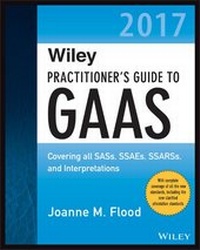
Wiley Practitioner's Guide to GAAS 2017
Description

This comprehensive guide to understanding Generally Accepted Auditing Standards (GAAS) is not just about auditing. It addresses the toughest part of an accountant's job--identifying, interpreting, and applying the many audit, attest, review, compilation, and preparation standards relevant to a particular engagement.
Wiley Practitioner's Guide to GAAS 2017 offers a clear and accessible distillation of the official language of GAAS, Statements on Standards for Attestation Engagements (SSAEs), and Statements on Standards for Accounting and Review Services (SSARSs)--as well as advice on exactly how to remain fully compliant with each.
Wiley Practitioner's Guide to GAAS 2017 is organized according to the logical arrangement of the clarified standards, presenting each section individually, and explaining how it is related to the engagement process. Guidance is offered on the entire process, in the form of practice notes, checklists, questionnaires, and real-world examples, illustrating how the fundamental requirements of each section are applied.
Other key features include:
* A brief identification of each auditing, SSAE, and SSARS section, with effective dates and tips on how to apply it
* Highlights of new requirements in the clarified attestation standards
* Concise listing and descriptions of each section's specific mandates, including definitions
* Easy-to-read capsule summary of interpretations, plus selected technical alerts
* Helpful techniques for remaining compliant with each standard
New in GAAS 2017:
In 2016, the AICPA's Auditing Standards Board completed a major stage of its clarity project and issued SSAE No. 18. The new guidance is effective for reports dated May 1, 2017. SSAE No. 18 replaces the attestation standards, introducing major new requirements that will change practice. In this transition year, guidance on the extant attestation standards is also included. Wiley Practitioner's Guide to GAAS 2017 is completely updated to reflect all the clarified standards and provide valuable implementation information.
More details
Other editions
Additional editions
Person
While in public accounting, she worked on major clients in retail, manufacturing, and finance and on small business clients in construction, manufacturing, and professional services. At the AICPA, she managed the development and wrote courses in the accounting and auditing product line. She also wrote and produced training materials in a wide variety of media, including print, video, and audio, and pioneered the AICPA's elearning product line.
Content
- Intro
- Series Page
- Title Page
- Copyright
- Preface
- About the Author
- Organization and Key Changes
- AU-C 200: Overall Objectives of the Independent Auditor and the Conduct of an Audit in Accordance with Generally Accepted Auditing Standards
- AU-C Original Pronouncements
- Technical Alert
- AU-C 200 Definitions of Terms
- Objectives of AU-C Section 200
- Requirements
- Complying with GAAS
- AU-C 210: Terms of Engagement
- AU-C Original Pronouncement
- Applicability
- AU-C 210 Definitions of Terms
- Objectives
- Fundamental Requirements
- Illustration
- AU-C 220: Quality Control for an Engagement Conducted in Accordance with Generally Accepted Auditing Standards
- AU-C Original Pronouncements
- Applicability
- AU-C 220 Definitions of Terms
- Objectives of AU-C Section 220
- Requirements
- AU-C 230: Audit Documentation
- AU-C Original Pronouncements
- AU-C 230 Definitions of Terms
- Objectives of AU-C Section 230
- Requirements
- Interpretations
- AU-C Illustrations
- AU-C 240: Consideration of Fraud in a Financial Statement Audit
- AU-C Original Pronouncements
- AU-C 240 Definitions of Terms
- Objectives of AU-C Section 240
- Requirements
- AU-C Illustrations
- AU-C 250: Consideration of Laws and Regulations in an Audit of Financial Statements
- AU-C Original Pronouncement
- AU-C 250 Definition of Term
- Objectives of AU Section 250
- Requirements
- AU-C 260: The Auditor's Communication with Those Charged with Governance
- AU-C Original Pronouncements
- AU-C Definitions of Terms
- Objectives of AU-C Section 260
- Requirements
- AU-C 265: Communicating Internal Control Related Matters Identified in an Audit
- AU-C Original Pronouncements
- Technical Alert
- AU-C Definitions of Terms
- Objectives
- Requirements
- Interpretations
- AU-C 265 Illustrations
- AU-C 300: Planning an Audit
- AU-C Original Pronouncements
- Objective of AU-C Section 300
- Requirements
- AU-C 315: Understanding the Entity and Its Environment and Assessing the Risks of Material Misstatement
- AU-C Original Pronouncements
- Technical Alert
- Definitions of Terms
- Objectives of AU-C Section 315
- Overview
- Requirements
- Illustrations
- AU-C 320: Materiality in Planning and Performing an Audit
- AU-C Pronouncement
- Definition of Term
- Objective of AU-C Section 320
- Overview
- Requirements
- AU-C 330: Performing Audit Procedures in Response to Assessed Risks and Evaluating the Audit Evidence Obtained
- AU-C Original Pronouncement
- Definitions of Terms
- Objective of AU-C Section 330
- Overview
- Requirements
- AU-C 402: Audit Considerations Relating to an Entity Using a Service Organization
- AU-C Original Pronouncements
- Technical Alert
- Definitions of Terms
- Objectives of AU-C Section 402
- Overview
- Scope
- Requirements
- AU-C 450: Evaluation of Misstatements Identified during the Audit
- AU-C Original Pronouncement
- Definitions of Terms
- Objectives of AU-C Section 450
- Requirements
- AU-C 500: Audit Evidence
- AU-C Original Pronouncements
- Definitions of Terms
- Objective
- Scope
- Requirements
- Interpretations
- AU-C 501: Audit Evidence-Specific Considerations for Selected Items
- AU-C Original Pronouncement
- Definitions of Terms
- Objectives Of AU Section 501
- Requirements-Investments in Securities and Derivative Instruments
- Illustrations-Investments in Securities and Derivative Instruments
- Requirements-Inventory Existence and Condition
- AU-C Illustrations-Inventory Observation
- Requirements-Litigation, Claims, and Assessments Involving the Entity
- AU-C Illustration-Litigation, Claims, and Assessments
- Requirements-Segment Reporting
- AU-C 505: External Confirmations
- AU-C Original Pronouncement
- Definitions of Terms
- Objective of AU-C Section 505
- Requirements
- AU-C Illustrations
- AU-C 510: Opening Balances-Initial Audit Engagements, Including Reaudit Engagements
- AU-C Original Pronouncement
- Applicability
- Definitions of Terms
- Objectives of AU-C Section 510
- Requirements
- Illustrations
- AU-C 520: Analytical Procedures
- AU-C Original Pronouncement
- AU-C Definition of Term
- Objectives of AU-C Section 520
- Overview
- Requirements
- AU-C Illustrations
- AU-C 530: Audit Sampling
- AU-C Original Pronouncement
- AU-C Definitions of Terms
- Objectives of AU-C Section 530
- Overview
- Requirements
- Nonsampling Techniques
- Nonstatistical Audit Sampling Techniques
- Statistical Audit Sampling Techniques
- AU-C 540: Auditing Accounting Estimates, Including Fair Value Accounting Estimates and Related Disclosures
- AU-C Original Pronouncement
- Definitions of Terms
- Objective of AU-C Section 540
- Overview
- Requirements
- Illustration
- AU-C 550: Related Parties
- AU-C Original Pronouncements
- Definitions of Terms
- Objectives of AU Section 550
- Requirements
- Illustration
- AU-C 560: Subsequent Events and Subsequently Discovered Facts
- AU-C Original Pronouncement
- Definitions of Terms
- Objectives of AU-C Section 560
- Overview
- Requirements
- Illustration
- AU-C 570: The Auditor's Consideration of an Entity's Ability to Continue as a Going Concern
- AU-C Original Pronouncement
- AU-C Definition of Term
- Objectives of AU-C Section 570
- Requirements
- Illustration
- Interpretations
- AU-C 580: Written Representations
- AU-C Original Pronouncement
- AU-C Definition of Term
- Objectives of AU-C Section 580
- Requirements
- AU-C 580 Illustrations
- AU-C 585: Consideration of Omitted Procedures after the Report Release Date
- AU-C Original Pronouncement
- Definition of Term
- Overview
- Objectives of AU Section 585
- Scope
- Requirements
- Illustration
- AU-C 600: Special Considerations-Audits of Group Financial Statements (Including the Work of Component Auditors)
- AU-C Original Pronouncements
- Technical Alert
- Introduction
- AU-C 600 Definitions of Terms
- Objectives of AU-C Section 600
- Overview
- Requirements
- Interpretations
- Illustrations
- AU-C 610: Using the Work of Internal Auditors
- AU-C Original Pronouncement
- Objectives of AU-C Section 610
- Applicability of AU-C Section 610
- Definitions of Terms
- Overview
- Requirements
- Illustrations
- AU-C 620: Using the Work of an Auditor's Specialist
- AU-C Original Pronouncement
- AU-C Definitions of Terms
- Objectives of AU-C Section 620
- Requirements
- AU-C Interpretations
- Illustrations
- AU-C 700: Forming an Opinion and Reporting on Financial Statements
- AU-C Original Pronouncement
- Technical Alert
- AU-C Definitions of Terms
- Objectives of AU-C Section 700
- Requirements: Forming an Opinion
- Requirements: Auditor's Standard Report
- Requirements: Reports on Comparative Financial Statements
- Interpretations
- AU-C 700 Illustrations (Source: AU-C 700.58)
- AU-C 705: Modifications to the Opinion in the Independent Auditor's Report
- AU-C Original Pronouncements
- AU-C Definitions of Terms
- Objective of AU-C Section 705
- Requirements
- AU-C 705 Illustrations (Source: AU-C 705.A32)
- AU-C 706: Emphasis-of-Matter Paragraphs and Other-Matter Paragraphs in the Independent Auditor's Report
- AU-C Original Pronouncement
- AU-C Definitions of Terms
- Objectives of AU-C Section 706.04
- Requirements
- AU-C 706 Illustrations
- AU-C 708: Consistency of Financial Statements
- AU-C Original Pronouncement
- AU-C Definition of Term
- Objectives of AU-C Section 708
- Requirements
- AU-C 720: Other Information in Documents Containing Audited Financial Statements
- AU-C Original Pronouncements
- AU-C Effective Date and Summary of Changes
- AU-C Definitions of Terms
- Objective of AU-C Section 720
- Requirements
- Illustration
- AU-C 725: Supplementary Information in Relation to Financial Statements as a Whole
- AU-C Original Pronouncements
- AU-C Definition of Term
- Objective of AU-C Section 725
- Requirements
- Interpretation
- AU-C 725 Illustrations
- AU-C 730: Required Supplementary Information
- AU-C Original Pronouncements
- AU-C Definitions of Terms
- Objectives of AU-C Section 730
- Requirements
- AU-C 730 Illustrations
- AU-C 800: Special Considerations-Audits of Financial Statements Prepared in Accordance with Special Purpose Frameworks
- AU-C Original Pronouncements
- AU-C Definitions of Terms
- Objectives of AU-C Section 800
- Scope
- Requirements
- AU-C 800 Illustrations (Source: AU-C 800.A36)
- AU-C 805: Special Considerations-Audits of Single Financial Statements and Specific Elements, Accounts, or Items of a Financial Statement
- AU-C Original Pronouncement
- AU-C Definitions of Terms
- Objectives of AU-C Section 805
- Scope
- Requirements
- Interpretation
- Illustrations of Auditor's Reports on a Single Financial Statement and a Specific Element of a Financial Statement (Source: AU-C 805.25)
- AU-C 806: Reporting on Compliance with Aspects of Contractual Agreements or Regulatory Requirements in Connection with Audited Financial Statements
- AU-C Original Pronouncements
- AU-C Definitions of Terms
- Objective of AU-C Section 806
- Scope
- Requirements
- AU-C 806 Illustrations (Source: AU-C 806.A8)
- AU-C 810: Engagements to Report on Summary Financial Statements
- AU-C Original Pronouncement
- Definitions of Terms
- Objectives of AU-C Section 810
- Scope
- Requirements
- AU-C 810 Illustrations (Source: AU-C 810.a22)
- AU-C 905: Alert That Restricts the Use of the Auditor's Written Communication
- AU-C Original Pronouncement
- AU-C Definition of Term
- Objectives of AU-C Section 905
- Requirements
- AU-C 905 Illustrations
- AU-C 910: Financial Statements Prepared in Accordance with a Financial Reporting Framework Generally Accepted in Another Country
- AU-C Original Pronouncement
- Technical Alert
- AU-C Definitions of Terms
- Objectives of AU-C Section 910
- Scope
- Requirements
- AU-C 910 Illustrations (Source: AU-C 910.A11)
- AU-C 915: Reports on Application of Requirements of an Applicable Financial Reporting Framework
- AU-C Original Pronouncements
- Applicability
- AU-C Definitions of Terms
- Objective of AU-C Section 915
- Requirements
- AU-C 915 Illustration (Source: AU-C 915.A8)
- AU-C 920: Letters for Underwriters and Certain Other Requesting Parties
- AU-C Original Pronouncements
- Applicability
- AU-C Definitions of Terms
- Objectives of AU-C Section 920
- Scope
- Requirements: General
- Requirements: Format and Contents of Comfort Letters
- Requirements: Commenting in a Comfort Letter on Information Other than Audited Financial Statements
- Requirements: Other Matters
- AU-C 920 Illustrations
- AU-C 925: Filings with the US Securities and Exchange Commission under the Securities Act of 1933
- AU-C Original Pronouncement
- AU-C Definitions of Terms
- Objectives of AU-C Section 925
- Requirements
- AU-C 925 Illustration
- AU-C 930: Interim Financial Information
- AU-C Original Pronouncement
- AU-C Definition of Term
- Objective of AU-C Section 930
- Scope
- Requirements: Review Procedures
- Techniques for Application
- Requirements: Communication with Management and Those Charged with Governance
- Requirements: Auditor's Report
- Requirements: Interim Financial Information Accompanying Audited Financial Statements
- Interpretations
- AU-C 930 Illustrations
- AU-C 935: Compliance Audits
- AU-C Original Pronouncements
- Technical Alert
- AU-C 935 Definitions of Terms
- Objectives of AU-C Section 935
- Scope
- Requirements
- AU-C Illustrations
- AU-C 940: An Audit of Internal Control over Financial Reporting That Is Integrated with an Audit of Financial Statements
- AU-C Original Pronouncement
- Technical Alert
- AU-C 940 Definitions of Terms
- AU-C 940 Objectives
- Scope
- Requirements
- Reporting Requirements
- Illustrations
- AT-C: Preface
- Technical Alert
- AT-C Preface
- Appendix
- AT-C 105: Concepts Common to All Attestation Engagements
- Original Pronouncement
- Applicability and Written Assertion
- Objectives
- Definitions of Terms
- Requirements
- Interpretations
- AT-C 205: Examination Engagements
- Overview
- Objectives
- Definitions of Terms
- Requirements
- Interpretations
- Illustrations (AT-C 205.A121)
- AT-C 210: Review Engagements
- Original Pronouncement
- Applicability
- Definitions of Terms
- Objectives of Section 215
- Requirements
- Illustrations-Illustrative Practitioner's Review Reports
- AT-C 215: Agreed-Upon Procedures Engagements
- Original Pronouncement
- Applicability
- Definitions of Terms
- Objectives of AT-C Section 215
- Requirements
- Interpretation
- Illustrations
- AT-C 305: Prospective Financial Information
- Original Pronouncement
- Applicability
- Definitions of Terms
- Objectives-Examination Engagements
- Objectivies-Agreed-Upon Procedures Engagements
- Requirements: Examination of Prospective Financial Statements
- Requirements: Applying Agreed-Upon Procedures to Prospective Financial Statements
- Illustration
- AT-C 310: Reporting on Pro Forma Financial Information
- Original Pronouncement
- Applicability
- Definition of Terms
- Objectives of an Examination Engagement
- Objectives of a Review Engagement
- Requirements
- Illustrations
- AT-C 315: Compliance Attestation
- Original Pronouncement
- Applicability
- Definitions of Terms
- Objectives of an Examination Engagement
- Objectives of an Agreed-Upon Procedures Engagement
- Requirements-Examination Engagements
- Illustration
- Requirements: Agreed-Upon Procedures Engagement
- Illustrations
- AT-C 320: Reporting on an Examination of Controls at a Service Organization Relevant to User Entities' Internal Control over Financial Reporting
- Original Pronouncement
- Applicability
- Definitions of Terms
- Objectives of AT-C Section 320
- Requirements
- Illustration
- AT-C Section 395: (Designated for AT Section 701) Management's Discussion and Analysis (MD&A)-A Summary
- Original Pronouncement
- Technical Alert
- Applicability
- Definition of term
- Objectives of at Section 395
- Requirements: Examination
- Requirements: Review
- Illustrations
- AT 20: Defining Professional Requirements in Statements on Standards for Attest Engagements
- Original Pronouncement
- Technical Alert
- Defining Professional Requirements in Statements on Standards for Attestation Engagements
- AT 50: SSAE Hierarchy
- Original Pronouncement
- Technical Alert
- Attestation Standards
- Attestation Interpretations
- Other Attestation Publications
- AT 101: Attest Engagements
- Original Pronouncements
- Technical Alert
- Applicability
- Definitions of Terms
- Objectives of Section 101
- Requirements
- Interpretations
- Illustrations: Examination Reports
- Illustrations: Review Reports
- AT 201: Agreed-Upon Procedures Engagements
- Original Pronouncement
- Technical Alert
- Applicability
- Definitions of Terms
- Objectives of at Section 201
- Requirements
- Interpretation
- Techniques for Application
- Illustrations
- AT 301: Financial Forecasts and Projections
- Original Pronouncement
- Technical Alert
- Applicability
- Definitions of Terms
- Objectives of at Section 301
- Requirements: General
- Requirements: Compilation of Prospective Financial Statements
- Requirements: Examination of Prospective Financial Statements
- Requirements: Applying Agreed-Upon Procedures to Prospective Financial Statements (see also at Section 201)
- Requirements: Other
- Interpretations
- Illustrations
- Appendices
- AT 401: Reporting on Pro Forma Financial Information
- Original Pronouncement
- Technical Alert
- Applicability
- Definition of Term
- Objectives of at Section 401
- Requirements
- Interpretations
- Techniques for Application
- Illustrations
- AT 501: An Examination of an Entity's Internal Control over Financial Reporting That Is Integrated with an Audit of Its Financial Statements
- Original Pronouncement
- Technical Alert
- Applicability
- Definitions of Terms
- Objectives of at Section 501
- Requirements
- Reporting Requirements
- Interpretations
- Illustrations
- AT 601: Compliance Attestation
- Original Pronouncement
- Technical Alert
- Applicability
- Definitions of Terms
- Objectives of at Section 601
- Requirements: General (Applicable to Both Agreed-Upon Procedures and Examination Engagements)
- Requirements: Agreed-Upon Procedures Engagement
- Requirements: Examination Engagement
- Interpretations
- Techniques for Application
- Illustrations
- AT 701: Management's Discussion and Analysis (MD&A)-A Summary
- Original Pronouncement
- Technical Alert
- Applicability
- Definition of Term
- Objectives of at Section 701
- Requirements: Examination
- Requirements: Review
- Interpretations
- Illustrations
- AT 801: Reporting on Controls at a Service Organization
- Original Pronouncement
- Technical Alert
- Applicability
- Definitions of Terms
- Objectives of at Section 801
- Requirements
- Illustrations
- AR-C 60: General Principles for Engagements Performed in Accordance with Statements on Standards for Accounting and Review Services
- Original Pronouncement
- Technical Alert
- Objectives and Limitations of SSARS Engagements
- Fundamental Requirements
- Appendix-Definitions of Terms for AR-C Sections 60 Through 90 (Source: AR-C 60-90)
- AR-C 70: Preparation of Financial Statements
- Original Pronouncement
- Objectives and Limitations of Preparation Engagements
- Technical Alert
- Definitions of Terms
- Determining the Type of Engagement
- Requirements
- Illustration (AR-C 70.A20)
- AR-C 80: Compilation Engagements
- Original Pronouncements
- Objectives and Limitations of Preparation Engagements
- Technical Alert
- Definitions of Terms
- Requirements
- Illustrations
- AR-C 90: Review of Financial Statements
- Original Pronouncement
- Objectives and Limitations of Review Engagements
- Technical Alert
- Definitions of Terms
- Requirements
- Illustrations: Review Engagement
- AR-C 120: Compilation of Pro Forma Financial Information
- Original Pronouncements
- Applicability
- Technical Alert
- Objectives of AR-C Section 120
- Requirements
- Illustrations
- Appendix A: Cross-References to SASs, SSAEs, and SSARSs
- Appendix B: List of AICPA Audit and Accounting Guides and AICPA Statements of Position-Auditing and Attestation
- Statements of Position-Auditing and Attestation
- Appendix C: Other Auditing Publications
- Index
- End User License Agreement
AU-C 200 Overall Objectives of the Independent Auditor and the Conduct of an Audit in Accordance with Generally Accepted Auditing Standards
AU-C Original Pronouncements
Sources Statements on Auditing Standards (SASs) 122, 123, 128, and 130.
Technical Alert
In October 2015, the Auditing Standards Board (ASB) issued Statement on Auditing Standards (SAS) No. 130. SAS No. 130 contains amendments to this section. Any relevant changes are incorporated into the information that follows.
AU-C 200 Definitions of Terms
Source: AU-C 200.14
- Applicable financial reporting framework. The financial reporting framework adopted by management and, when appropriate, those charged with governance in the preparation and fair presentation of the financial statements that is acceptable in view of the nature of the entity and the objective of the financial statements, or that is required by law or regulation.
- Audit evidence. Information used by the auditor in arriving at the conclusions on which the auditor's opinion is based. Audit evidence includes both information contained in the accounting records underlying the financial statements and other information. Sufficiency of audit evidence is the measure of the quantity of audit evidence. The quantity of the audit evidence needed is affected by the auditor's assessment of the risks of material misstatement and also by the quality of such audit evidence. Appropriateness of audit evidence is the measure of the quality of audit evidence; that is, its relevance and its reliability in providing support for the conclusions on which the auditor's opinion is based.
- Audit risk. The risk that the auditor expresses an inappropriate audit opinion when the financial statements are materially misstated. Audit risk is a function of the risk of material misstatement and detection risk.
- Auditor. The term used to refer to the person or persons conducting the audit, usually the engagement partner or other members of the engagement team or, as applicable, the firm. When an AU-C section expressly intends that a requirement or responsibility be fulfilled by the engagement partner, the term engagement partner rather than auditor is used. Engagement partner and firm are to be read as referring to their governmental equivalents when relevant.
- Detection risk. The risk that the procedures performed by the auditor to reduce audit risk to an acceptably low level will not detect a misstatement that exists and that could be material, either individually or when aggregated with other misstatements.
- Financial reporting framework. A set of criteria used to determine measurement, recognition, presentation, and disclosure of all material items appearing in the financial statements; for example, US generally accepted accounting principles, International Financial Reporting Standards (IFRSs) promulgated by the International Accounting Standards Board (IASB), or a special purpose framework.
The term fair presentation framework is used to refer to a financial reporting framework that requires compliance with the requirements of the framework and:
- Acknowledges explicitly or implicitly that, to achieve fair presentation of the financial statements, it may be necessary for management to provide disclosures beyond those specifically required by the framework; or
- Acknowledges explicitly that it may be necessary for management to depart from a requirement of the framework to achieve fair presentation of the financial statements. Such departures are expected to be necessary only in extremely rare circumstances.
A financial reporting framework that requires compliance with the requirements of the framework but does not contain the acknowledgments in 1 or 2 is not a fair presentation framework.
- Financial statements. A structured representation of historical financial information, including related notes, intended to communicate an entity's economic resources and obligations at a point in time or the changes therein for a period of time in accordance with a financial reporting framework. The related notes ordinarily comprise a summary of significant accounting policies and other explanatory information. The term financial statements ordinarily refers to a complete set of financial statements as determined by the requirements of the applicable financial reporting framework, but can also refer to a single financial statement.
- Historical financial information. Information expressed in financial terms regarding a particular entity, derived primarily from that entity's accounting system, about economic events occurring in past time periods or about economic conditions or circumstances at points in time in the past.
- Interpretive publications. Auditing interpretations of generally accepted accounting standards (GAAS), exhibits to GAAS, auditing guidance included in the American Institute of Certified Public Accountants (AICPA) Audit and Accounting Guides, and the AICPA Auditing Statements of Position (SOPs).
- Management. The person(s) with executive responsibility for the conduct of the entity's operations. For some entities, management includes some or all of those charged with governance; for example, executive members of a governance board or an owner-manager.
- Misstatement. A difference between the amount, classification, presentation, or disclosure of a reported financial statement item and the amount, classification, presentation, or disclosure that is required for the item to be presented fairly in accordance with the applicable financial reporting framework. Misstatements can arise from fraud or error.
- Other auditing publications. Publications other than interpretive publications; these include AICPA auditing publications not defined as interpretive publications; auditing articles in the Journal of Accountancy and other professional journals; continuing professional education programs and other instruction materials, textbooks, guidebooks, audit programs, and checklists; and other auditing publications from state certified public accountant (CPA) societies, other organizations, and individuals.
- Premise, relating to the responsibilities of management and, when appropriate, those charged with governance, on which an audit is conducted (the premise). Management and, when appropriate, those charged with governance have acknowledged and understand that they have the following responsibilities that are fundamental to the conduct of an audit in accordance with GAAS; that is, responsibility:
- For the preparation and fair presentation of the financial statements in accordance with the applicable financial reporting framework;
- For the design, implementation, and maintenance of internal control relevant to the preparation and fair presentation of financial statements that are free from material misstatement, whether due to fraud or error; and
- To provide the auditor with:
- Access to all information of which management and, when appropriate, those charged with governance are aware that is relevant to the preparation and fair presentation of the financial statements, such as records, documentation, and other matters;
- Additional information that the auditor may request from management and, when appropriate, those charged with governance for the purpose of the audit; and
- Unrestricted access to persons within the entity from whom the auditor determines it necessary to obtain audit evidence.
The premise, relating to the responsibilities of management and, when appropriate, those charged with governance, on which an audit is conducted may also be referred to as the premise.
- Professional judgment. The application of relevant training, knowledge, and experience within the context provided by auditing, accounting, and ethical standards in making informed decisions about the courses of action that are appropriate in the circumstances of the audit engagement.
- Professional skepticism. An attitude that includes a questioning mind, being alert to conditions that may indicate possible misstatement due to fraud or error, and a critical assessment of audit evidence.
- Reasonable assurance. In the context of an audit of financial statements, a high, but not absolute, level of assurance.
- Risk of material misstatement. The risk that the financial statements are materially misstated prior to the audit. This consists of two components, described as follows at the assertion level:
- Inherent risk. The susceptibility of an assertion about a class of transaction, account balance, or disclosure to a misstatement that could be material, either individually or when aggregated with other misstatements, before consideration of any related controls.
- Control risk. The risk that a misstatement that could occur in an assertion about a class of transaction, account balance, or disclosure and that could be material, either individually or when aggregated with other misstatements, will not be prevented, or detected and corrected, on a timely basis by the entity's internal control.
- Those charged with governance.The person(s) or organization(s) (for example, a corporate trustee) with responsibility for overseeing the strategic direction of the entity and the...
