

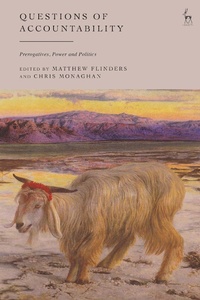
Questions of Accountability
Prerogatives, Power and Politics
1st Edition
Published on 21. September 2023
368 pages
978-1-5099-6424-6 (ISBN)
Description

This book explores accountability from a range of perspectives, crossing traditional disciplinary, thematic, and professional boundaries. It asks fresh questions about accountability and its place and importance in democratic societies.
Accountability matters. It matters because it connects the governors with the governed, and for this reason it is a hallmark of democratic governance. And yet, amidst a backdrop of concerns about democratic back-sliding, the rise of populism, the role of algorithmic governance, moral barbarism, and post-truth politics - to mention just a few issues - a number of potentially far-reaching questions of accountability have been asked. It is for exactly this reason that this book explores the concept of accountability from a range of perspectives, crossing traditional disciplinary, thematic, and professional boundaries. It asks fresh questions about accountability and its place and importance in democratic societies.
The book considers the questions raised by the shifting architecture of accountability. Whilst some scholars suggest that accountability processes have never been so effective -trumpeting the rise of monitory democracy with its dense array of watchdogs, sleaze-busters, auditors, legislative committees, statutory supports, and investigative mechanisms - others express concern about the risk of 'overloads', 'gaps', and 'traps'. This has led to a focus on fuzzy accountability and diagonal accountability, pointing to increasing conceptual confusion.
Bringing together world-leading scholars and former politicians and public servants, the book cuts through this confusion and provides the reader with the answers to the most debated issues, including rarely discussed 'pathologies of accountability', post-human governance, and a novel focus on balance and proportionality.
Accountability matters. It matters because it connects the governors with the governed, and for this reason it is a hallmark of democratic governance. And yet, amidst a backdrop of concerns about democratic back-sliding, the rise of populism, the role of algorithmic governance, moral barbarism, and post-truth politics - to mention just a few issues - a number of potentially far-reaching questions of accountability have been asked. It is for exactly this reason that this book explores the concept of accountability from a range of perspectives, crossing traditional disciplinary, thematic, and professional boundaries. It asks fresh questions about accountability and its place and importance in democratic societies.
The book considers the questions raised by the shifting architecture of accountability. Whilst some scholars suggest that accountability processes have never been so effective -trumpeting the rise of monitory democracy with its dense array of watchdogs, sleaze-busters, auditors, legislative committees, statutory supports, and investigative mechanisms - others express concern about the risk of 'overloads', 'gaps', and 'traps'. This has led to a focus on fuzzy accountability and diagonal accountability, pointing to increasing conceptual confusion.
Bringing together world-leading scholars and former politicians and public servants, the book cuts through this confusion and provides the reader with the answers to the most debated issues, including rarely discussed 'pathologies of accountability', post-human governance, and a novel focus on balance and proportionality.
More details
Edition
1. Auflage
Language
English
Place of publication
London
United Kingdom
Publishing group
Bloomsbury Publishing PLC
Target group
Professional and scholarly
College/higher education
ISBN-13
978-1-5099-6424-6 (9781509964246)
Copyright in bibliographic data and cover images is held by Nielsen Book Services Limited or by the publishers or by their respective licensors: all rights reserved.
Schweitzer Classification
Other editions
Additional editions

Book
03/2025
Hart Publishing
€65.40
Shipment within 15-20 days

Book
09/2023
Hart Publishing
€133.70
Shipment within 15-20 days
Persons
Matthew Flinders is Professor of Politics at the University of Sheffield, UK.
Chris Monaghan is Principal Lecturer in Law at the University of Worcester, UK.
Chris Monaghan is Principal Lecturer in Law at the University of Worcester, UK.
Content
Acknowledgements
Foreword, Lord Neuberger of Abbotsbury, Former President of the Supreme Court of the United Kingdom
1. Accountability Matters, Matthew Flinders (University of Sheffield, UK) and Chris Monaghan (University of Worcester, UK)
Part I: Framing
2. Questions of Perspective - Accountability as a Behavioural Proposition, Thomas Schillemans (Utrecht University, the Netherlands)
3. Questions of Measurement: Striking an Accountability Balance, Ellen Rock (University of Technology Sydney, Australia)
4. Loss of Balance? Exploring the 'Dark Side' of Accountability, Matthew Flinders (University of Sheffield, UK)
5. Fuzzy Law, Executive Powers and the Problem of Accountability, Margit Cohn (Hebrew University of Jerusalem, Israel)
6. Collaborative Constitutional Accountability, Se-shauna Wheatle (University of Durham, UK)
Part II: Themes
7. Questions of Control: Accountability in the Shadow of Prorogation, Chris Monaghan (University of Worcester, UK and Josie Welsh (University of Worcester, UK)
8. Questions of Counsel: Accountability and Policy Advice, Jonathan Slater (King's Policy Institute; former Permanent Secretary in the Department for Education, UK)
9. Enforcing the Conventions of Constitutional Monarchy, Robert Blackburn (King's College London, UK)
10. Accountability, Human Rights and Beyond: Lessons from Social Security Law, Alison Young (University of Cambridge, UK)
Part III: Futures
11. Accountability in Global Governance, Kate Macdonald (University of Melbourne, Australia) and Terry Macdonald (University of Melbourne, Australia)
12. Accountability from the Inside-Out, David Blunkett (Member of the House of Lords, UK; former Home Secretary)
13. Positive Accountability: From Naming, Shaming and Blaming to Lesson Learning, Sharon Shoesmith (former Director of Education and Children's Social Care, UK)
14. Accountability in the Age of Artificial Intelligence, Madalina Busuioc (Vrije University, the Netherlands)
Part IV: Where Next?
15. Questions Still to be Answered, Matthew Flinders (University of Sheffield, UK) and Chris Monaghan (University of Worcester, UK)
Foreword, Lord Neuberger of Abbotsbury, Former President of the Supreme Court of the United Kingdom
1. Accountability Matters, Matthew Flinders (University of Sheffield, UK) and Chris Monaghan (University of Worcester, UK)
Part I: Framing
2. Questions of Perspective - Accountability as a Behavioural Proposition, Thomas Schillemans (Utrecht University, the Netherlands)
3. Questions of Measurement: Striking an Accountability Balance, Ellen Rock (University of Technology Sydney, Australia)
4. Loss of Balance? Exploring the 'Dark Side' of Accountability, Matthew Flinders (University of Sheffield, UK)
5. Fuzzy Law, Executive Powers and the Problem of Accountability, Margit Cohn (Hebrew University of Jerusalem, Israel)
6. Collaborative Constitutional Accountability, Se-shauna Wheatle (University of Durham, UK)
Part II: Themes
7. Questions of Control: Accountability in the Shadow of Prorogation, Chris Monaghan (University of Worcester, UK and Josie Welsh (University of Worcester, UK)
8. Questions of Counsel: Accountability and Policy Advice, Jonathan Slater (King's Policy Institute; former Permanent Secretary in the Department for Education, UK)
9. Enforcing the Conventions of Constitutional Monarchy, Robert Blackburn (King's College London, UK)
10. Accountability, Human Rights and Beyond: Lessons from Social Security Law, Alison Young (University of Cambridge, UK)
Part III: Futures
11. Accountability in Global Governance, Kate Macdonald (University of Melbourne, Australia) and Terry Macdonald (University of Melbourne, Australia)
12. Accountability from the Inside-Out, David Blunkett (Member of the House of Lords, UK; former Home Secretary)
13. Positive Accountability: From Naming, Shaming and Blaming to Lesson Learning, Sharon Shoesmith (former Director of Education and Children's Social Care, UK)
14. Accountability in the Age of Artificial Intelligence, Madalina Busuioc (Vrije University, the Netherlands)
Part IV: Where Next?
15. Questions Still to be Answered, Matthew Flinders (University of Sheffield, UK) and Chris Monaghan (University of Worcester, UK)
