

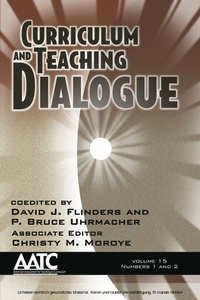
Curriculum and Teaching Dialogue
Vol. 15 # 1 & 2
1st Edition
Published on 1. September 2013
325 pages
978-1-62396-432-0 (ISBN)
Description

Curriculum and Teaching Dialogue (CTD) is a publication of the American Association of Teaching and Curriculum (AATC), a national learned society for the scholarly field of teaching and curriculum. The field includes those working on the theory, design and evaluation of educational programs at large. At the university level, faculty members identified with this field are typically affiliated with the departments of curriculum and instruction, teacher education, educational foundations, elementary education, secondary education, and higher education. CTD promotes all analytical and interpretive approaches that are appropriate for the scholarly study of teaching and curriculum. In fulfillment of this mission, CTD addresses a range of issues across the broad fields of educational research and policy for all grade levels and types of educational programs.
All prices
More details
Other editions
Additional editions
David J. Flinders | P. Bruce Uhrmacher | Christy M. Moroye
Curriculum and Teaching Dialogue Vol 15 Issue 1 & 2
Volume 15, Numbers 1 and 2
Book
09/2013
Information Age Publishing
€70.80
Shipment within 3-4 weeks
Content
- Front Cover
- Curriculum and Teaching Dialogue
- Volume 15, Numbers 1 and 2
- CONTENTS
- Volume 15, number 1
- 1. Continuing the Work of Unpopular Ideas: Moving Beyond Curricular Paralysis
- 2. Teacher Identity and Curriculum: Space for Dissent
- 3. Accomplishing the Goals of Multicultural Education: A Transdisciplinary Perspective
- 4. Questioning and Learning: How Do We Recognize Children's Questions?
- 5. The Risking of Observations in the Classroom: Teacher as Cultural Critic
- 6. Narrative Authority = Making Mathematics Personal With Hands-On Experiences
- 7. Heritage Language Use Among 10th-Grade Asian and Hispanic Students in the United States
- 8. Developing Dynamic Artist/Teacher/Leaders in Preservice Art Education Programs
- 9. Teacher Insights About Teaching, Mentoring, and Schools as Workplaces
- 10. Teachers' Experiences With Classroom Management and Children Diagnosed With Emotional Behavioral Disorder
- 11. The Teacher Work Sample and 21st Century Learning
- Volume 15, number 2
- 1. Notes on Composing and Composition
- 2. Eisner's Evaluation in the Age of Race to the Top
- 3. Common Core and Inner Core: Co-Collaborators in Preparing Teachers to Serve All Learners
- 4. A Model of Associated Teaching
- 5. The 4E Wiki Writing Model: Redefining Collaboration for Technological Relevance
- 6. Translating Sustainability: The Design of a Secondary Charter School
- 7. Making a Long-Term Impact on Students Through a Place-Based Experiential Approach to Academics
- 8. Teachers Revitalizing the Culture Commons: An Ecological Imperative for the 21st Century Curriculum
- 9. Technology From Gutenberg to Google and the Plastic Brain: A Review of Nicholas Carr's The Shallows
- 10. Review of I'd Like to Apologize to Every Teacher I've Ever Had: My Year as a Rookie Teacher at Northeast High by Tony Danza
- 11. Awake! Awake! American Schooling is Under Siege! Some Personal Remarks About the 2012 AATC Book of the Year
- Information Age Publishing, Inc.
- Charlotte, North Carolina www.infoagepub.com
- Curriculum and Teaching Dialogue AATC Leadership
- President: Barbara Stern, James Madison University
- Past President: Amy L. Masko, Grand Valley State University
- President-Elect: Chara Bohan, Georgia State University
- Executive Secretary: Lynne Bailey, State College Area School District
- Program Chair: Bradley Conrad, Capital University
- Newsletter Editor: Pamela Thompson, Thomas College
- Executive Committee
- Blake Bickham Colorado Mesa University
- Peggy Moch Valdosta State University
- John Pecore University of West Florida
- Shelley B. Harris Texan A&M University, San Antonio
- Michelle Tenam-Zemach Nova Southeastern University
- William White Buffalo State University
- Joseph Flynn Northern Illinois University
- Ruben Garza Texas State University
- Donna Breault West Virginia University
- Editorial Board, Curriculum and Teaching Dialogue
- David Flinders
- Indiana University
- Bruce Uhrmacher
- University of Denver
- Christy M. Moroye
- University of Northern Colorado
- Editorial Review Board
- Robert Boostrom
- University of Southern Indiana
- Robert Donmoyer
- University of San Diego
- J. Randall Koetting
- Marian College
- William Veal
- College of Charleston
- Lyn Forester
- Doane College
- Alan Garrett
- Eastern New Mexico University
- Editorial Advisory Board
- Michael Apple
- University of Wisconsin-Madison
- Thomas Barone
- Arizona State University
- D. Jean Clandinin
- University of Alberta, Canada
- Elliot Eisner
- Stanford University
- William Pinar
- The University of British Columbia
- Steve Selden
- University of Maryland at College Park
- Curriculum and Teaching Dialogue
- Coedited by
- David J. Flinders Indiana University
- and
- P. Bruce Uhrmacher University of Denver
- Associate Editor
- Christy M. Moroye University of Northern Colorado
- President's Message
- Curriculum and Community
- Amy L. Masko
- References
- Editor's Notes
- Anthem of the Dead: Live Curriculum and an Education of Improvisation
- P. Bruce Uhrmacher
- Acknowledgments
- References
- President's Speech-AATC 2012
- Continuing the Work of Unpopular Ideas
- Moving Beyond Curricular Paralysis
- Richard L. Biffle III
- References
- CHAPTER 2
- Teacher Identity and Curriculum
- Space for Dissent
- Paul T. Parkison
- INTRODUCTION
- PRIMER ON THE POLITICS OF AUTHENITIC IDENTITY
- 1. an agreed upon set of standards can be designed to guide teaching and learning
- 2. every child and youth should be held to high expectations for meeting these standards
- 3. all teachers can achieve high standards by using evidence base practices
- and
- 4. educators should be held accountable for student learning.
- IMPLICATIONS FOR SCHOOLING
- DELIBERATIVE DISCOURSE AROUND STANDARDS:
- 1. What is the depth of knowledge desired?
- 2. Where does this standard fall within Bloom's Taxonomy?
- 3. Where can I find resources for this content?
- 4. Why do we need to teach and students to learn this specific content?
- 5. Why do the students in this class or school need to know this material?
- 6. How does the project I developed about our community, local industry, local history, or current events fit within these standards? Or,
- 7. Why are we not addressing this other learning need?
- References
- CHAPTER 3
- Accomplishing the Goals of Multicultural Education
- A Transdisciplinary Perspective
- Patriann Smith
- Transdisciplinarity: A Historical Overview
- Transdisciplinarity for Multicultural Teacher Education
- Axioms of Transdisciplinarity
- Ontological Axiom
- Logical Axiom
- Complexity Axiom
- The Paradigm Shift
- Transdisciplinarity for Teacher Educators
- Transdisciplinarity for Teacher Candidates
- Learning to Know
- Learning to Do
- Learning to Live Together With and Learning to Be
- Transdisciplinarity for Teachers in Classrooms
- (a) Social Studies: teachers providing instruction about Islam, Hinduism, or Confucianism, based on the logic of the included middle, may require students to demonstrate how the three systems reflected very similar streams of thought, thereby illustr...
- (b) Science: when teaching inquiry within science, transdisciplinarity would require teachers to enable students to express their emotions in relation to empirical evidence obtained. This approach ensures that a balance is maintained between the mate...
- (c) Mathematics: when teaching the concept of fractions and decimals in mathematics, a teacher may demonstrate the tendency of elements that appear dissimilar to be the same. An example of this can be demonstrated by illustrating how 3/6 and 1/2 appe...
- (d) Literacy: in teaching literature, teachers may incorporate the idea of transdisciplinarity by considering how themes such as loyalty, betrayal, death, family, love, power, and lust are universal, despite variations in culture. Teachers may also e...
- Conclusion
- References
- CHAPTER 4
- Questioning and Learning
- How Do We Recognize Children's Questions?
- Maria Vittoria Cifone
- Conceptual Framework
- In What Ways Is How We Think Related to How We Ask Questions?
- Method
- How to Collect and Understand Data (Questions)
- The School, the Children and the Activity
- Collecting and Understanding the Material
- Children's Questions
- What Are the Criteria for Calling Something a Question?
- The Meaning of Questioning
- Analysis and Conclusion
- What Are the Implications for Teachers?
- NOTES
- References
- CHAPTER 5
- The Risking of Observations in the Classroom
- Teacher as Cultural Critic
- Houman Harouni
- A SIMPLE EXAMPLE
- "She saw what she saw: it's really there"
- THE RISK OF AN ARGUMENT
- TEACHER AS CULTURAL CRITIC
- Exploration and Ideology
- NOTES
- References
- CHAPTER 6
- Narrative Authority = Making Mathematics Personal With Hands-On Experiences
- Angela López Pedrana
- Connecting the Dots for Building a Common Understanding
- Dimensions of Experiences Guiding This Study
- Scaffolding Practice on Personal Practical Knowledge
- Perpetually Pregnant: Integration of Metacognition and Problem Solving
- The Notion of Making the Math-Science Connection Personal
- How Does This "All" Add Up and Where Do We Go From Here?
- Concluding Remarks and the Notion of Making Math Personal
- ACKNOWLEDGMENTS
- References
- Table 7.1. The Relationship of Ethnicity and Generational Status to Heritage Language Use
- CHAPTER 7
- Heritage Language Use Among 10th-Grade Asian and Hispanic Students in the United States
- Eunjeong Choi
- Introduction
- Survey of the Literature
- Heritage Language Speakers
- Heritage Language Maintenance or Loss
- The Present Research
- 1. How often did the Asian and Hispanic students speak their heritage languages, depending on their interlocutors?
- 2. How did the frequency of their heritage languages use differ depending upon generational status?
- Analyses and Results
- Heritage Language Use and Interlocutors
- Heritage Language Use and Generational Status
- Discussion
- Conclusion
- Notes
- References
- Figure 7. 1. Heritage language use frequency and race.
- Table 7.2. The Frequency of Heritage Language Use Depending on Generational Status Within Ethnic Groups
- Table 7.3. Interaction Between Ethnicity and Generational Status
- Figure 7. 4. Heritage language use and race.
- Figure 7. 2. The frequency of heritage language use depending on generational status (N = 2515).
- Figure 7. 3. L1 use frequency, race, and generational status.
- Figure 8. 1. Typical design thinking processes (author unknown).
- CHAPTER 8
- Developing Dynamic Artist/Teacher/Leaders in Preservice Art Education Programs
- Delane Ingalls Vanada
- The Need for Balance
- Debunking Myths
- Promoting Balanced Teacher-Leaders
- Design Thinking and Connection Making
- How Preservice Art Education Programs Should Respond: About Praxis
- A Broad and Integrated View
- The Need for a Conceptual Framework for Capacity Building
- Summary
- References
- Figure 8. 2. Quality thinking systems model.
- CHAPTER 9
- Teacher Insights about Teaching, Mentoring, and Schools as Workplaces
- Virginia Resta, Leslie Huling, and Pat Yeargain
- Novice Teacher Induction Program
- NTIP Follow-Up Study (Phase I, 2005-2010)
- NTIP Phase I Findings
- NTIP Follow-Up Study Phase II, 2010-2012
- Methodology for Phase II Research
- Data Analyses
- Coding the Data
- NTIP Phase II Findings
- Personal Teaching Experiences
- Most Teachers Had Experienced a Career Low-Point
- To The "Brink" and Back
- Reflections on Being Mentored and Mentoring Others
- Teachers Report Mentoring Was Instrumental to Them as Novices
- Teachers Have Subsequently Mentored Others
- Mentoring Promotes Self-Reflection
- Teachers Report Little Support for Mentoring
- Teacher Insights About Schools as Workplaces
- Coworkers and Communities Cited as Reasons to Stay
- Workplaces Negatively Impacted by Teacher Turnover
- Conclusions and Implications
- References
- Figure 9. 1. Comparative retention of NTIP cohorts 1-3 (N = 954).
- Table 9.1. Location, Dates, and Participants Involved in NTIP Focus Groups
- Figure 9. 2. Career period in which teacher experienced a low point and considered leaving the profession.
- Figure 9. 3. Factors identified by teachers as influencing their decision to remain in the profession after suffering a career low point.
- Figure 9. 4. Conditions identified by teachers as influencing their retention at their campus.
- CHAPTER 10
- Teachers' Experiences With Classroom Management and Children Diagnosed With Emotional Behavioral Disorder
- Candace Schlein, Raol Taft, and Valerie Tucker-Blackwell
- Theoretical Framework
- Methodology
- Data Analysis and Discussion
- Educational Significance
- AUTHOR NOTE
- References
- CHAPTER 11
- The Teacher Work Sample and 21st Century Learning
- Kimberly Hartnett-Edwards
- Review of the Literature
- California's Teacher Performance Assessment
- Professional Teaching Portfolios
- A University-Based Program Makes Changes
- The Study
- The Members
- The Process
- Findings
- DOL Findings
- Conclusions, Limitation, and Implications for Future Study
- Appendix 1: Discussion board chat questions
- 1. Taking the pulse: As you move into the third and final quarter of fieldwork, take a minute and reflect on the "good, the bad and the ugly." Share with the group activities that were most helpful as well as ideas for what could make future coho...
- 2. You should have had a chance to review your cohorts e-portfolios. Please share the success you viewed in the portfolios, the confusions that may exist and any suggestions you have for individuals or the group as a whole where it applies to viewing...
- 3. As you complete your lesson study observations, compare this type of collaborative observation with the traditional observations we have done in the previous quarter: What did you request feedback on? Did you receive that feedback? Did the feedbac...
- 4. Now that you have completed your TE program and the DOL pilot, what are the highlights of each? With the DOL pilot, what changes do you recommend for the bigger TEP pilot (the entire program)? What would you keep, what would you change, will you p...
- Appendix 2: Selected comments from Apprentice Teachers after pilot
- References
- VOLUME 15, NUMBER 2
- Editor's Notes
- Exploring the Art of Teaching and the Earth of Which We Are a Part
- David J. Flinders
- CHAPTER 1
- Notes on Composing and Composition
- Elliot W. Eisner and Susan Freeman
- Composition and Language
- Composition and Art
- Summary
- Composition and Schooling
- References
- CHAPTER 2
- Eisner's Evaluation in the Age of Race to the Top
- Derek Gottlieb
- Introduction
- The Purposes of Assessment in Race to the Top
- Internal Problems With Duncan's Proposals
- Eisner's Educational Criticism and the Task of Evaluation
- Conclusion
- References
- Figure 3. 1. The integrated model of common core and inner core in the preparation of teachers
- CHAPTER 3
- Common Core and Inner Core
- Co-Collaborators in Teacher Preparation
- Paul Michalec
- Introduction
- INTEGRATED MODEL OF TEACHER EDUCATION
- ICEBERG METAPHOR OF COMMON CORE AND INNER CORE
- THE WATERLINE OF COMMON CORE AND INNER CORE COCOLLABORATION
- COMMON CORE AND INNER CORE MODEL FOR PROFESSIONAL DEVELOPMENT
- Conclusion
- REFERENCES
- CHAPTER 4
- A Mode of Associated Teaching
- John Dewey and the Structural Isolation of Teachers
- Brian White
- From Reading Dewey's Critics to Becoming One
- Dewey and the Importance of Teachers' Independence
- Teacher as Mother, Artist, and Researcher
- Digesting Classroom Experiences Together
- Supporting Teacher-Research Through Collaborative Investigation and Instruction
- A Call for Associated Teaching
- References
- CHAPTER 5
- The 4E Wiki Writing Model
- Redefining Collaboration for Technological Relevance
- Jenifer Thornton
- Introduction
- Wikis
- Conceptual Framework
- Collaborative Writing and Learning
- Differentiation
- Context
- The 4E Wiki Writing Model
- Phases of Model
- Phase 1-Establish and Create
- Phase 2-Extend and Expand
- Phase 3-Elaborate and Embellish
- Phase 4-Edit
- Discussion of Benefits and Considerations
- Conclusions
- APPENDIX: WIKI PHASE DEVELOPMENT RUBRIC
- References
- Table 6.3. (Continued)
- CHAPTER 6
- Translating Sustainability
- The Design of a Secondary Charter School
- Todd Hodgkinson
- Introduction
- Review of Literature
- 1. conceptual problems related to environmental education
- 2. poorly defined school philosophy and goals
- 3. difficulties in coordinating the project between individual efforts and departments
- and
- 4. a hiatus between administration and teacher perceptions (of environmental education) (p. 13).
- 1. How did the founding members of a secondary charter school design a comprehensive model of secondary schooling around the theme of sustainability?
- 2. What are the complexities involved with developing and enacting this model?
- Methodology and Design
- Findings and Implications
- Adaptation
- Emergence
- Conclusion
- NOTES
- References
- Table 6.4. Curriculum Matrix for the True Leaves Charter School
- Table 6.1. Data Collection Matrix (Type of Information by Source)
- Table 6.2. The Five Dimensions of Schooling
- Table 6.3. Adaptations Made by the Founding Members of True Leaves Charter School
- Table 6.5. Questions for Consideration When Planning Sustainability Education
- Table 7.1. Skill/Knowledge Development and Character Strength Development Frameworks
- CHAPTER 7
- Making a Long-Term Impact on Students Through a Place-Based, Experiential Approach to Academics
- Lauren Victor
- Introduction
- Review of the Literature
- Context
- Methodology and Design
- Results
- Discussion
- References
- Table 7.2. Outline of This Study's Participant Characteristics
- Table 8.1. Major Characteristics of Practice in the Cultural Commons
- CHAPTER 8
- Teachers Revitalizing the Culture Commons
- An Ecological Imperative for the 21st Century Curriculum
- Audrey Dentith and Debra A. Root
- Theoretical Framework
- Key Characteristics of the Cultural Commons
- The Academy
- Implications of Cultural Commons from the Academy
- Conclusion
- References
- BOOK REVIEW
- Technology From Gutenberg to Google and the Plastic Brain
- Review of Carr's The Shallows
- Kari Hodge and Lucinda Harman
- Application For Educators
- Conclusion
- References
- BOOK REVIEW
- Review of I'd Like to apologize to Every Teacher I've Ever Had: My Year as a Rookie Teacher at Northeast High by Tony Danza
- Jacqueline Bach and Sarah Ramsey
- Introduction
- The Teacher Memoir
- I'm Really Just Like You
- Rookie Mistakes and Victory Dances
- The Arc of a Teacher
- Conclusion
- NOTES
- References
- Awake! Awake! American Schooling is Under Siege!
- Some Personal Remarks About the 2012 AATC Book of the Year
- O. L. Davis, Jr.
- NOTES
- Volume 15 Acknowledgments
- About the Authors
- Back Cover

