

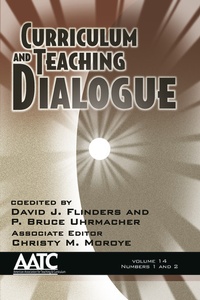
Curriculum and Teaching Dialogue
Vol. 14 #1 & 2
1st Edition
Published on 1. January 2013
327 pages
978-1-62396-024-7 (ISBN)
Description

Curriculum and Teaching Dialogue (CTD) is a publication of the American Association of Teaching and Curriculum (AATC), a national learned society for the scholarly field of teaching and curriculum. The field includes those working on the theory, design and evaluation of educational programs at large. At the university level, faculty members identified with this field are typically affiliated with the departments of curriculum and instruction, teacher education, educational foundations, elementary education, secondary education, and higher education. CTD promotes all analytical and interpretive approaches that are appropriate for the scholarly study of teaching and curriculum. In fulfillment of this mission, CTD addresses a range of issues across the broad fields of educational research and policy for all grade levels and types of educational programs.
All prices
More details
Other editions
Additional editions

David J. Flinders | P. Bruce Uhrmacher
Curriculum and Teaching Dialogue Vol 14 Issue 1 & 2
Volume 14 numbers 1 & 2
Book
09/2012
Information Age Publishing
€122.90
Shipment within 3-4 weeks
David J. Flinders | P. Bruce Uhrmacher
Curriculum and Teaching Dialogue Vol 14 Issue 1 & 2
Volume 14 numbers 1 & 2
Book
09/2012
Information Age Publishing
€70.90
Shipment within 3-4 weeks
Content
1 - Curriculum and Teaching Dialogue [Seite 2]
1.1 - Volume 14, Numbers 1 and 2 [Seite 2]
2 - CONTENTS [Seite 8]
2.1 - Volume 14, number 1 [Seite 8]
2.1.1 - 1. The Search for Content in Curriculum Making [Seite 8]
2.1.2 - 2. Reconsidering University-Based Teacher Education [Seite 8]
2.1.3 - 3. Crossing Boundaries: A Commentary on Liston's "Reconsidering University-Based Teacher Education" [Seite 8]
2.1.4 - 4. Teacher Accountability & Student Responsibility: A Cross-Cultural Comparison of American and Ghanaian Schooling Practices, Policies, and a Reflection on NCLB [Seite 8]
2.1.5 - 5. Curriculum in Exile: Teaching Tiananmen at Harvard [Seite 8]
2.1.6 - 6. Knowing What Students Know: Negotiating Challenges of Distance, Desire, and Context in Constructivist Literacy Classrooms [Seite 8]
2.1.7 - 7. Intentions and Beliefs: Why They Matter and a Conceptual Framework for Understanding Them in Culturally Responsive Teachers [Seite 9]
2.1.8 - 8. Curriculum: The Inside Story [Seite 9]
2.1.9 - 9. Four Portraits of Belief and Unbelief: The Experiences of Preservice Teachers With Religious Diversity in a Teacher Education Program [Seite 9]
2.1.10 - 10. Problem-Based Learning: Teachers Who Flourish and Flounder [Seite 9]
2.1.11 - 11. 21st Century Skills and Science Education in K-12 Environment: Investigating a Symbiotic Relationship [Seite 9]
2.2 - Volume 14, number 2 [Seite 9]
2.2.1 - 1. Being There: The Ontological Measure of Teaching [Seite 9]
2.2.2 - 2. Beyond Measurement: Context, Caution, and the Integrity of Teachers' Work [Seite 9]
2.2.3 - 3. Judgment, Deliberation, Evaluation: Rediscovering Joseph Schwab's Practical Arts [Seite 9]
2.2.4 - 4. Classroom Discourse: A Means to Positively Influence Mathematics Achievement for African American Students [Seite 9]
2.2.5 - 5. Teaching Democracy: Is It More Complicated Than We Think? An Ethnographic Case Study in St. Petersburg, Russia [Seite 9]
2.2.6 - 6. Hear Me Out! The Use of Identity, Space, and Voice in an Online Classroom [Seite 9]
2.2.7 - 7. Why Take Time To Teach School Culture? [Seite 9]
2.2.8 - 8. Gaming as Curriculum [Seite 10]
2.2.9 - 9. Challenging Minds: Enhancing the Mathematical Learning of African American Students Through Games [Seite 10]
2.3 - BOOK REVIEW [Seite 10]
2.3.1 - Information Age Publishing, Inc. [Seite 4]
2.3.2 - Charlotte, North Carolina www.infoagepub.com [Seite 4]
2.3.3 - Curriculum and Teaching Dialogue AATC Leadership [Seite 6]
2.3.4 - President: Richard Biffle III, Thomas College [Seite 6]
2.3.5 - Past President: J. Wesley Null, Baylor University [Seite 6]
2.3.6 - President-Elect: Amy Masko, Grand Valley State University [Seite 6]
2.3.7 - Executive Secretary: Lynne Bailey, Education Consultant. Drop American Public University [Seite 6]
2.3.8 - Program Chair: Shelley B. Harris, Texas A&M University-San Antonio [Seite 6]
2.4 - Newsletter Editor: Pamela Thompson, Thomas College [Seite 6]
2.5 - Executive Council [Seite 6]
2.5.1 - Shelley B. Harris, Texas A&M University- San Antonio [Seite 6]
2.5.2 - William White, Buffalo State University [Seite 6]
2.5.3 - Michelle Tenam-Zermach, Nova Southeastern University [Seite 6]
2.5.4 - Peggy Moch, Valdosta State University [Seite 6]
2.5.5 - Gretchen Schwarz, Baylor University [Seite 6]
2.5.6 - Pamela Thompson, Thomas College [Seite 6]
2.5.7 - Blake Bickham, Colorado Mesa University [Seite 6]
2.5.8 - John Pecore, University of West Florida [Seite 6]
2.6 - Editorial Board, Curriculum and Teaching Dialogue [Seite 6]
2.6.1 - David Flinders [Seite 6]
2.6.2 - Indiana University [Seite 6]
2.6.3 - Bruce Uhrmacher [Seite 6]
2.6.4 - University of Denver [Seite 6]
2.6.5 - Christy M. Moroye [Seite 6]
2.6.6 - University of Northern Colorado [Seite 6]
2.7 - Editorial Review Board [Seite 6]
2.7.1 - Robert Boostrom [Seite 6]
2.7.2 - University of Southern Indiana [Seite 6]
2.7.3 - Robert Donmoyer [Seite 6]
2.7.4 - University of San Diego [Seite 6]
2.7.5 - J. Randall Koetting [Seite 6]
2.7.6 - Marian College [Seite 6]
2.7.7 - William Veal [Seite 6]
2.7.8 - College of Charleston [Seite 6]
2.7.9 - Lyn Forester [Seite 6]
2.7.10 - Doane College [Seite 6]
2.7.11 - Alan Garrett [Seite 6]
2.7.12 - Eastern New Mexico University [Seite 6]
2.7.13 - Jeanne Tunks [Seite 6]
2.7.14 - University of North Texas [Seite 6]
2.8 - Editorial Advisory Board [Seite 6]
2.8.1 - Michael Apple [Seite 6]
2.8.2 - University of Wisconsin-Madison [Seite 6]
2.8.3 - Thomas Barone [Seite 6]
2.8.4 - Arizona State University [Seite 6]
2.8.5 - D. Jean Clandinin [Seite 6]
2.8.6 - University of Alberta, Canada [Seite 6]
2.8.7 - Elliot Eisner [Seite 6]
2.8.8 - Stanford University [Seite 6]
2.8.9 - William Pinar [Seite 6]
2.8.10 - The University of British Columbia [Seite 6]
2.8.11 - Steve Selden [Seite 6]
2.8.12 - University of Maryland at College Park [Seite 6]
3 - Curriculum and Teaching Dialogue [Seite 4]
3.1 - Coedited by [Seite 4]
3.2 - David J. Flinders Indiana University [Seite 4]
3.3 - and [Seite 4]
3.4 - P. Bruce Uhrmacher Morgridge College of Education [Seite 4]
3.5 - Associate Editor [Seite 4]
3.6 - Christy M. Moroye [Seite 4]
3.7 - University of Northern Colorado [Seite 4]
4 - President's Message [Seite 12]
4.1 - Whose Curriculum and for What Purpose? [Seite 12]
4.1.1 - Richard L. Biffle III [Seite 12]
4.1.1.1 - "They do not teach us to learn what we live and live what we learn." [Seite 12]
4.1.1.2 - -J. Abner Pediwell, The Sabertooth Curriculum [Seite 12]
4.1.1.3 - References [Seite 15]
5 - Editor's Notes [Seite 18]
5.1 - Chasing Curriculum Through Image and Provocation [Seite 18]
5.1.1 - P. Bruce Uhrmacher [Seite 18]
5.1.1.1 - Acknowledgments [Seite 24]
5.1.1.2 - References [Seite 24]
5.2 - volume 14, number1 [Seite 26]
6 - The Search for Content in Curriculum Making [Seite 28]
6.1 - Wesley Null [Seite 28]
6.1.1 - Five Curriculum Traditions [Seite 30]
6.1.1.1 - Curriculum Problem #1: Should American Sign Language Count as a Foreign Language? [Seite 31]
6.1.1.2 - Curriculum Problem #2: Should Online Courses Count as Transfer Credit? [Seite 32]
6.1.1.3 - Curriculum Deliberation and the Public Good [Seite 34]
6.1.1.4 - A New Home for Content in Curriculum Making [Seite 35]
6.1.2 - References [Seite 38]
6.1.2.1 - CHAPTER 1 [Seite 28]
7 - Reconsidering University- Based Teacher Education [Seite 40]
7.1 - Daniel P. Liston [Seite 40]
7.1.1 - Introduction [Seite 40]
7.1.1.1 - The Current Situation and Critiques [Seite 41]
7.1.1.1.1 - 1. In the fall of 2011 the United States Department of Education released "Our Futures, Our Teachers"-Secretary Arne Duncan's and President Obama's plan for teacher education reform and improvement. Duncan (2009) acknowledged that a few of ... [Seite 41]
7.1.1.1.2 - 2. Art Levine's (2006) empirical study of teacher education, Educating School Teachers, attempts to depict the state of university-based teacher education at the beginning of this century. Levine's study is best summarized by his claim that there... [Seite 42]
7.1.1.1.3 - 3. Norman Atkins of Relay Graduate School of Education, a new on- line training program for teachers in New York, proclaims that his new private endeavor will train teachers for schools in a manner that is "beyond ideological." Sharon Otterman (2... [Seite 42]
7.1.1.1.4 - 4. Stanford scholar of teacher education, David Labaree (2006), has consistently and persistently argued that schools of education, and the ranks of teacher education, are filled with progressive education ideologues, individuals who are out of touch... [Seite 43]
7.1.1.1.5 - 5. U.S. Secretary of Education Arne Duncan (2009) agrees with Labaree's depiction of the ideological narrowness of university-based education. He maintains that U.S. teacher education is, for the most part, "subjective, obscure, faddish . out-o... [Seite 43]
7.1.1.1.6 - 6. English professor E. D. Hirsch, the father of the acclaimed, content-rich Core Knowledge Program, got his own taste of the ideological blinders at colleges of education when he chose to teach an ed school course on the causes and cure of the achie... [Seite 44]
7.1.1.1.7 - 7. Unfortunately, the attitudes that kept Hirsch's enrollment numbers low are not unique to that particular university. It seems to be a problem endemic to schools, colleges, and departments of education. When university-sponsored teacher preparati... [Seite 44]
7.1.1.1.8 - 8. Add to these depictions and developments the long standing claim that the effects of most reform based/progressive teacher education programs are "washed out" within the first 2 to 4 years of beginning teachers' careers (Zeichner & Tabachnik... [Seite 44]
7.1.1.1.9 - 9. And add to the "washed out" phenomenon the oft cited statistic that anywhere from 46-51% of new teachers drop1 out after the first 5 years and one has to wonder about the efficacy and capacities of our university-based teacher education efforts. [Seite 44]
7.1.1.1.10 - 10. Align these observations with the awareness that this nation's most liberal president in 50 years has joined forces with the conservatively aligned critics of public schools and teacher education, and we have (if teacher educators are even mode... [Seite 44]
7.1.1.2 - Two Educational Proposals [Seite 46]
7.1.1.3 - Proposal #1-Reviving the Humanist Agenda for All [Seite 46]
7.1.1.4 - Proposal #2-Educating and Training Teachers Within Established and Viable Communities of Practice [Seite 50]
7.1.2 - Conclusion [Seite 51]
7.1.3 - Acknowledgments [Seite 52]
7.1.4 - Notes [Seite 52]
7.1.5 - References [Seite 53]
7.1.5.1 - CHAPTER 2 [Seite 40]
8 - Crossing Boundaries [Seite 56]
8.1 - A Commentary on Liston's "Reconsidering University-Based Teacher Education" [Seite 56]
8.1.1 - Jennie A. Whitcomb [Seite 56]
8.1.1.1 - Contextualizing Current Critiques of University-Based Teacher Education [Seite 57]
8.1.1.2 - Too Ideological? [Seite 60]
8.1.1.3 - Liston's Two-Stranded Proposal: An Example of Boundary Crossing [Seite 61]
8.1.1.4 - References [Seite 62]
8.1.1.4.1 - CHAPTER 3 [Seite 56]
9 - Teacher Accountability and Student Responsibility [Seite 64]
9.1 - A Cross-Cultural Comparison of American and Ghanaian Schooling Practices, Policies and a Reflection on NCLB [Seite 64]
9.1.1 - Amy L. Masko and Lawrence Bosiwah [Seite 64]
9.1.1.1 - Internationalism Versus Internationalization of Curriculum [Seite 65]
9.1.1.2 - Research Methodology [Seite 66]
9.1.1.3 - Research Context [Seite 67]
9.1.1.4 - Child Responsibility in Ghana [Seite 69]
9.1.1.5 - Cross-Cultural Discussion [Seite 71]
9.1.1.6 - References [Seite 75]
9.1.1.6.1 - CHAPTER 4 [Seite 64]
10 - Curriculum in Exile [Seite 78]
10.1 - Teaching Tiananmen at Harvard [Seite 78]
10.1.1 - Rowena Xiaoqing He [Seite 78]
10.1.1.1 - Tiananmen in Retrospect: History and Memory in Exile [Seite 79]
10.1.1.1.1 - Aftermath-Arrest and Purge [Seite 80]
10.1.1.1.2 - "Rumors and the Truth" [Seite 80]
10.1.1.1.3 - A Distorted Patriotism [Seite 81]
10.1.1.1.4 - 1989: The Forbidden Memory [Seite 82]
10.1.1.2 - Teaching the Taboo [Seite 83]
10.1.1.2.1 - "Rebels With a Cause: Tiananmen in History and Memory": An Interdisciplinary Syllabus [Seite 84]
10.1.1.2.2 - Guest Speakers [Seite 85]
10.1.1.2.3 - Tiananmen Archive [Seite 86]
10.1.1.2.4 - Debates and Acting in Class [Seite 86]
10.1.1.2.5 - Class Symposium [Seite 87]
10.1.1.3 - Curriculum, Memory, and Power [Seite 88]
10.1.1.4 - Author Note [Seite 89]
10.1.1.5 - References [Seite 90]
10.1.1.5.1 - CHAPTER 5 [Seite 78]
11 - Knowing What Students Know [Seite 92]
11.1 - Negotiating Challenges of Distance, Desire, and Context in Constructivist Literacy Classrooms [Seite 92]
11.1.1 - Elizabeth Hope Dorman [Seite 92]
11.1.1.1 - Introduction [Seite 92]
11.1.1.2 - Conceptual Framework [Seite 94]
11.1.1.3 - Methodology [Seite 95]
11.1.1.3.1 - Participants and Setting [Seite 95]
11.1.1.3.2 - Data Collection and Analysis [Seite 95]
11.1.1.4 - Findings and Discussion [Seite 96]
11.1.1.4.1 - Engage in Meaningful, Responsive Literacy Conversations Within an Apprenticeship Model [Seite 96]
11.1.1.4.2 - Know Oneself Well, Both as a Teacher and a Learner [Seite 103]
11.1.1.4.3 - Structure Multimodal Experiences in a Variety of Contexts [Seite 105]
11.1.1.5 - Conclusions, Implications [Seite 107]
11.1.1.6 - Note [Seite 108]
11.1.1.7 - References [Seite 108]
11.1.1.7.1 - CHAPTER 6 [Seite 92]
12 - Intentions and Beliefs [Seite 112]
12.1 - Why They Matter and a Conceptual Framework for Understanding Them in Culturally Responsive Teachers [Seite 112]
12.1.1 - Bradley Conrad [Seite 112]
12.1.1.1 - Introduction [Seite 112]
12.1.1.1.1 - Intentions, Beliefs, and CRP [Seite 114]
12.1.1.1.2 - Why Intentions Matter [Seite 115]
12.1.1.1.3 - Inquiry Mode and Data Sources of the Relevant Literature [Seite 118]
12.1.1.1.4 - Showing Care for Students [Seite 119]
12.1.1.1.5 - Creating a Community of Learners [Seite 119]
12.1.1.1.6 - Being Conscious of Communication in the Classroom [Seite 120]
12.1.1.2 - Conclusion [Seite 120]
12.1.1.3 - References [Seite 121]
12.1.1.3.1 - CHAPTER 7 [Seite 112]
13 - Curriculum [Seite 126]
13.1 - The Inside Story [Seite 126]
13.1.1 - Vicki Ross and Jennifer Prior [Seite 126]
13.1.1.1 - "Curriculum is a destination you must reach by passing all the right checkpoints. Each checkpoint is a standard or objective." [Seite 126]
13.1.1.2 - -Jay Meadows, teacher candidate [Seite 126]
13.1.1.3 - Context of Inquiry [Seite 127]
13.1.1.4 - A Developing Methodology [Seite 128]
13.1.1.4.1 - Preassessment Data [Seite 128]
13.1.1.4.1.1 - 1. What is curriculum? [Seite 128]
13.1.1.4.1.2 - 2. Who is in charge of curriculum? [Seite 128]
13.1.1.4.2 - Sample of Question 1 Responses [Seite 129]
13.1.1.4.3 - Question 2 Responses [Seite 129]
13.1.1.5 - Reflection in Teacher Education [Seite 130]
13.1.1.6 - And So Begins "the Story" [Seite 131]
13.1.1.7 - The Plot Thickens [Seite 132]
13.1.1.8 - The Story Continues [Seite 133]
13.1.1.9 - Epilogue [Seite 134]
13.1.1.10 - References [Seite 135]
13.1.1.10.1 - CHAPTER 8 [Seite 126]
14 - Four Portraits of Belief and Unbelief [Seite 136]
14.1 - The Experiences of Teacher Candidates With Religious Diversity in a Teacher Education Program [Seite 136]
14.1.1 - Kate Kauper [Seite 136]
14.1.1.1 - "The evil that is in the world almost always comes of ignorance, and good intentions may do as much harm as malevolence if they lack understanding." [Seite 136]
14.1.1.2 - -Albert Camus [Seite 136]
14.1.1.3 - Introduction and Rationale [Seite 137]
14.1.1.4 - Methodology [Seite 138]
14.1.1.4.1 - If there were only one truth, you couldn't paint a hundred canvases on one theme. [Seite 138]
14.1.1.4.2 - -Pablo Picasso, 1966 [Seite 138]
14.1.1.4.2.1 - Claire Steele: The Sojourner [Seite 141]
14.1.1.4.2.2 - Benjamin Carter: The Agnostic [Seite 142]
14.1.1.4.2.3 - Naomi Myers: The Global Citizen [Seite 143]
14.1.1.4.2.4 - Mike Sutherland: The Egalitarian [Seite 144]
14.1.1.5 - Discussion [Seite 145]
14.1.1.6 - Note [Seite 146]
14.1.1.7 - References [Seite 147]
14.1.1.7.1 - CHAPTER 9 [Seite 136]
15 - PROBLEM-BASED LEARNING [Seite 150]
15.1 - Teachers Who Flourish and Flounder [Seite 150]
15.1.1 - John L. Pecore and Chara Haeussler Bohan [Seite 150]
15.1.1.1 - Introduction: Two Contrasting Teaching Experiences [Seite 150]
15.1.1.2 - PBL: Key Components [Seite 152]
15.1.1.3 - Research Approach [Seite 153]
15.1.1.3.1 - PBL Workshop Experience [Seite 153]
15.1.1.3.1.1 - Description and Context of Teacher Participants [Seite 154]
15.1.1.3.1.2 - Data Collection [Seite 155]
15.1.1.4 - Findings [Seite 155]
15.1.1.4.1 - Dana [Seite 155]
15.1.1.4.2 - Emma [Seite 158]
15.1.1.4.3 - Cross-Case Analysis [Seite 159]
15.1.1.5 - Discussion [Seite 161]
15.1.1.6 - References [Seite 162]
15.1.1.6.1 - CHAPTER 10 [Seite 150]
15.1.1.6.1.1 - Figure 11. 2. Word association-critical thinking and problem solving. [Seite 171]
15.1.1.6.1.2 - Figure 11. 4. Word association-collaboration. [Seite 172]
15.1.1.6.1.3 - Figure 11. 1. Word association-creativity and innovation. [Seite 171]
15.1.1.6.1.4 - Figure 11. 3. Word association-communication. [Seite 172]
16 - 21ST CENTURY SKILLS AND SCIENCE EDUCATION in K-12 Environment [Seite 164]
16.1 - Investigating a Symbiotic Relationship [Seite 164]
16.1.1 - Shimelis Assefa and Lynn Gershman [Seite 164]
16.1.1.1 - Introduction [Seite 164]
16.1.1.2 - Background information and Relevant Literature [Seite 167]
16.1.1.3 - Methods [Seite 169]
16.1.1.3.1 - Materials [Seite 169]
16.1.1.3.2 - Analytic Procedures [Seite 170]
16.1.1.4 - Results and Discussion [Seite 170]
16.1.1.5 - Discussion [Seite 178]
16.1.1.6 - Conclusion [Seite 182]
16.2 - Appendix A: Learning and Innovation Cluster [Seite 182]
16.3 - Appendix A: Continued [Seite 183]
16.3.1 - Note [Seite 185]
16.3.2 - References [Seite 185]
16.3.2.1 - CHAPTER 11 [Seite 164]
16.3.2.1.1 - Figure 11. 5. Context units in the learning outcome with occurrence values for the three grade levels. [Seite 173]
16.3.2.1.2 - Figure 11. 6. Word association-around "lesson aims to" (learning objective subset). [Seite 174]
16.3.2.1.3 - Figure 11. 7. Word association-around "students will understand" (learning objective subset). [Seite 174]
16.3.2.1.4 - Figure 11. 8. Word association-around "science" (learning objective subset). [Seite 175]
16.3.2.1.5 - Figure 11. 9. Word association-around "Understanding" (learning objective subset). [Seite 175]
16.3.2.1.6 - Figure 11. 10. Visual representation of key-terms found in the learning objectives text [Seite 176]
16.3.2.1.7 - Figure 11. 11. Visual representation of key-terms found in the learning activities text. [Seite 176]
16.3.2.1.8 - Figure 11. 12. Word association-around "Communication" (using 21CS definition). [Seite 177]
16.3.2.1.9 - Figure 11. 13. Word association-around "Creative." [Seite 178]
16.3.2.1.10 - Figure 11. 14. Word association-around "Problem." [Seite 179]
16.3.2.1.11 - Figure 11. 15. Word association-around "Explain." [Seite 179]
16.3.2.1.12 - Figure 11. 16. Word association-around "work_in_pairs." [Seite 180]
16.4 - Appendix B. Association Index for Each of the Four 21CS Area [Seite 183]
16.5 - Appendix B. Continued [Seite 184]
16.6 - Appendix B. Continued [Seite 185]
16.7 - volume 14, number 2 [Seite 188]
17 - Editor's Notes [Seite 190]
17.1 - Learning to Act [Seite 190]
17.1.1 - David J. Flinders [Seite 190]
17.1.1.1 - References [Seite 195]
18 - Being There [Seite 196]
18.1 - The Ontological Measure of Teaching [Seite 196]
18.1.1 - Peter Hlebowitsh [Seite 196]
18.1.1.1 - Enter Professor Schwab [Seite 197]
18.1.1.2 - Being There and the Idea of Best Practices [Seite 199]
18.1.1.3 - Ideas Over People [Seite 200]
18.1.1.4 - Discretionary Space [Seite 202]
18.1.1.5 - Conclusions [Seite 205]
18.1.1.6 - Acknowledgments [Seite 206]
18.1.1.7 - References [Seite 206]
18.1.1.7.1 - CHAPTER 1 [Seite 196]
19 - BEYOND MEASUREMENT [Seite 208]
19.1 - Context, Caution, and the Integrity of Teachers' Work [Seite 208]
19.1.1 - William G. Wraga [Seite 208]
19.1.1.1 - Contexts [Seite 209]
19.1.1.1.1 - 1. Set clear organizational goals and high standards for everyone. [Seite 209]
19.1.1.1.2 - 2. Restructure operations so that managers and employees who deliver the services decide what to do. [Seite 209]
19.1.1.1.3 - 3. Reward those who meet or exceed their goals. Shame or punish those who fail. [Seite 209]
19.1.1.1.4 - 4. Expand competition and choice in products and services. (p. 30) [Seite 209]
19.1.1.2 - Insufficient Measures [Seite 210]
19.1.1.3 - Beyond Measurement [Seite 212]
19.1.1.4 - Acknowledgment [Seite 214]
19.1.1.5 - References [Seite 214]
19.1.1.5.1 - CHAPTER 2 [Seite 208]
20 - Judgment, Deliberation, Evaluation [Seite 216]
20.1 - Rediscovering Joseph Schwab's Practical Arts [Seite 216]
20.1.1 - Derek Gottlieb [Seite 216]
20.1.1.1 - Introduction [Seite 216]
20.1.1.1.1 - The Insufficiency of the Theoretic in the Conduct of Schooling [Seite 217]
20.1.1.1.2 - Knowing, Judging, Doing: The Arts of the Practical [Seite 220]
20.1.1.1.3 - Deliberation and the Skeptical Question [Seite 222]
20.1.1.2 - Conclusion [Seite 224]
20.1.1.3 - Notes [Seite 226]
20.1.1.4 - References [Seite 228]
20.1.1.4.1 - CHAPTER 3 [Seite 216]
21 - Classroom Discourse [Seite 230]
21.1 - A Means to Positively Influence Mathematics Achievement for African American Students [Seite 230]
21.1.1 - Nicole M. Russell [Seite 230]
21.1.1.1 - Mathematics Teaching in the United States: What Counts? What is Valued? [Seite 232]
21.1.1.2 - Making Connections: Classroom Discourse and Marginalized Students [Seite 233]
21.1.1.2.1 - Discourse and Learning Mathematics [Seite 235]
21.1.1.2.2 - The Role of the Teacher [Seite 236]
21.1.1.2.3 - The Power of Identity in Mathematics Classrooms [Seite 237]
21.1.1.2.4 - The Potential of Multicultural Education in Analyzing Mathematics Achievement of African American Students [Seite 239]
21.1.1.3 - References [Seite 241]
21.1.1.3.1 - CHAPTER 4 [Seite 230]
22 - Teaching democracy [Seite 244]
22.1 - Is It More Complicated Than We Think? An Ethnographic Case Study in St. Petersburg, Russia [Seite 244]
22.1.1 - Michelle D. Cude [Seite 244]
22.1.1.1 - Review of the Literature [Seite 246]
22.1.1.2 - Methods [Seite 248]
22.1.1.2.1 - Data Collection & Analysis [Seite 248]
22.1.1.2.2 - Site and Participants Chosen [Seite 248]
22.1.1.2.3 - Program Description: Civitas [Seite 249]
22.1.1.3 - Results [Seite 250]
22.1.1.3.1 - The Method and Message of Civitas: Participatory Democracy [Seite 250]
22.1.1.3.2 - How Vera Made Sense of the Civitas Message [Seite 251]
22.1.1.3.3 - How Vera Adapted the Civitas Method in Her Own Classroom: Two Examples [Seite 252]
22.1.1.3.4 - Example #1: Multiple Perspectives [Seite 252]
22.1.1.3.5 - Example #2: Multiple Types of Assessment [Seite 254]
22.1.1.4 - Discussion [Seite 255]
22.1.1.5 - Conclusion [Seite 256]
22.1.1.6 - References [Seite 256]
22.1.1.6.1 - CHAPTER 5 [Seite 244]
22.2 - Table 6.3. Excerpts for the Theme Voice [Seite 265]
22.3 - Table 6.1. Excerpts From the Data That Support the Theme Space [Seite 264]
22.4 - Table 6.2. Excerpts From the Data That Show How Students Construed Identity in Online Classrooms [Seite 264]
23 - Hear Me Out! [Seite 258]
23.1 - The Use of Identity, Space, and Voice in an Online Classroom [Seite 258]
23.1.1 - Thomas Keopuhiwa, Nitin Srivastava, Harrison Oonge, and Irene Maundu [Seite 258]
23.1.1.1 - Introduction and Rationale [Seite 258]
23.1.1.1.1 - Cultural Differences [Seite 259]
23.1.1.1.2 - Inclusion of Voice [Seite 260]
23.1.1.1.3 - Using Space to Create a Community [Seite 260]
23.1.1.2 - Methodology [Seite 261]
23.1.1.3 - Findings [Seite 262]
23.1.1.4 - Discussion [Seite 265]
23.1.1.5 - Limitations [Seite 266]
23.1.1.6 - Implications and Conclusion [Seite 267]
23.1.1.7 - Appendix [Seite 268]
23.1.1.7.1 - Interview Protocol [Seite 268]
23.1.1.7.1.1 - 1. Have you taken online class(es) [Seite 268]
23.1.1.7.1.2 - (a) If yes, how many? [Seite 268]
23.1.1.7.1.3 - (b) When did you take your last online class? [Seite 268]
23.1.1.7.1.4 - (c) Describe to us the nature of the online activities (interactions) that you engaged in while taking that class? [Seite 268]
23.1.1.7.1.5 - (d) What was your experience while taking the online class(es)? [Seite 268]
23.1.1.7.1.6 - (e) What were the strengths and weaknesses of the online class experiences? [Seite 268]
23.1.1.7.1.6.1 - 2. Have you ever taught any physical or online class? [Seite 268]
23.1.1.7.1.6.2 - 3. Which classroom style do you prefer: online or a physical classroom setting? [Seite 268]
23.1.1.7.1.7 - (a) Please elaborate on which you prefer. [Seite 268]
23.1.1.7.1.8 - (b) Do you feel each type of classroom has its advantages and disadvantages? [Seite 268]
23.1.1.7.1.9 - (c) Which would you say that you feel more comfortable in? In terms of sharing your responses/thoughts/ideas with others. [Seite 268]
23.1.1.7.1.9.1 - 4. In the future, do you plan on taking more courses in a physical classroom or an online classroom? [Seite 268]
23.1.1.7.1.9.2 - 5. Can you describe an experience when you felt misunderstood in an online class interaction? [Seite 268]
23.1.1.7.1.10 - (a) What about a physical classroom setting? [Seite 269]
23.1.1.7.1.11 - (b) How did the situations resolve? [Seite 269]
23.1.1.7.1.11.1 - 6. Do you feel that cultural barriers prevent you from expressing your responses/thoughts/ideas? [Seite 269]
23.1.1.7.1.12 - (a) In what way? [Seite 269]
23.1.1.7.1.12.1 - 7. Have you ever refrained from saying something in class because you thought it may offend someone? [Seite 269]
23.1.1.7.1.12.2 - 8. Is there anything you feel that could be changed within the classroom (online and physical) that could help to encourage others to speak in class? [Seite 269]
23.1.1.7.1.12.3 - 9. Please describe a past classroom discussion that had a strong impact on the class discussion? [Seite 269]
23.1.1.7.1.13 - (a) What do you believe helped to facilitate this discussion? [Seite 269]
23.1.1.7.1.13.1 - 10. Do you feel that students interact more freely in an online classroom as compared to a physical classroom? [Seite 269]
23.1.1.7.1.13.2 - 11. Have you ever felt resistant to wanting to discuss in class (online and physical)? [Seite 269]
23.1.1.7.1.14 - (a) Can you describe the situation? [Seite 269]
23.1.1.7.1.14.1 - 12. Do you feel that you are closer (not in terms of physical space) to the students in an online classroom or a physical classroom? [Seite 269]
23.1.1.7.1.15 - (a) Please elaborate. [Seite 269]
23.1.1.7.1.16 - (b) Has there been anything that helped to enhance the "closeness" you felt to the students in your classes? [Seite 269]
23.1.1.7.1.16.1 - 13. In your opinion could a student better interact (in terms of expressing his or her thoughts/ideas) in an online or physical classroom? [Seite 269]
23.1.1.7.1.16.2 - 14. Have you had experiences of individuals dominating class discussion in the classes you've taken? [Seite 269]
23.1.1.7.1.17 - (a) Where there any differences between online or physical classroom? [Seite 269]
23.1.1.8 - References [Seite 269]
23.1.1.8.1 - CHAPTER 6 [Seite 258]
24 - Why Take Time To Teach School Culture? [Seite 272]
24.1 - Dana L. Haraway [Seite 272]
24.1.1 - Teaching School Culture [Seite 272]
24.1.1.1 - The Discovery Program [Seite 276]
24.1.1.2 - A Case Study [Seite 277]
24.1.1.3 - Themes [Seite 278]
24.1.1.4 - Final Comments [Seite 281]
24.1.2 - Note [Seite 282]
24.1.3 - References [Seite 282]
24.1.3.1 - CHAPTER 7 [Seite 272]
25 - GAMING AS CURRICULUM [Seite 284]
25.1 - Jessica E. Broussard and Krisanna Machtmes [Seite 284]
25.1.1 - Introduction [Seite 284]
25.1.2 - Purpose [Seite 285]
25.1.3 - Population [Seite 285]
25.1.4 - Literature [Seite 286]
25.1.4.1 - Millennial Mentality [Seite 286]
25.1.4.1.1 - The Gaming Population [Seite 289]
25.1.5 - Implementation [Seite 290]
25.1.5.1 - Achievements [Seite 292]
25.1.5.2 - Game Balance: Nerfing and Buffing [Seite 293]
25.1.6 - Reactions to Gaming the Curriculum [Seite 294]
25.1.6.1 - Achievements [Seite 294]
25.1.6.1.1 - Language Changes [Seite 295]
25.1.6.1.2 - Guilds [Seite 296]
25.1.7 - Implications [Seite 297]
25.1.8 - References [Seite 298]
25.1.8.1 - CHAPTER 8 [Seite 284]
25.2 - Table 8.1. Population [Seite 286]
25.3 - Table 8.3. Percentage of Students Receiving CR Achievements by "Presentation" [Seite 294]
25.4 - Table 8.2. Comparison of Sheldon and Broussard Methods [Seite 291]
25.5 - Table 8.3. Changes Made to Classroom Terminology [Seite 292]
26 - Challenging Minds [Seite 300]
26.1 - Enhancing the Mathematical Learning of African American Students Through Games [Seite 300]
26.1.1 - Crystal Hill Morton, Jan A. Yow, and Daniella Ann Cook [Seite 300]
26.1.1.1 - "I learned that math games can help you too. I learned the game "get to a 1,000" will help you count and add." [Seite 300]
26.1.1.2 - "I love to play Mancala because it is really fun and because you can come with new strategies and it is really challenging." [Seite 300]
26.1.1.3 - "I learned how to play new games and learn at the same time." [Seite 300]
26.1.1.4 - REVIEW OF THE LITERATURE [Seite 301]
26.1.1.4.1 - Number Sense [Seite 301]
26.1.1.4.1.1 - Affective Dispositions (Attitudes) [Seite 303]
26.1.1.4.1.2 - Games [Seite 304]
26.1.1.4.1.3 - Study Context [Seite 305]
26.1.1.4.1.4 - MATRIX Project Structure [Seite 305]
26.1.1.4.1.5 - Curriculum [Seite 306]
26.1.1.4.1.6 - Overview of Number Sense Focused Games [Seite 307]
26.1.1.5 - METHODS [Seite 307]
26.1.1.5.1 - Participants [Seite 308]
26.1.1.5.2 - Data Sources [Seite 308]
26.1.1.5.2.1 - (a) the development of number sense for rational numbers 0.01 to 99,999 [Seite 308]
26.1.1.5.2.2 - (b) using models, diagrams, and reasoning about fractions and relationships among fractions to solve problems [Seite 308]
26.1.1.5.2.3 - (c) fluency with addition and subtraction of non negative rational numbers with like denominators including decimal fractions through hundredths (problems 8 & 10) [Seite 308]
26.1.1.5.2.4 - (d) pattern recognition [Seite 308]
26.1.1.5.2.5 - (e) permutation and combinations [Seite 308]
26.1.1.5.2.6 - (f) logic [Seite 308]
26.1.1.6 - FINDINGS [Seite 309]
26.1.1.6.1 - Pre- Postmath Assessment [Seite 309]
26.1.1.6.1.1 - Teacher Postsurvey [Seite 309]
26.1.1.6.1.2 - Pre- Poststudent Attitude Survey [Seite 309]
26.1.1.7 - DISCUSSION AND CONCLUSION [Seite 310]
26.1.1.8 - APPENDIX A [Seite 311]
26.1.1.9 - APPENDIX B [Seite 312]
26.1.1.10 - References [Seite 313]
26.1.1.10.1 - CHAPTER 9 [Seite 300]
27 - Peace Education: How We Come to Love and Hate War [Seite 316]
27.1 - N. Noddings Cambridge University Press, 2012 [Seite 316]
27.1.1 - Reviewed by Gülistan Gürsel Bilgin [Seite 316]
27.1.1.1 - References [Seite 321]
27.1.1.1.1 - Book review [Seite 316]
28 - About the Authors [Seite 322]
28.1 - Volume 14 Reviewers [Seite 325]
1.1 - Volume 14, Numbers 1 and 2 [Seite 2]
2 - CONTENTS [Seite 8]
2.1 - Volume 14, number 1 [Seite 8]
2.1.1 - 1. The Search for Content in Curriculum Making [Seite 8]
2.1.2 - 2. Reconsidering University-Based Teacher Education [Seite 8]
2.1.3 - 3. Crossing Boundaries: A Commentary on Liston's "Reconsidering University-Based Teacher Education" [Seite 8]
2.1.4 - 4. Teacher Accountability & Student Responsibility: A Cross-Cultural Comparison of American and Ghanaian Schooling Practices, Policies, and a Reflection on NCLB [Seite 8]
2.1.5 - 5. Curriculum in Exile: Teaching Tiananmen at Harvard [Seite 8]
2.1.6 - 6. Knowing What Students Know: Negotiating Challenges of Distance, Desire, and Context in Constructivist Literacy Classrooms [Seite 8]
2.1.7 - 7. Intentions and Beliefs: Why They Matter and a Conceptual Framework for Understanding Them in Culturally Responsive Teachers [Seite 9]
2.1.8 - 8. Curriculum: The Inside Story [Seite 9]
2.1.9 - 9. Four Portraits of Belief and Unbelief: The Experiences of Preservice Teachers With Religious Diversity in a Teacher Education Program [Seite 9]
2.1.10 - 10. Problem-Based Learning: Teachers Who Flourish and Flounder [Seite 9]
2.1.11 - 11. 21st Century Skills and Science Education in K-12 Environment: Investigating a Symbiotic Relationship [Seite 9]
2.2 - Volume 14, number 2 [Seite 9]
2.2.1 - 1. Being There: The Ontological Measure of Teaching [Seite 9]
2.2.2 - 2. Beyond Measurement: Context, Caution, and the Integrity of Teachers' Work [Seite 9]
2.2.3 - 3. Judgment, Deliberation, Evaluation: Rediscovering Joseph Schwab's Practical Arts [Seite 9]
2.2.4 - 4. Classroom Discourse: A Means to Positively Influence Mathematics Achievement for African American Students [Seite 9]
2.2.5 - 5. Teaching Democracy: Is It More Complicated Than We Think? An Ethnographic Case Study in St. Petersburg, Russia [Seite 9]
2.2.6 - 6. Hear Me Out! The Use of Identity, Space, and Voice in an Online Classroom [Seite 9]
2.2.7 - 7. Why Take Time To Teach School Culture? [Seite 9]
2.2.8 - 8. Gaming as Curriculum [Seite 10]
2.2.9 - 9. Challenging Minds: Enhancing the Mathematical Learning of African American Students Through Games [Seite 10]
2.3 - BOOK REVIEW [Seite 10]
2.3.1 - Information Age Publishing, Inc. [Seite 4]
2.3.2 - Charlotte, North Carolina www.infoagepub.com [Seite 4]
2.3.3 - Curriculum and Teaching Dialogue AATC Leadership [Seite 6]
2.3.4 - President: Richard Biffle III, Thomas College [Seite 6]
2.3.5 - Past President: J. Wesley Null, Baylor University [Seite 6]
2.3.6 - President-Elect: Amy Masko, Grand Valley State University [Seite 6]
2.3.7 - Executive Secretary: Lynne Bailey, Education Consultant. Drop American Public University [Seite 6]
2.3.8 - Program Chair: Shelley B. Harris, Texas A&M University-San Antonio [Seite 6]
2.4 - Newsletter Editor: Pamela Thompson, Thomas College [Seite 6]
2.5 - Executive Council [Seite 6]
2.5.1 - Shelley B. Harris, Texas A&M University- San Antonio [Seite 6]
2.5.2 - William White, Buffalo State University [Seite 6]
2.5.3 - Michelle Tenam-Zermach, Nova Southeastern University [Seite 6]
2.5.4 - Peggy Moch, Valdosta State University [Seite 6]
2.5.5 - Gretchen Schwarz, Baylor University [Seite 6]
2.5.6 - Pamela Thompson, Thomas College [Seite 6]
2.5.7 - Blake Bickham, Colorado Mesa University [Seite 6]
2.5.8 - John Pecore, University of West Florida [Seite 6]
2.6 - Editorial Board, Curriculum and Teaching Dialogue [Seite 6]
2.6.1 - David Flinders [Seite 6]
2.6.2 - Indiana University [Seite 6]
2.6.3 - Bruce Uhrmacher [Seite 6]
2.6.4 - University of Denver [Seite 6]
2.6.5 - Christy M. Moroye [Seite 6]
2.6.6 - University of Northern Colorado [Seite 6]
2.7 - Editorial Review Board [Seite 6]
2.7.1 - Robert Boostrom [Seite 6]
2.7.2 - University of Southern Indiana [Seite 6]
2.7.3 - Robert Donmoyer [Seite 6]
2.7.4 - University of San Diego [Seite 6]
2.7.5 - J. Randall Koetting [Seite 6]
2.7.6 - Marian College [Seite 6]
2.7.7 - William Veal [Seite 6]
2.7.8 - College of Charleston [Seite 6]
2.7.9 - Lyn Forester [Seite 6]
2.7.10 - Doane College [Seite 6]
2.7.11 - Alan Garrett [Seite 6]
2.7.12 - Eastern New Mexico University [Seite 6]
2.7.13 - Jeanne Tunks [Seite 6]
2.7.14 - University of North Texas [Seite 6]
2.8 - Editorial Advisory Board [Seite 6]
2.8.1 - Michael Apple [Seite 6]
2.8.2 - University of Wisconsin-Madison [Seite 6]
2.8.3 - Thomas Barone [Seite 6]
2.8.4 - Arizona State University [Seite 6]
2.8.5 - D. Jean Clandinin [Seite 6]
2.8.6 - University of Alberta, Canada [Seite 6]
2.8.7 - Elliot Eisner [Seite 6]
2.8.8 - Stanford University [Seite 6]
2.8.9 - William Pinar [Seite 6]
2.8.10 - The University of British Columbia [Seite 6]
2.8.11 - Steve Selden [Seite 6]
2.8.12 - University of Maryland at College Park [Seite 6]
3 - Curriculum and Teaching Dialogue [Seite 4]
3.1 - Coedited by [Seite 4]
3.2 - David J. Flinders Indiana University [Seite 4]
3.3 - and [Seite 4]
3.4 - P. Bruce Uhrmacher Morgridge College of Education [Seite 4]
3.5 - Associate Editor [Seite 4]
3.6 - Christy M. Moroye [Seite 4]
3.7 - University of Northern Colorado [Seite 4]
4 - President's Message [Seite 12]
4.1 - Whose Curriculum and for What Purpose? [Seite 12]
4.1.1 - Richard L. Biffle III [Seite 12]
4.1.1.1 - "They do not teach us to learn what we live and live what we learn." [Seite 12]
4.1.1.2 - -J. Abner Pediwell, The Sabertooth Curriculum [Seite 12]
4.1.1.3 - References [Seite 15]
5 - Editor's Notes [Seite 18]
5.1 - Chasing Curriculum Through Image and Provocation [Seite 18]
5.1.1 - P. Bruce Uhrmacher [Seite 18]
5.1.1.1 - Acknowledgments [Seite 24]
5.1.1.2 - References [Seite 24]
5.2 - volume 14, number1 [Seite 26]
6 - The Search for Content in Curriculum Making [Seite 28]
6.1 - Wesley Null [Seite 28]
6.1.1 - Five Curriculum Traditions [Seite 30]
6.1.1.1 - Curriculum Problem #1: Should American Sign Language Count as a Foreign Language? [Seite 31]
6.1.1.2 - Curriculum Problem #2: Should Online Courses Count as Transfer Credit? [Seite 32]
6.1.1.3 - Curriculum Deliberation and the Public Good [Seite 34]
6.1.1.4 - A New Home for Content in Curriculum Making [Seite 35]
6.1.2 - References [Seite 38]
6.1.2.1 - CHAPTER 1 [Seite 28]
7 - Reconsidering University- Based Teacher Education [Seite 40]
7.1 - Daniel P. Liston [Seite 40]
7.1.1 - Introduction [Seite 40]
7.1.1.1 - The Current Situation and Critiques [Seite 41]
7.1.1.1.1 - 1. In the fall of 2011 the United States Department of Education released "Our Futures, Our Teachers"-Secretary Arne Duncan's and President Obama's plan for teacher education reform and improvement. Duncan (2009) acknowledged that a few of ... [Seite 41]
7.1.1.1.2 - 2. Art Levine's (2006) empirical study of teacher education, Educating School Teachers, attempts to depict the state of university-based teacher education at the beginning of this century. Levine's study is best summarized by his claim that there... [Seite 42]
7.1.1.1.3 - 3. Norman Atkins of Relay Graduate School of Education, a new on- line training program for teachers in New York, proclaims that his new private endeavor will train teachers for schools in a manner that is "beyond ideological." Sharon Otterman (2... [Seite 42]
7.1.1.1.4 - 4. Stanford scholar of teacher education, David Labaree (2006), has consistently and persistently argued that schools of education, and the ranks of teacher education, are filled with progressive education ideologues, individuals who are out of touch... [Seite 43]
7.1.1.1.5 - 5. U.S. Secretary of Education Arne Duncan (2009) agrees with Labaree's depiction of the ideological narrowness of university-based education. He maintains that U.S. teacher education is, for the most part, "subjective, obscure, faddish . out-o... [Seite 43]
7.1.1.1.6 - 6. English professor E. D. Hirsch, the father of the acclaimed, content-rich Core Knowledge Program, got his own taste of the ideological blinders at colleges of education when he chose to teach an ed school course on the causes and cure of the achie... [Seite 44]
7.1.1.1.7 - 7. Unfortunately, the attitudes that kept Hirsch's enrollment numbers low are not unique to that particular university. It seems to be a problem endemic to schools, colleges, and departments of education. When university-sponsored teacher preparati... [Seite 44]
7.1.1.1.8 - 8. Add to these depictions and developments the long standing claim that the effects of most reform based/progressive teacher education programs are "washed out" within the first 2 to 4 years of beginning teachers' careers (Zeichner & Tabachnik... [Seite 44]
7.1.1.1.9 - 9. And add to the "washed out" phenomenon the oft cited statistic that anywhere from 46-51% of new teachers drop1 out after the first 5 years and one has to wonder about the efficacy and capacities of our university-based teacher education efforts. [Seite 44]
7.1.1.1.10 - 10. Align these observations with the awareness that this nation's most liberal president in 50 years has joined forces with the conservatively aligned critics of public schools and teacher education, and we have (if teacher educators are even mode... [Seite 44]
7.1.1.2 - Two Educational Proposals [Seite 46]
7.1.1.3 - Proposal #1-Reviving the Humanist Agenda for All [Seite 46]
7.1.1.4 - Proposal #2-Educating and Training Teachers Within Established and Viable Communities of Practice [Seite 50]
7.1.2 - Conclusion [Seite 51]
7.1.3 - Acknowledgments [Seite 52]
7.1.4 - Notes [Seite 52]
7.1.5 - References [Seite 53]
7.1.5.1 - CHAPTER 2 [Seite 40]
8 - Crossing Boundaries [Seite 56]
8.1 - A Commentary on Liston's "Reconsidering University-Based Teacher Education" [Seite 56]
8.1.1 - Jennie A. Whitcomb [Seite 56]
8.1.1.1 - Contextualizing Current Critiques of University-Based Teacher Education [Seite 57]
8.1.1.2 - Too Ideological? [Seite 60]
8.1.1.3 - Liston's Two-Stranded Proposal: An Example of Boundary Crossing [Seite 61]
8.1.1.4 - References [Seite 62]
8.1.1.4.1 - CHAPTER 3 [Seite 56]
9 - Teacher Accountability and Student Responsibility [Seite 64]
9.1 - A Cross-Cultural Comparison of American and Ghanaian Schooling Practices, Policies and a Reflection on NCLB [Seite 64]
9.1.1 - Amy L. Masko and Lawrence Bosiwah [Seite 64]
9.1.1.1 - Internationalism Versus Internationalization of Curriculum [Seite 65]
9.1.1.2 - Research Methodology [Seite 66]
9.1.1.3 - Research Context [Seite 67]
9.1.1.4 - Child Responsibility in Ghana [Seite 69]
9.1.1.5 - Cross-Cultural Discussion [Seite 71]
9.1.1.6 - References [Seite 75]
9.1.1.6.1 - CHAPTER 4 [Seite 64]
10 - Curriculum in Exile [Seite 78]
10.1 - Teaching Tiananmen at Harvard [Seite 78]
10.1.1 - Rowena Xiaoqing He [Seite 78]
10.1.1.1 - Tiananmen in Retrospect: History and Memory in Exile [Seite 79]
10.1.1.1.1 - Aftermath-Arrest and Purge [Seite 80]
10.1.1.1.2 - "Rumors and the Truth" [Seite 80]
10.1.1.1.3 - A Distorted Patriotism [Seite 81]
10.1.1.1.4 - 1989: The Forbidden Memory [Seite 82]
10.1.1.2 - Teaching the Taboo [Seite 83]
10.1.1.2.1 - "Rebels With a Cause: Tiananmen in History and Memory": An Interdisciplinary Syllabus [Seite 84]
10.1.1.2.2 - Guest Speakers [Seite 85]
10.1.1.2.3 - Tiananmen Archive [Seite 86]
10.1.1.2.4 - Debates and Acting in Class [Seite 86]
10.1.1.2.5 - Class Symposium [Seite 87]
10.1.1.3 - Curriculum, Memory, and Power [Seite 88]
10.1.1.4 - Author Note [Seite 89]
10.1.1.5 - References [Seite 90]
10.1.1.5.1 - CHAPTER 5 [Seite 78]
11 - Knowing What Students Know [Seite 92]
11.1 - Negotiating Challenges of Distance, Desire, and Context in Constructivist Literacy Classrooms [Seite 92]
11.1.1 - Elizabeth Hope Dorman [Seite 92]
11.1.1.1 - Introduction [Seite 92]
11.1.1.2 - Conceptual Framework [Seite 94]
11.1.1.3 - Methodology [Seite 95]
11.1.1.3.1 - Participants and Setting [Seite 95]
11.1.1.3.2 - Data Collection and Analysis [Seite 95]
11.1.1.4 - Findings and Discussion [Seite 96]
11.1.1.4.1 - Engage in Meaningful, Responsive Literacy Conversations Within an Apprenticeship Model [Seite 96]
11.1.1.4.2 - Know Oneself Well, Both as a Teacher and a Learner [Seite 103]
11.1.1.4.3 - Structure Multimodal Experiences in a Variety of Contexts [Seite 105]
11.1.1.5 - Conclusions, Implications [Seite 107]
11.1.1.6 - Note [Seite 108]
11.1.1.7 - References [Seite 108]
11.1.1.7.1 - CHAPTER 6 [Seite 92]
12 - Intentions and Beliefs [Seite 112]
12.1 - Why They Matter and a Conceptual Framework for Understanding Them in Culturally Responsive Teachers [Seite 112]
12.1.1 - Bradley Conrad [Seite 112]
12.1.1.1 - Introduction [Seite 112]
12.1.1.1.1 - Intentions, Beliefs, and CRP [Seite 114]
12.1.1.1.2 - Why Intentions Matter [Seite 115]
12.1.1.1.3 - Inquiry Mode and Data Sources of the Relevant Literature [Seite 118]
12.1.1.1.4 - Showing Care for Students [Seite 119]
12.1.1.1.5 - Creating a Community of Learners [Seite 119]
12.1.1.1.6 - Being Conscious of Communication in the Classroom [Seite 120]
12.1.1.2 - Conclusion [Seite 120]
12.1.1.3 - References [Seite 121]
12.1.1.3.1 - CHAPTER 7 [Seite 112]
13 - Curriculum [Seite 126]
13.1 - The Inside Story [Seite 126]
13.1.1 - Vicki Ross and Jennifer Prior [Seite 126]
13.1.1.1 - "Curriculum is a destination you must reach by passing all the right checkpoints. Each checkpoint is a standard or objective." [Seite 126]
13.1.1.2 - -Jay Meadows, teacher candidate [Seite 126]
13.1.1.3 - Context of Inquiry [Seite 127]
13.1.1.4 - A Developing Methodology [Seite 128]
13.1.1.4.1 - Preassessment Data [Seite 128]
13.1.1.4.1.1 - 1. What is curriculum? [Seite 128]
13.1.1.4.1.2 - 2. Who is in charge of curriculum? [Seite 128]
13.1.1.4.2 - Sample of Question 1 Responses [Seite 129]
13.1.1.4.3 - Question 2 Responses [Seite 129]
13.1.1.5 - Reflection in Teacher Education [Seite 130]
13.1.1.6 - And So Begins "the Story" [Seite 131]
13.1.1.7 - The Plot Thickens [Seite 132]
13.1.1.8 - The Story Continues [Seite 133]
13.1.1.9 - Epilogue [Seite 134]
13.1.1.10 - References [Seite 135]
13.1.1.10.1 - CHAPTER 8 [Seite 126]
14 - Four Portraits of Belief and Unbelief [Seite 136]
14.1 - The Experiences of Teacher Candidates With Religious Diversity in a Teacher Education Program [Seite 136]
14.1.1 - Kate Kauper [Seite 136]
14.1.1.1 - "The evil that is in the world almost always comes of ignorance, and good intentions may do as much harm as malevolence if they lack understanding." [Seite 136]
14.1.1.2 - -Albert Camus [Seite 136]
14.1.1.3 - Introduction and Rationale [Seite 137]
14.1.1.4 - Methodology [Seite 138]
14.1.1.4.1 - If there were only one truth, you couldn't paint a hundred canvases on one theme. [Seite 138]
14.1.1.4.2 - -Pablo Picasso, 1966 [Seite 138]
14.1.1.4.2.1 - Claire Steele: The Sojourner [Seite 141]
14.1.1.4.2.2 - Benjamin Carter: The Agnostic [Seite 142]
14.1.1.4.2.3 - Naomi Myers: The Global Citizen [Seite 143]
14.1.1.4.2.4 - Mike Sutherland: The Egalitarian [Seite 144]
14.1.1.5 - Discussion [Seite 145]
14.1.1.6 - Note [Seite 146]
14.1.1.7 - References [Seite 147]
14.1.1.7.1 - CHAPTER 9 [Seite 136]
15 - PROBLEM-BASED LEARNING [Seite 150]
15.1 - Teachers Who Flourish and Flounder [Seite 150]
15.1.1 - John L. Pecore and Chara Haeussler Bohan [Seite 150]
15.1.1.1 - Introduction: Two Contrasting Teaching Experiences [Seite 150]
15.1.1.2 - PBL: Key Components [Seite 152]
15.1.1.3 - Research Approach [Seite 153]
15.1.1.3.1 - PBL Workshop Experience [Seite 153]
15.1.1.3.1.1 - Description and Context of Teacher Participants [Seite 154]
15.1.1.3.1.2 - Data Collection [Seite 155]
15.1.1.4 - Findings [Seite 155]
15.1.1.4.1 - Dana [Seite 155]
15.1.1.4.2 - Emma [Seite 158]
15.1.1.4.3 - Cross-Case Analysis [Seite 159]
15.1.1.5 - Discussion [Seite 161]
15.1.1.6 - References [Seite 162]
15.1.1.6.1 - CHAPTER 10 [Seite 150]
15.1.1.6.1.1 - Figure 11. 2. Word association-critical thinking and problem solving. [Seite 171]
15.1.1.6.1.2 - Figure 11. 4. Word association-collaboration. [Seite 172]
15.1.1.6.1.3 - Figure 11. 1. Word association-creativity and innovation. [Seite 171]
15.1.1.6.1.4 - Figure 11. 3. Word association-communication. [Seite 172]
16 - 21ST CENTURY SKILLS AND SCIENCE EDUCATION in K-12 Environment [Seite 164]
16.1 - Investigating a Symbiotic Relationship [Seite 164]
16.1.1 - Shimelis Assefa and Lynn Gershman [Seite 164]
16.1.1.1 - Introduction [Seite 164]
16.1.1.2 - Background information and Relevant Literature [Seite 167]
16.1.1.3 - Methods [Seite 169]
16.1.1.3.1 - Materials [Seite 169]
16.1.1.3.2 - Analytic Procedures [Seite 170]
16.1.1.4 - Results and Discussion [Seite 170]
16.1.1.5 - Discussion [Seite 178]
16.1.1.6 - Conclusion [Seite 182]
16.2 - Appendix A: Learning and Innovation Cluster [Seite 182]
16.3 - Appendix A: Continued [Seite 183]
16.3.1 - Note [Seite 185]
16.3.2 - References [Seite 185]
16.3.2.1 - CHAPTER 11 [Seite 164]
16.3.2.1.1 - Figure 11. 5. Context units in the learning outcome with occurrence values for the three grade levels. [Seite 173]
16.3.2.1.2 - Figure 11. 6. Word association-around "lesson aims to" (learning objective subset). [Seite 174]
16.3.2.1.3 - Figure 11. 7. Word association-around "students will understand" (learning objective subset). [Seite 174]
16.3.2.1.4 - Figure 11. 8. Word association-around "science" (learning objective subset). [Seite 175]
16.3.2.1.5 - Figure 11. 9. Word association-around "Understanding" (learning objective subset). [Seite 175]
16.3.2.1.6 - Figure 11. 10. Visual representation of key-terms found in the learning objectives text [Seite 176]
16.3.2.1.7 - Figure 11. 11. Visual representation of key-terms found in the learning activities text. [Seite 176]
16.3.2.1.8 - Figure 11. 12. Word association-around "Communication" (using 21CS definition). [Seite 177]
16.3.2.1.9 - Figure 11. 13. Word association-around "Creative." [Seite 178]
16.3.2.1.10 - Figure 11. 14. Word association-around "Problem." [Seite 179]
16.3.2.1.11 - Figure 11. 15. Word association-around "Explain." [Seite 179]
16.3.2.1.12 - Figure 11. 16. Word association-around "work_in_pairs." [Seite 180]
16.4 - Appendix B. Association Index for Each of the Four 21CS Area [Seite 183]
16.5 - Appendix B. Continued [Seite 184]
16.6 - Appendix B. Continued [Seite 185]
16.7 - volume 14, number 2 [Seite 188]
17 - Editor's Notes [Seite 190]
17.1 - Learning to Act [Seite 190]
17.1.1 - David J. Flinders [Seite 190]
17.1.1.1 - References [Seite 195]
18 - Being There [Seite 196]
18.1 - The Ontological Measure of Teaching [Seite 196]
18.1.1 - Peter Hlebowitsh [Seite 196]
18.1.1.1 - Enter Professor Schwab [Seite 197]
18.1.1.2 - Being There and the Idea of Best Practices [Seite 199]
18.1.1.3 - Ideas Over People [Seite 200]
18.1.1.4 - Discretionary Space [Seite 202]
18.1.1.5 - Conclusions [Seite 205]
18.1.1.6 - Acknowledgments [Seite 206]
18.1.1.7 - References [Seite 206]
18.1.1.7.1 - CHAPTER 1 [Seite 196]
19 - BEYOND MEASUREMENT [Seite 208]
19.1 - Context, Caution, and the Integrity of Teachers' Work [Seite 208]
19.1.1 - William G. Wraga [Seite 208]
19.1.1.1 - Contexts [Seite 209]
19.1.1.1.1 - 1. Set clear organizational goals and high standards for everyone. [Seite 209]
19.1.1.1.2 - 2. Restructure operations so that managers and employees who deliver the services decide what to do. [Seite 209]
19.1.1.1.3 - 3. Reward those who meet or exceed their goals. Shame or punish those who fail. [Seite 209]
19.1.1.1.4 - 4. Expand competition and choice in products and services. (p. 30) [Seite 209]
19.1.1.2 - Insufficient Measures [Seite 210]
19.1.1.3 - Beyond Measurement [Seite 212]
19.1.1.4 - Acknowledgment [Seite 214]
19.1.1.5 - References [Seite 214]
19.1.1.5.1 - CHAPTER 2 [Seite 208]
20 - Judgment, Deliberation, Evaluation [Seite 216]
20.1 - Rediscovering Joseph Schwab's Practical Arts [Seite 216]
20.1.1 - Derek Gottlieb [Seite 216]
20.1.1.1 - Introduction [Seite 216]
20.1.1.1.1 - The Insufficiency of the Theoretic in the Conduct of Schooling [Seite 217]
20.1.1.1.2 - Knowing, Judging, Doing: The Arts of the Practical [Seite 220]
20.1.1.1.3 - Deliberation and the Skeptical Question [Seite 222]
20.1.1.2 - Conclusion [Seite 224]
20.1.1.3 - Notes [Seite 226]
20.1.1.4 - References [Seite 228]
20.1.1.4.1 - CHAPTER 3 [Seite 216]
21 - Classroom Discourse [Seite 230]
21.1 - A Means to Positively Influence Mathematics Achievement for African American Students [Seite 230]
21.1.1 - Nicole M. Russell [Seite 230]
21.1.1.1 - Mathematics Teaching in the United States: What Counts? What is Valued? [Seite 232]
21.1.1.2 - Making Connections: Classroom Discourse and Marginalized Students [Seite 233]
21.1.1.2.1 - Discourse and Learning Mathematics [Seite 235]
21.1.1.2.2 - The Role of the Teacher [Seite 236]
21.1.1.2.3 - The Power of Identity in Mathematics Classrooms [Seite 237]
21.1.1.2.4 - The Potential of Multicultural Education in Analyzing Mathematics Achievement of African American Students [Seite 239]
21.1.1.3 - References [Seite 241]
21.1.1.3.1 - CHAPTER 4 [Seite 230]
22 - Teaching democracy [Seite 244]
22.1 - Is It More Complicated Than We Think? An Ethnographic Case Study in St. Petersburg, Russia [Seite 244]
22.1.1 - Michelle D. Cude [Seite 244]
22.1.1.1 - Review of the Literature [Seite 246]
22.1.1.2 - Methods [Seite 248]
22.1.1.2.1 - Data Collection & Analysis [Seite 248]
22.1.1.2.2 - Site and Participants Chosen [Seite 248]
22.1.1.2.3 - Program Description: Civitas [Seite 249]
22.1.1.3 - Results [Seite 250]
22.1.1.3.1 - The Method and Message of Civitas: Participatory Democracy [Seite 250]
22.1.1.3.2 - How Vera Made Sense of the Civitas Message [Seite 251]
22.1.1.3.3 - How Vera Adapted the Civitas Method in Her Own Classroom: Two Examples [Seite 252]
22.1.1.3.4 - Example #1: Multiple Perspectives [Seite 252]
22.1.1.3.5 - Example #2: Multiple Types of Assessment [Seite 254]
22.1.1.4 - Discussion [Seite 255]
22.1.1.5 - Conclusion [Seite 256]
22.1.1.6 - References [Seite 256]
22.1.1.6.1 - CHAPTER 5 [Seite 244]
22.2 - Table 6.3. Excerpts for the Theme Voice [Seite 265]
22.3 - Table 6.1. Excerpts From the Data That Support the Theme Space [Seite 264]
22.4 - Table 6.2. Excerpts From the Data That Show How Students Construed Identity in Online Classrooms [Seite 264]
23 - Hear Me Out! [Seite 258]
23.1 - The Use of Identity, Space, and Voice in an Online Classroom [Seite 258]
23.1.1 - Thomas Keopuhiwa, Nitin Srivastava, Harrison Oonge, and Irene Maundu [Seite 258]
23.1.1.1 - Introduction and Rationale [Seite 258]
23.1.1.1.1 - Cultural Differences [Seite 259]
23.1.1.1.2 - Inclusion of Voice [Seite 260]
23.1.1.1.3 - Using Space to Create a Community [Seite 260]
23.1.1.2 - Methodology [Seite 261]
23.1.1.3 - Findings [Seite 262]
23.1.1.4 - Discussion [Seite 265]
23.1.1.5 - Limitations [Seite 266]
23.1.1.6 - Implications and Conclusion [Seite 267]
23.1.1.7 - Appendix [Seite 268]
23.1.1.7.1 - Interview Protocol [Seite 268]
23.1.1.7.1.1 - 1. Have you taken online class(es) [Seite 268]
23.1.1.7.1.2 - (a) If yes, how many? [Seite 268]
23.1.1.7.1.3 - (b) When did you take your last online class? [Seite 268]
23.1.1.7.1.4 - (c) Describe to us the nature of the online activities (interactions) that you engaged in while taking that class? [Seite 268]
23.1.1.7.1.5 - (d) What was your experience while taking the online class(es)? [Seite 268]
23.1.1.7.1.6 - (e) What were the strengths and weaknesses of the online class experiences? [Seite 268]
23.1.1.7.1.6.1 - 2. Have you ever taught any physical or online class? [Seite 268]
23.1.1.7.1.6.2 - 3. Which classroom style do you prefer: online or a physical classroom setting? [Seite 268]
23.1.1.7.1.7 - (a) Please elaborate on which you prefer. [Seite 268]
23.1.1.7.1.8 - (b) Do you feel each type of classroom has its advantages and disadvantages? [Seite 268]
23.1.1.7.1.9 - (c) Which would you say that you feel more comfortable in? In terms of sharing your responses/thoughts/ideas with others. [Seite 268]
23.1.1.7.1.9.1 - 4. In the future, do you plan on taking more courses in a physical classroom or an online classroom? [Seite 268]
23.1.1.7.1.9.2 - 5. Can you describe an experience when you felt misunderstood in an online class interaction? [Seite 268]
23.1.1.7.1.10 - (a) What about a physical classroom setting? [Seite 269]
23.1.1.7.1.11 - (b) How did the situations resolve? [Seite 269]
23.1.1.7.1.11.1 - 6. Do you feel that cultural barriers prevent you from expressing your responses/thoughts/ideas? [Seite 269]
23.1.1.7.1.12 - (a) In what way? [Seite 269]
23.1.1.7.1.12.1 - 7. Have you ever refrained from saying something in class because you thought it may offend someone? [Seite 269]
23.1.1.7.1.12.2 - 8. Is there anything you feel that could be changed within the classroom (online and physical) that could help to encourage others to speak in class? [Seite 269]
23.1.1.7.1.12.3 - 9. Please describe a past classroom discussion that had a strong impact on the class discussion? [Seite 269]
23.1.1.7.1.13 - (a) What do you believe helped to facilitate this discussion? [Seite 269]
23.1.1.7.1.13.1 - 10. Do you feel that students interact more freely in an online classroom as compared to a physical classroom? [Seite 269]
23.1.1.7.1.13.2 - 11. Have you ever felt resistant to wanting to discuss in class (online and physical)? [Seite 269]
23.1.1.7.1.14 - (a) Can you describe the situation? [Seite 269]
23.1.1.7.1.14.1 - 12. Do you feel that you are closer (not in terms of physical space) to the students in an online classroom or a physical classroom? [Seite 269]
23.1.1.7.1.15 - (a) Please elaborate. [Seite 269]
23.1.1.7.1.16 - (b) Has there been anything that helped to enhance the "closeness" you felt to the students in your classes? [Seite 269]
23.1.1.7.1.16.1 - 13. In your opinion could a student better interact (in terms of expressing his or her thoughts/ideas) in an online or physical classroom? [Seite 269]
23.1.1.7.1.16.2 - 14. Have you had experiences of individuals dominating class discussion in the classes you've taken? [Seite 269]
23.1.1.7.1.17 - (a) Where there any differences between online or physical classroom? [Seite 269]
23.1.1.8 - References [Seite 269]
23.1.1.8.1 - CHAPTER 6 [Seite 258]
24 - Why Take Time To Teach School Culture? [Seite 272]
24.1 - Dana L. Haraway [Seite 272]
24.1.1 - Teaching School Culture [Seite 272]
24.1.1.1 - The Discovery Program [Seite 276]
24.1.1.2 - A Case Study [Seite 277]
24.1.1.3 - Themes [Seite 278]
24.1.1.4 - Final Comments [Seite 281]
24.1.2 - Note [Seite 282]
24.1.3 - References [Seite 282]
24.1.3.1 - CHAPTER 7 [Seite 272]
25 - GAMING AS CURRICULUM [Seite 284]
25.1 - Jessica E. Broussard and Krisanna Machtmes [Seite 284]
25.1.1 - Introduction [Seite 284]
25.1.2 - Purpose [Seite 285]
25.1.3 - Population [Seite 285]
25.1.4 - Literature [Seite 286]
25.1.4.1 - Millennial Mentality [Seite 286]
25.1.4.1.1 - The Gaming Population [Seite 289]
25.1.5 - Implementation [Seite 290]
25.1.5.1 - Achievements [Seite 292]
25.1.5.2 - Game Balance: Nerfing and Buffing [Seite 293]
25.1.6 - Reactions to Gaming the Curriculum [Seite 294]
25.1.6.1 - Achievements [Seite 294]
25.1.6.1.1 - Language Changes [Seite 295]
25.1.6.1.2 - Guilds [Seite 296]
25.1.7 - Implications [Seite 297]
25.1.8 - References [Seite 298]
25.1.8.1 - CHAPTER 8 [Seite 284]
25.2 - Table 8.1. Population [Seite 286]
25.3 - Table 8.3. Percentage of Students Receiving CR Achievements by "Presentation" [Seite 294]
25.4 - Table 8.2. Comparison of Sheldon and Broussard Methods [Seite 291]
25.5 - Table 8.3. Changes Made to Classroom Terminology [Seite 292]
26 - Challenging Minds [Seite 300]
26.1 - Enhancing the Mathematical Learning of African American Students Through Games [Seite 300]
26.1.1 - Crystal Hill Morton, Jan A. Yow, and Daniella Ann Cook [Seite 300]
26.1.1.1 - "I learned that math games can help you too. I learned the game "get to a 1,000" will help you count and add." [Seite 300]
26.1.1.2 - "I love to play Mancala because it is really fun and because you can come with new strategies and it is really challenging." [Seite 300]
26.1.1.3 - "I learned how to play new games and learn at the same time." [Seite 300]
26.1.1.4 - REVIEW OF THE LITERATURE [Seite 301]
26.1.1.4.1 - Number Sense [Seite 301]
26.1.1.4.1.1 - Affective Dispositions (Attitudes) [Seite 303]
26.1.1.4.1.2 - Games [Seite 304]
26.1.1.4.1.3 - Study Context [Seite 305]
26.1.1.4.1.4 - MATRIX Project Structure [Seite 305]
26.1.1.4.1.5 - Curriculum [Seite 306]
26.1.1.4.1.6 - Overview of Number Sense Focused Games [Seite 307]
26.1.1.5 - METHODS [Seite 307]
26.1.1.5.1 - Participants [Seite 308]
26.1.1.5.2 - Data Sources [Seite 308]
26.1.1.5.2.1 - (a) the development of number sense for rational numbers 0.01 to 99,999 [Seite 308]
26.1.1.5.2.2 - (b) using models, diagrams, and reasoning about fractions and relationships among fractions to solve problems [Seite 308]
26.1.1.5.2.3 - (c) fluency with addition and subtraction of non negative rational numbers with like denominators including decimal fractions through hundredths (problems 8 & 10) [Seite 308]
26.1.1.5.2.4 - (d) pattern recognition [Seite 308]
26.1.1.5.2.5 - (e) permutation and combinations [Seite 308]
26.1.1.5.2.6 - (f) logic [Seite 308]
26.1.1.6 - FINDINGS [Seite 309]
26.1.1.6.1 - Pre- Postmath Assessment [Seite 309]
26.1.1.6.1.1 - Teacher Postsurvey [Seite 309]
26.1.1.6.1.2 - Pre- Poststudent Attitude Survey [Seite 309]
26.1.1.7 - DISCUSSION AND CONCLUSION [Seite 310]
26.1.1.8 - APPENDIX A [Seite 311]
26.1.1.9 - APPENDIX B [Seite 312]
26.1.1.10 - References [Seite 313]
26.1.1.10.1 - CHAPTER 9 [Seite 300]
27 - Peace Education: How We Come to Love and Hate War [Seite 316]
27.1 - N. Noddings Cambridge University Press, 2012 [Seite 316]
27.1.1 - Reviewed by Gülistan Gürsel Bilgin [Seite 316]
27.1.1.1 - References [Seite 321]
27.1.1.1.1 - Book review [Seite 316]
28 - About the Authors [Seite 322]
28.1 - Volume 14 Reviewers [Seite 325]

