

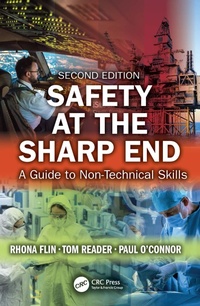
Safety at the Sharp End
A Guide to Non-Technical Skills
2nd Edition
Published on 4. November 2025
340 pages
978-1-040-43855-8 (ISBN)
Description

Many 21st-century operations are characterized by teams of workers dealing with significant risks and complex technology, in competitive, commercially driven environments. Informed managers have realized the necessity of understanding the human dimension of their operations if they hope to improve production and safety performance. A key aspect is the non-technical skills of the system operators based at the 'sharp end' of the organization. These include the cognitive and social skills required for safe and efficient performance, often termed 'Crew Resource Management (CRM) skills'.
This book is a general guide to the theory and practice of non-technical skills (NTS) for safety. Now fully updated in this new edition, Safety at the Sharp End: A Guide to Non-Technical Skills considers the growth of interest in Crew Resource Management (CRM) approaches to identifying, training and assessing CRM/NTS skills. It covers the identification, training and evaluation of NTS and has been written for use by individuals who are studying or training these skills in CRM and other safety or human factors courses. It outlines the underlying principles, as well as practical techniques and advice and has been revised to cover the latest developments by drawing on a wider sample of work settings where an NTS approach is being adopted. A full literature review is offered, and the authors have drawn upon an international network of contacts across industry, military and healthcare occupations and academic sources to deliver current practice and emerging issues. The reader will develop a thorough understanding of the theory and practice of non-technical skills for safety from this title.
This book is an ideal read for professionals and those practising or studying human factors or industrial safety programmes. Its appeal will extend to those in safety-critical industries including healthcare, aviation, rail, maritime, energy production and the military.
This book:
* Delivers a comprehensive and accessible guide on non-technical skills (NTS) for practitioners.
* Focuses on the latest scientific evidence for each skill category written in an accessible manner.
* Explains the application of an NTS approach across a wide range of occupations.
* Covers the authors' extensive research and experience of collaborating with practitioners across a range of higher risk work settings resulting in practical examples throughout the text.
* Details a good range of sources provided for further reading and additional information.
This book is a general guide to the theory and practice of non-technical skills (NTS) for safety. Now fully updated in this new edition, Safety at the Sharp End: A Guide to Non-Technical Skills considers the growth of interest in Crew Resource Management (CRM) approaches to identifying, training and assessing CRM/NTS skills. It covers the identification, training and evaluation of NTS and has been written for use by individuals who are studying or training these skills in CRM and other safety or human factors courses. It outlines the underlying principles, as well as practical techniques and advice and has been revised to cover the latest developments by drawing on a wider sample of work settings where an NTS approach is being adopted. A full literature review is offered, and the authors have drawn upon an international network of contacts across industry, military and healthcare occupations and academic sources to deliver current practice and emerging issues. The reader will develop a thorough understanding of the theory and practice of non-technical skills for safety from this title.
This book is an ideal read for professionals and those practising or studying human factors or industrial safety programmes. Its appeal will extend to those in safety-critical industries including healthcare, aviation, rail, maritime, energy production and the military.
This book:
* Delivers a comprehensive and accessible guide on non-technical skills (NTS) for practitioners.
* Focuses on the latest scientific evidence for each skill category written in an accessible manner.
* Explains the application of an NTS approach across a wide range of occupations.
* Covers the authors' extensive research and experience of collaborating with practitioners across a range of higher risk work settings resulting in practical examples throughout the text.
* Details a good range of sources provided for further reading and additional information.
Reviews / Votes
Delivers a comprehensive and accessible guide on non-technical skills (NTS) for practitionersFocusses on the latest scientific evidence for each skill category written in an accessible manner
Explains the application of an NTS approach across a wide range of occupations
Covers the authors' extensive research and experience of collaborating with practitioners across a range of higher risk work settings resulting in practical examples throughout the text
Details a good range of sources provided for further reading and additional information
More details
Edition
2nd edition
Language
English
Place of publication
London
United Kingdom
Publishing group
Taylor & Francis Ltd
Target group
Professional and scholarly
Illustrations
19 Line drawings, black and white; 6 Halftones, black and white; 25 Illustrations, black and white
File size
9,72 MB
ISBN-13
978-1-040-43855-8 (9781040438558)
Copyright in bibliographic data and cover images is held by Nielsen Book Services Limited or by the publishers or by their respective licensors: all rights reserved.
Schweitzer Classification
Other editions
Additional editions
Book
11/2025
2nd Edition
CRC Press
€80.90
Shipment within 10-20 days
Book
11/2025
2nd Edition
CRC Press
€186.80
Shipment within 10-20 days
Persons
Rhona Flin (BSc, PhD Psychology) is Professor of Industrial Psychology at Aberdeen Business, Robert Gordon University and Emeritus Professor of Applied Psychology, University of Aberdeen, UK. She is a Chartered Psychologist, a Fellow of the British Psychological Society and of the Royal Society of Edinburgh. Her research examines human performance in high-risk work settings (e.g., energy sector, healthcare, aviation, emergency services) focusing on non-technical skills, safety and emergency response. She led the Scottish Patient Safety Research Network, was a Trustee of the Clinical Human Factors Group and a member of the Military Aviation Safety Committee at the Ministry of Defence. She holds Fellowships (ad hom.) from the Royal College of Surgeons Edinburgh and the Royal College of Physicians and Surgeons Glasgow for her research on non-technical skills in surgeons and anaesthetists.
Tom Reader (MA, PhD Psychology) is an Associate Professor of Psychology in the Department of Psychological and Behavioural Science at the London School of Economics (LSE), UK. He directs the MSc in Organizational and Social Psychology at LSE, and also leads the Culture and Risk Research Unit. Tom's research investigates the cultural processes that underlie accidents and organizational failures, and he studies how organizations and teams operating in high-risk contexts develop capabilities for effectively managing hazards and disruptions. He has worked in many high-risk domains (e.g., healthcare, aviation, energy, finance), and his research has been published in leading scientific journals on psychology and risk: for example, Journal of Applied Psychology, Human Factors, Human Relations, Risk Analysis, Journal of Occupational and Organizational Psychology and Safety Science.
Paul O'Connor (BSc, MSc, MA, PhD) is a Personal Professor and Human Factors Psychologist in the School of Medicine at the University of Galway, Republic of Ireland. He is the Director of the Irish Centre for Applied Patient Safety and Simulation, and Director of the Postgraduate programme in Healthcare Simulation and Patient Safety. His research and teaching are concerned with improving human performance and safety in high-risk work environments. He has worked with a wide range of industries (e.g., civil aviation, energy sector) and the military (e.g., aviation, special operations). In recent years his research and teaching have focused on healthcare simulation and the human factors that contribute to patient safety and quality of care.
Tom Reader (MA, PhD Psychology) is an Associate Professor of Psychology in the Department of Psychological and Behavioural Science at the London School of Economics (LSE), UK. He directs the MSc in Organizational and Social Psychology at LSE, and also leads the Culture and Risk Research Unit. Tom's research investigates the cultural processes that underlie accidents and organizational failures, and he studies how organizations and teams operating in high-risk contexts develop capabilities for effectively managing hazards and disruptions. He has worked in many high-risk domains (e.g., healthcare, aviation, energy, finance), and his research has been published in leading scientific journals on psychology and risk: for example, Journal of Applied Psychology, Human Factors, Human Relations, Risk Analysis, Journal of Occupational and Organizational Psychology and Safety Science.
Paul O'Connor (BSc, MSc, MA, PhD) is a Personal Professor and Human Factors Psychologist in the School of Medicine at the University of Galway, Republic of Ireland. He is the Director of the Irish Centre for Applied Patient Safety and Simulation, and Director of the Postgraduate programme in Healthcare Simulation and Patient Safety. His research and teaching are concerned with improving human performance and safety in high-risk work environments. He has worked with a wide range of industries (e.g., civil aviation, energy sector) and the military (e.g., aviation, special operations). In recent years his research and teaching have focused on healthcare simulation and the human factors that contribute to patient safety and quality of care.
Content
1. Introduction. 2 Situation Awareness. 3 Decision Making. 4 Communication. 5. Teamworking. 6 Leadership. 7 Stress. 8 Fatigue. 9 Identify. 10. Training. 11 Assessing. 12. Future directions
