

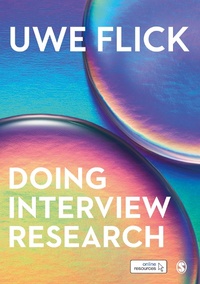
Doing Interview Research
The Essential How To Guide
1st Edition
Published on 13. October 2021
448 pages
978-1-5297-7031-5 (ISBN)
Description

If you want to use interview methods in your research project but are not sure where to start, this book will get you up and running. With hands-on advice for every stage of the social research process, it helps you succeed in every step, from understanding interview research through to designing and conducting your study and working with data.
The book:
Discusses eight methods of interviewing in-depth, including semi-structured interviews, narrative interviews, focus groups and online interviews.
Features over 75 case studies of real interview research from across the globe, including Australia, Canada, Germany, Norway, the Philippines and South Africa.
Spotlights strategies for conducting ethical, inclusive research, including indigenous research approaches.
Packed not only with learning features - including learning objectives, checklists of questions to ask yourself at every stage of your project, practical exercises to help you put your learning into practice and further reading so you can broaden your knowledge - it is also supported by online resources such as annotated transcripts and videos of mock interviews to empower any social science student to use interview research methods with confidence.
The book:
Discusses eight methods of interviewing in-depth, including semi-structured interviews, narrative interviews, focus groups and online interviews.
Features over 75 case studies of real interview research from across the globe, including Australia, Canada, Germany, Norway, the Philippines and South Africa.
Spotlights strategies for conducting ethical, inclusive research, including indigenous research approaches.
Packed not only with learning features - including learning objectives, checklists of questions to ask yourself at every stage of your project, practical exercises to help you put your learning into practice and further reading so you can broaden your knowledge - it is also supported by online resources such as annotated transcripts and videos of mock interviews to empower any social science student to use interview research methods with confidence.
Reviews / Votes
This book is not just yet another manual about interview procedures. Rather, the strength of this excellent extended discussion is that the author not only knows about interviews in theory, but is also experienced in actually putting that theory into practice when conducting interviews. This makes for a book that is able to address how to do interviews in a thoughtful and responsible way, as the discussion is grounded in the theoretical, ethical, methodological and practical thinking that shapes how interviews are conducted. -- Julianne Cheek A clear and practical guide to conducting research interviews for those inexperienced with qualitative methodologies and methods. -- Shanu Sadhwani Doing Interview Research is a comprehensive, captivating guide for carrying out interviews. It has everything the social science postgraduate researcher requires to explore the expansive nature of qualitative inquiry. A very informative resource for both students and supervisors. -- Jessica Clapham Uwe Flick tackles interviewing-a ubiquitous research method-in his exceptionally useful and user-friendly book. By ending each chapter with a recurring refrain-what you need to ask yourself, what you need to succeed, and what you learned-he invites readers to actively and reflexively engage with the material. -- Karen Staller This book gives the reader an excellent introduction to interview research. It provides rationales for choosing interviews and discusses when to do interviews and why. It is a comprehensive and yet accessible book that includes the whole process, from designing interview research to conducting different types of interviews in different contexts, and to analyzing and reporting interview data. Throughout each step, Flick thoughtfully discusses epistemology, quality, critiques, and reflexivity, so the book offers the reader a theoretical approach at the same time as clear guidance on how to design and conduct interview research. -- Robert ThornbergMore details
Edition
1. Auflage
Language
English
Place of publication
London
United Kingdom
Publishing group
Sage Publications Ltd (Digital)
Target group
College/higher education
Product notice
Reflowable
ISBN-13
978-1-5297-7031-5 (9781529770315)
Copyright in bibliographic data and cover images is held by Nielsen Book Services Limited or by the publishers or by their respective licensors: all rights reserved.
Schweitzer Classification
Other editions
Additional editions

Book
10/2021
1st Edition
SAGE Publications Ltd
€142.50
Shipment within 15-20 days

Book
10/2021
1st Edition
SAGE Publications Ltd
€51.00
Shipment within 15-20 days
Person
Uwe Flick is Senior Professor of Qualitative Research in Social Science and Education at the Freie Universitaet Berlin, Germany. He is a trained psychologist and sociologist and received his PhD from the Freie Universitaet Berlin in 1988 and his Habilitation from the Technical University Berlin in 1994. He has been Professor of Qualitative Research at Alice Salomon University of Applied Sciences in Berlin, Germany and at the University of Vienna, Austria. Previously, he was Adjunct Professor at the Memorial University of Newfoundland in St. John's, Canada; a Lecturer in research methodology at the Freie Universitaet Berlin; a Reader and Assistant Professor in qualitative methods and evaluation at the Technical University Berlin; and Associate Professor and Head of the Department of Medical Sociology at the Hannover Medical School. He has held visiting appointments at the London School of Economics, the Ecole des Hautes Etudes en Sciences Sociales in Paris, Cambridge University (UK), Memorial University of St John's (Canada), University of Lisbon (Portugal), Institute of Higher Studies in Vienna, in Italy and Sweden, and the School of Psychology at Massey University, Auckland (New Zealand). His main research interests are qualitative methods, social representations in the fields of individual and public health, vulnerability in fields like youth homelessness or (forced) migration and chronical illness in everyday live. He is the editor of The SAGE Handbook of Qualitative Research Design (2 Vols.; Sage 2022). The SAGE Handbook of Qualitative Data Analysis (Sage, 2014), The SAGE Qualitative Research Kit (Sage, 2nd edn, 2018), A Companion to Qualitative Research (Sage, 2004), Psychology of the Social (Cambridge University Press, 1998). His most recent publications are the seventh edition of An Introduction to Qualitative Research (Sage, 2023), Doing Grounded Theory (Sage, 2018), Doing Triangulation and Mixed Methods (Sage, 2018), The SAGE Handbook of Qualitative Data Collection (editor, Sage, 2018), the third edition of Introducing Research Methodology - Thinking Your Way through Your Research Project (Sage, 2020) and Doing Interview Research - The Essential How To Guide (Sage 2022). In 2019, Uwe Flick received the Lifetime Award in Qualitative Inquiry at the 15th International Congress of Qualitative Inquiry.
Content
Part I: How to Understand Interview Research
Chapter 1: What Doing Interview Research Means
Chapter 2: Theories and Epistemologies of Interviewing
Chapter 3: When to Choose Interviews as a Research Method
Chapter 4: Methods and Formats of Interviewing
Part II: Designing Interview Research
Chapter 5: Planning and Designing Interview Research
Chapter 6: How Many Interviewees?: Sampling and Saturation
Chapter 7: Accessing and Recruiting Participants
Part III: How to Conduct Interviews
Chapter 8: How to Respect and Protect: Ethics of Interviewing
Chapter 9: Semi-structured Interviews: Working with Questions and Answers
Chapter 10: Interviewing Experts and Elites
Chapter 11: Integrating Narratives in Interviews: Episodic Interviews
Part IV: Doing Interviews in Contexts
Chapter 12: How to Work with Life Histories: Narrative Interviews
Chapter 13: Working with Focus Groups as Interviews
Chapter 14: Ask in the Field: Ethnographic and Mobile Interviewing
Chapter 15: Doing Online Interviews
Part V: How to Work with Interview Data
Chapter 16: Working with Interview Data
Chapter 17: Credibility and Transparency: Quality and Writing in Interview Research
Chapter 18: From Interviewing to an Inner View: Critiques and Reflexivity
Chapter 1: What Doing Interview Research Means
Chapter 2: Theories and Epistemologies of Interviewing
Chapter 3: When to Choose Interviews as a Research Method
Chapter 4: Methods and Formats of Interviewing
Part II: Designing Interview Research
Chapter 5: Planning and Designing Interview Research
Chapter 6: How Many Interviewees?: Sampling and Saturation
Chapter 7: Accessing and Recruiting Participants
Part III: How to Conduct Interviews
Chapter 8: How to Respect and Protect: Ethics of Interviewing
Chapter 9: Semi-structured Interviews: Working with Questions and Answers
Chapter 10: Interviewing Experts and Elites
Chapter 11: Integrating Narratives in Interviews: Episodic Interviews
Part IV: Doing Interviews in Contexts
Chapter 12: How to Work with Life Histories: Narrative Interviews
Chapter 13: Working with Focus Groups as Interviews
Chapter 14: Ask in the Field: Ethnographic and Mobile Interviewing
Chapter 15: Doing Online Interviews
Part V: How to Work with Interview Data
Chapter 16: Working with Interview Data
Chapter 17: Credibility and Transparency: Quality and Writing in Interview Research
Chapter 18: From Interviewing to an Inner View: Critiques and Reflexivity
