

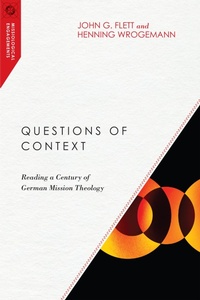
Questions of Context
Description

The gospel is for every tribe, tongue, and nation (Revelation 7:9), but there is no single biblical or theological model for the relationship between the gospel and these diverse cultures. Indeed, every suggested approach carriesits own range of philosophical and theological commitments that all too often remain unexamined. Contextualization is fraught with challenges-yet wrestling with questions of context is essential for how we understand mission, theology, and the embodiment of the Christian faith.
German missiology has engaged these questions in a variety of ways that can both inform and critique Anglo-American traditions. In this compilation and analysis, John Flett and Henning Wrogemann translate and comment on a core thread of German missiological works, explaining both their historical and current significance. Drawn from journals and books across a century of academic discourse, these classic writings trace developments from Gustav Warneck, the father of contemporary missiology, through key thinkers such as Karl Hartenstein, who coined the term missio Dei, down to twenty-first century discussions of intercultural hermeneutics. Along the way they reveal advances, mistakes, and changingdefinitions as German missiologists interacted with the cultural and political realities of their time.
This longitudinal study, showcasing many texts available in English for the first time, tackles the history and dynamics of contextualization head-on and sheds new light on the state of missiology today. We are reminded, Flett and Wrogemann argue, that we must keep working to honor difference within the worldwide Christian community as necessary to the fullness of our being in Christ.
Missiological Engagements charts interdisciplinary and innovative trajectories in the history, theology, and practice of Christian mission, featuring contributions by leading thinkers from both the Euro-American West and the majority world whosemissiological scholarship bridges church, academy, and society.
More details
Other editions
Additional editions
Person
Henning Wrogemann (DTheol, DHabil, Ruprecht-Karls University of Heidelberg) is a world-renowned missiologist and scholar of religion. He holds the chair for mission studies, comparative religion, and ecumenics at the Protestant University Wuppertal/Bethel in Germany, where he also heads the Institute for Intercultural Theology and Interreligious Studies. He is the author of Intercultural Theology.
John G. Flett (PhD, Princeton Theological Seminary; DHabil, Kirchliche Hochschule Wuppertal/Bethel) lectures in intercultural theology and mission studies at Pilgrim Theological College, part of the University of Divinity in Melbourne, Australia. He is the author of Apostolicity: The Ecumenical Question in World Christian Perspective and The Witness of God: The Trinity, Missio Dei, Karl Barth and the Nature of Christian Community and is ordained in the Uniting Church in Australia.
Content
Acknowledgments Introduction: Is It Possible to Abandon Contextualization? 1. At the Beginning of German Mission Theory 2. Grounded in the Orders of Creation 3. Eschatology and Agency 4. The Widening of Horizons 5. Hermeneutics, Communication, and Translation 6. Intercultural Theology Conclusion: The Proper Complexity of Context Bibliography
