

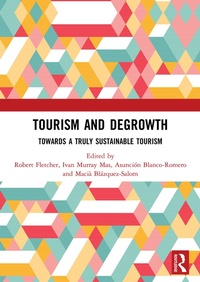
Tourism and Degrowth
Towards a Truly Sustainable Tourism
1st Edition
Published on 29. June 2020
222 pages
978-1-000-06634-0 (ISBN)
Description

Tourism and Degrowth develops a conceptual framework and research agenda for exploring the relationship between tourism and degrowth.
Rapid and uneven expansion of tourism as a response to the 2008 economic crisis has proceeded in parallel with the rise of social discontent concerning so-called "overtourism." Meanwhile, despite decades of concerted global effort to achieve sustainable development, socioecological conflicts and inequality have rarely reversed, but in fact increased in many places. Degrowth, understood as both social theory and social movement, has emerged within the context of this global crisis. However, thus far the vibrant degrowth discussion has yet to engage systematically with the tourism industry in particular, while, by the same token, tourism research has largely neglected explicit discussion of degrowth.
This volume brings the two discussions together to interrogate their complementarity. Identifying a growth imperative in the basic structure of the capitalist economy, the contributors contend that mounting critique of overtourism can be understood as a structural response to the ravages of capitalist development more broadly. Debate concerning overtourism thus offers a valuable opportunity to re-politicise discussion of tourism development generally.
Exploring of the potential for degrowth to facilitate a truly sustainable tourism, Tourism and Degrowth will be of great interest to scholars of tourism, environmental sustainability and development. The chapters were originally published as a special issue of the Journal of Sustainable Tourism.
Rapid and uneven expansion of tourism as a response to the 2008 economic crisis has proceeded in parallel with the rise of social discontent concerning so-called "overtourism." Meanwhile, despite decades of concerted global effort to achieve sustainable development, socioecological conflicts and inequality have rarely reversed, but in fact increased in many places. Degrowth, understood as both social theory and social movement, has emerged within the context of this global crisis. However, thus far the vibrant degrowth discussion has yet to engage systematically with the tourism industry in particular, while, by the same token, tourism research has largely neglected explicit discussion of degrowth.
This volume brings the two discussions together to interrogate their complementarity. Identifying a growth imperative in the basic structure of the capitalist economy, the contributors contend that mounting critique of overtourism can be understood as a structural response to the ravages of capitalist development more broadly. Debate concerning overtourism thus offers a valuable opportunity to re-politicise discussion of tourism development generally.
Exploring of the potential for degrowth to facilitate a truly sustainable tourism, Tourism and Degrowth will be of great interest to scholars of tourism, environmental sustainability and development. The chapters were originally published as a special issue of the Journal of Sustainable Tourism.
More details
Edition
1. Auflage
Language
English
Place of publication
London
United Kingdom
Publishing group
Taylor & Francis Ltd
Target group
College/higher education
ISBN-13
978-1-000-06634-0 (9781000066340)
Copyright in bibliographic data and cover images is held by Nielsen Book Services Limited or by the publishers or by their respective licensors: all rights reserved.
Schweitzer Classification
Other editions
Additional editions
Robert Fletcher | Ivan Murray Mas | Asuncion Blanco Romero
Tourism and Degrowth
Towards a Truly Sustainable Tourism
Book
06/2021
1st Edition
Routledge
€65.20
Shipment within 15-20 days
Robert Fletcher | Ivan Murray Mas | Asuncion Blanco Romero
Tourism and Degrowth
Towards a Truly Sustainable Tourism
Book
03/2020
1st Edition
Routledge
€179.51
Shipment within 15-20 days
Persons
Robert Fletcher is Associate Professor in the Sociology of Development and Change group at Wageningen University in the Netherlands. He is the author of Romancing the Wild: Cultural Dimensions of Ecotourism (2014) and co-editor of NatureTM Inc.: Environmental Conservation in the Neoliberal Age (2014).
Ivan Murray holds a PhD in Geography from the University of the Balearic Islands and a MsC in Environmental Sustainability from the University of Edinburgh. He is Associate Professor of geography at the University of the Balearic Islands, where he is also a member of the research group on sustainability and space. His research merges political ecology, political economy and ecological economics of tourism. Recently, he co-edited Turistificacion global: Perspectivias criticas en turismo with Ernest Canada. He is also involved in social movements.
Asuncion Blanco-Romero is Associate Professor of Geography at the Universitat Autonoma de Barcelona, and also participates with the National University of Distance Education, the Universitat Oberta de Catalunya and the OSTELEA School of Tourism and Hospitality. She is member of TUDISTAR research group (tourism and new social and territorial dynamics), with which she has participated in several research projects. Her research focuses on cultural and heritage tourism, new tourisms and local development, tourism and degrowth and geography and gender issues in regional development.
Macia Blazquez-Salom is Associate Professor in the Department of Geography at the University of the Balearic Islands. His research interests include tourism, territorial planning and nature conservation from a sustainability perspective. He has been visiting scholar in several European and Central American universities. His most recent publications deal with urban and regional planning regulation and the expansion of the Balearic Islands' hotel chains in Central America and the Caribbean.
Ivan Murray holds a PhD in Geography from the University of the Balearic Islands and a MsC in Environmental Sustainability from the University of Edinburgh. He is Associate Professor of geography at the University of the Balearic Islands, where he is also a member of the research group on sustainability and space. His research merges political ecology, political economy and ecological economics of tourism. Recently, he co-edited Turistificacion global: Perspectivias criticas en turismo with Ernest Canada. He is also involved in social movements.
Asuncion Blanco-Romero is Associate Professor of Geography at the Universitat Autonoma de Barcelona, and also participates with the National University of Distance Education, the Universitat Oberta de Catalunya and the OSTELEA School of Tourism and Hospitality. She is member of TUDISTAR research group (tourism and new social and territorial dynamics), with which she has participated in several research projects. Her research focuses on cultural and heritage tourism, new tourisms and local development, tourism and degrowth and geography and gender issues in regional development.
Macia Blazquez-Salom is Associate Professor in the Department of Geography at the University of the Balearic Islands. His research interests include tourism, territorial planning and nature conservation from a sustainability perspective. He has been visiting scholar in several European and Central American universities. His most recent publications deal with urban and regional planning regulation and the expansion of the Balearic Islands' hotel chains in Central America and the Caribbean.
Content
Foreword by Filka Sekulova 1. Tourism and degrowth: an emerging agenda for research and praxis Robert Fletcher, Ivan Murray Mas, Asuncion Blanco-Romero and Macia Blazquez-Salom 2. Territorial tourism planning in Spain: from boosterism to tourism degrowth? Macia Blazquez-Salom, Asuncion Blanco-Romero, Fernando Vera-Rebollo and Josep Ivars-Baidal 3. Growth machines and social movements in mature tourist destinations Costa del Sol-Malaga Enrique Navarro-Jurado, Yolanda Romero-Padilla, Jose Maria Romero-Martinez, Eduardo Serrano-Munoz, Sabina Habegger and Ruben Mora-Esteban 4. Overtourism, optimisation, and destination performance indicators: a case study of activities in Fjord Norway Ove Oklevik, Stefan Gossling, C. Michael Hall, Jens Kristian Steen Jacobsen, Ivar Petter Grotte and Scott McCabe 5. Tourism as a right: a "frivolous claim" against degrowth? Jordi Gascon 6. Post-growth in the Tropics? Contestations over Tri Hita Karana and a tourism megaproject in Bali Made Adityanandana and Julien-Francois Gerber 7. Overtourism and degrowth: a social movements perspective Claudio Milano, Marina Novelli and Joseph M. Cheer 8. The social construction of the tourism degrowth discourse in the Balearic Islands Joaquin Valdivielso and Joan Moranta 9. Community-owned tourism and degrowth: a case study in the Kichwa Anangu community Sarah Rachelle Renkert 10. Buen Vivir: Degrowing extractivism and growing wellbeing through tourism Natasha Chassagne and Phoebe Everingham 11. Degrowing tourism: rethinking tourism Freya Higgins-Desbiolles, Sandro Carnicelli, Chris Krolikowski, Gayathri Wijesinghe and Karla Boluk Postscript
