

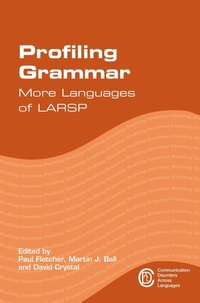
Profiling Grammar
More Languages of LARSP
Published on 2. February 2016
289 pages
978-1-78309-488-2 (ISBN)
Description

This book brings together twelve previously unpublished language profiles based on the original Language Assessment, Remediation and Screening Procedure (LARSP). The languages featured are: Afrikaans, Bulgarian, Cantonese, Finnish, Greek, Hindi, Hungarian, Japanese, Kannada, Korean, Malay and Swedish. Each chapter includes a grammatical sketch of the language, details of typical language development in speakers of the language, as well as a description of and justification for the profile itself. The book will be an invaluable resource for speech-language pathologists and others wishing to analyse the grammatical abilities of individuals speaking one of these languages. This new collection complements a previous book in this series on the same theme: Assessing Grammar: The Languages of LARSP (Ball et al., 2012,).
Reviews / Votes
This well-conceived and innovative volume breathes new life into LARSP, extending the number of languages to which it has now been applied to 24, with the promise of more to come. Not only does it thus make LARSP available to many more clinicians around the world, but by providing a common template for linguistic comparison it also gives added impetus to crosslinguistic research into both typical and atypical language use and development. * Mick Perkins, University of Sheffield, UK * This second volume of research on LARSP provides important new information on 12 Asian, European and South African languages. Each chapter offers a concise overview of that language's grammar, a synopsis of research on children's grammatical development and a language-specific profile chart. Along with a chapter providing a fresh look at LARSP stage V in English-speaking children, this unique book will be a valuable resource to clinicians and researchers. * Thomas Klee, University of Hong Kong, Hong Kong *More details
Series
Language
English
Place of publication
Bristol
United Kingdom
Publishing group
Channel View Publications Ltd
Target group
College/higher education
Professional and scholarly
ISBN-13
978-1-78309-488-2 (9781783094882)
Copyright in bibliographic data and cover images is held by Nielsen Book Services Limited or by the publishers or by their respective licensors: all rights reserved.
Schweitzer Classification
Other editions
Additional editions
Book
02/2016
Multilingual Matters
€182.50
Shipment within 10-20 days
Persons
Paul Fletcher is Emeritus Professor of Speech and Hearing Sciences at University College Cork, Ireland. Since the 1970s he has published widely on language development and language impairment in children speaking English, and more recently on those speaking Cantonese and Mandarin. His research focus, initially primarily on syntax, has broadened to include vocabulary, and the interaction between vocabulary and syntax in language development. He is the author, with Ciara O'Toole, of Language Development and Language Impairment: A Problem-based Introduction (2016).
Martin J. Ball is Professor of Speech Language Pathology at Linkoeping University, Sweden. He is co-editor of the journal Clinical Linguistics and Phonetics (Taylor & Francis), and the book series Communication Disorders Across Languages (Multilingual Matters). His main research interests include sociolinguistics, clinical phonetics and phonology, and the Celtic languages.
David Crystal is Honorary Professor of Linguistics at the University of Bangor, UK. Since 1984, he has worked from his home in Holyhead, North Wales as a writer, editor, lecturer and broadcaster on linguistics, applied linguistics, and English language studies. His books include The Cambridge Encyclopedia of Language (3rd edn, 2010), The Stories of English (2004) and Making a Point; the Pernickety Story of English Punctuation (2015).
Martin J. Ball is Professor of Speech Language Pathology at Linkoeping University, Sweden. He is co-editor of the journal Clinical Linguistics and Phonetics (Taylor & Francis), and the book series Communication Disorders Across Languages (Multilingual Matters). His main research interests include sociolinguistics, clinical phonetics and phonology, and the Celtic languages.
David Crystal is Honorary Professor of Linguistics at the University of Bangor, UK. Since 1984, he has worked from his home in Holyhead, North Wales as a writer, editor, lecturer and broadcaster on linguistics, applied linguistics, and English language studies. His books include The Cambridge Encyclopedia of Language (3rd edn, 2010), The Stories of English (2004) and Making a Point; the Pernickety Story of English Punctuation (2015).
Content
Contributors
Introduction
1. Claire Penn and Heila Jordaan: Afrikaans LARSP: Past and Future?
2. Stavroula Stavrakaki and Areti Okalidou: Gr-LARSP: Towards a Greek Version of LARSP
3. Maria Rosenberg and Ingmarie Mellenius: Swe-LARSP: A Grammatical Profile of Swedish
4. Sari Kunnari, Lea Nieminen and Paeivi Torvelainen: FIN-LARSP: Morphosyntactic Profiling of Finnish Children
5. Ferenc Bunta, Maria Gosy and Judit Bona: HU-LARSP: Assessing Children's Language Skills in Hungarian
6. Brajesh Priyadarshi, Ramesh Kaipa and Shyamala K. Chengappa: Grammatical Profile of Hindi-speaking Children: H-LARSP
7. Varun Uthappa A. G., Shyamala K. Chengappa and Ramesh Kaipa: K-LARSP: A Grammatical Profile of Kannada-speaking Children
8. Rogayah A. Razak, Lixian Jin, Lim Hui Woan and Mohd Azmarul A. Aziz: Profiling Malay Children's Syntactic Development: A Malay-LARSP
9. Man Tak Leung and Hong Lan Li: Cantonese LARSP: A Procedure for Assessment and Remediation for Cantonese-speaking Children
10. Tomohiko Itoh and Manabu Oi: Japanese: Devising the J-LARSP
11. Soyeong Pae: Korean LARSP: a Korean Language Assessment, Remediation, Screening Procedure
12. Cynthia Vakareliyska: Language-Specific Issues for the Bulgarian LARSP Profile and Adult Aphasia Examinations
13. Paul Fletcher and Pauline Frizelle: Complex Sentences in Development and Impairment: LARSP Stage V Revisited
Introduction
1. Claire Penn and Heila Jordaan: Afrikaans LARSP: Past and Future?
2. Stavroula Stavrakaki and Areti Okalidou: Gr-LARSP: Towards a Greek Version of LARSP
3. Maria Rosenberg and Ingmarie Mellenius: Swe-LARSP: A Grammatical Profile of Swedish
4. Sari Kunnari, Lea Nieminen and Paeivi Torvelainen: FIN-LARSP: Morphosyntactic Profiling of Finnish Children
5. Ferenc Bunta, Maria Gosy and Judit Bona: HU-LARSP: Assessing Children's Language Skills in Hungarian
6. Brajesh Priyadarshi, Ramesh Kaipa and Shyamala K. Chengappa: Grammatical Profile of Hindi-speaking Children: H-LARSP
7. Varun Uthappa A. G., Shyamala K. Chengappa and Ramesh Kaipa: K-LARSP: A Grammatical Profile of Kannada-speaking Children
8. Rogayah A. Razak, Lixian Jin, Lim Hui Woan and Mohd Azmarul A. Aziz: Profiling Malay Children's Syntactic Development: A Malay-LARSP
9. Man Tak Leung and Hong Lan Li: Cantonese LARSP: A Procedure for Assessment and Remediation for Cantonese-speaking Children
10. Tomohiko Itoh and Manabu Oi: Japanese: Devising the J-LARSP
11. Soyeong Pae: Korean LARSP: a Korean Language Assessment, Remediation, Screening Procedure
12. Cynthia Vakareliyska: Language-Specific Issues for the Bulgarian LARSP Profile and Adult Aphasia Examinations
13. Paul Fletcher and Pauline Frizelle: Complex Sentences in Development and Impairment: LARSP Stage V Revisited
