

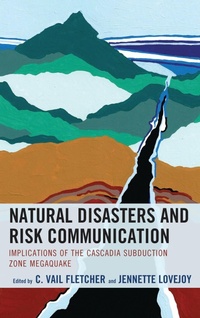
Natural Disasters and Risk Communication
Implications of the Cascadia Subduction Zone Megaquake
1st Edition
Published on 23. May 2018
1 pages
979-8-216-21110-5 (ISBN)
Description

Natural Disasters and Risk Communication: Implications of the Cascadia Subduction Zone Megaquake asks and addresses how we communicate about natural disasters and what effect our communication has on natural disaster education, understanding, assessment of risk, preparation, and recovery. The chapters of this book present expertise, analyses, and perspectives that are designed to help us better comprehend and deal with the natural risks such as the Cascadia Subduction Zone. It seeks to move past primal, fear-induced physiological and emotional responses to crises with the understanding that if we accept that the disaster will occur, expect it, and learn how we can prepare, we can calm the collective panicked beats of our hearts as we wait for its first tremors.
More details
Series
Edition
1. Auflage
Language
English
Place of publication
United States
Publishing group
Bloomsbury Publishing Plc
Target group
Professional and scholarly
Illustrations
1 b/w illustration; 17 b/w photos; 11 table; 18 graphs
ISBN-13
979-8-216-21110-5 (9798216211105)
Copyright in bibliographic data and cover images is held by Nielsen Book Services Limited or by the publishers or by their respective licensors: all rights reserved.
Schweitzer Classification
Other editions
Additional editions
C. Vail Fletcher | Jennette Lovejoy
Natural Disasters and Risk Communication
Implications of the Cascadia Subduction Zone Megaquake
Book
05/2018
Lexington Books
€140.90
Shipment within 15-20 days
Persons
C. Vail Fletcher is associate professor in the Department of Communication at the University of Portland.
Jennette Lovejoy is associate professor in the Department of Communication at the University of Portland.
Jennette Lovejoy is associate professor in the Department of Communication at the University of Portland.
Content
Acknowledgements
Foreword
Kathryn Schulz
1. Introduction
Conceptualizing Risk: Media Coverage and Natural Disasters
Jennette Lovejoy
Part 1: Cascadia Subduction Zone: Geological Background and Predicting Preparedness in the Pacific Northwest
2. Cascadia Earthquake Science and Hazards
Robert F. Butler
3. Risk Perception and Earthquake Preparedness Motivation: Predicting Responses to a Cascadia Subduction Zone Catastrophic Event
Bradley Adame and Claude Miller
Part 2: Confronting Risk Information: Rhetorical Framing in the Media and Stages of Crisis
4. The article that shook the public: A comparative study of "The Really Big One" and other earthquake news coverage
Julie Homchick Crowe
5. A "Fast and Frugal" Approach to Risk Judgment and Decision-Making and its Implications for Natural Disaster
Kai Kuang
Part 3: Local and Global Case Studies: Analyzing Demographic, Attitude and Economic Factors in Natural Disasters
6. Public risk perception attitudes on flooding by different societal sectors: An investigation based on the August 2016 flood in Louisiana
Do Kyun Kim and Phillip Madison
7. Economic Evaluation of Multi-Hazard Risk Information in Japan: Implication for Earthquake Risk Communication
Hiroaki Matsuura and Keiichi Sato
Part 4: Community, Organizing, and Resilience: Pragmatic Considerations
8. Families, Companion Animals, and the CSZ Disaster: Implications for Crisis and Risk Communication
Julie M. Novak and Ashleigh Day
9. What is to be Done?-A Preparedness Polemic
Yianni Doulis
10. Nature, Fear, and Bewilderment: An Anthropcenic (Dis)Connect
C. Vail Fletcher
Epilogue
Chris Goldfinger
Index
About the Contributors
Foreword
Kathryn Schulz
1. Introduction
Conceptualizing Risk: Media Coverage and Natural Disasters
Jennette Lovejoy
Part 1: Cascadia Subduction Zone: Geological Background and Predicting Preparedness in the Pacific Northwest
2. Cascadia Earthquake Science and Hazards
Robert F. Butler
3. Risk Perception and Earthquake Preparedness Motivation: Predicting Responses to a Cascadia Subduction Zone Catastrophic Event
Bradley Adame and Claude Miller
Part 2: Confronting Risk Information: Rhetorical Framing in the Media and Stages of Crisis
4. The article that shook the public: A comparative study of "The Really Big One" and other earthquake news coverage
Julie Homchick Crowe
5. A "Fast and Frugal" Approach to Risk Judgment and Decision-Making and its Implications for Natural Disaster
Kai Kuang
Part 3: Local and Global Case Studies: Analyzing Demographic, Attitude and Economic Factors in Natural Disasters
6. Public risk perception attitudes on flooding by different societal sectors: An investigation based on the August 2016 flood in Louisiana
Do Kyun Kim and Phillip Madison
7. Economic Evaluation of Multi-Hazard Risk Information in Japan: Implication for Earthquake Risk Communication
Hiroaki Matsuura and Keiichi Sato
Part 4: Community, Organizing, and Resilience: Pragmatic Considerations
8. Families, Companion Animals, and the CSZ Disaster: Implications for Crisis and Risk Communication
Julie M. Novak and Ashleigh Day
9. What is to be Done?-A Preparedness Polemic
Yianni Doulis
10. Nature, Fear, and Bewilderment: An Anthropcenic (Dis)Connect
C. Vail Fletcher
Epilogue
Chris Goldfinger
Index
About the Contributors
