

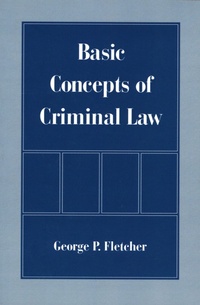
Basic Concepts of Criminal Law
Published on 3. September 1998
236 pages
978-0-19-972921-0 (ISBN)
Description

In the United States today criminal justice can vary from state to state, as various states alter the Modern Penal Code to suit their own local preferences and concerns. In Eastern Europe, the post-Communist countries are quickly adopting new criminal codes to reflect their specific national concerns as they gain autonomy from what was once a centralized Soviet policy. As commonalities among countries and states disintegrate, how are we to view the basic concepts of criminal law as a whole?
Eminent legal scholar George Fletcher acknowledges that criminal law is becoming increasingly localized, with every country and state adopting their own conception of punishable behavior, determining their own definitions of offenses. Yet by taking a step back from the details and linguistic variations of the criminal codes, Fletcher is able to perceive an underlying unity among diverse systems of criminal justice. Challenging common assumptions, he discovers a unity that emerges not on the surface of statutory rules and case law but in the underlying debates that inform them.
Basic Concepts of Criminal Law identifies a set of twelve distinctions that shape and guide the controversies that inevitably break out in every system of criminal justice. Devoting a chapter to each of these twelve concepts, Fletcher maps out what he considers to be the deep structure of all systems of criminal law. Understanding these distinctions will not only enable students to appreciate the universal fundamental ideas of criminal law, but will enable them to understand the significance of local details and variations.
This accessible illustration of the unity of diverse systems of criminal justice will provoke and inform students and scholars of law and the philosophy of law, as well as lawyers seeking a better understanding of the law they practice.
More details
Other editions
Additional editions
Fletcher
Basic Concepts of Criminal Law
Book
10/1998
Oxford University Press Inc
€66.90
Shipment within 15-20 days

George Philip Fletcher
Basic Concepts of Criminal Law
Book
09/1998
Oxford University Press Inc
€43.33
Article exhausted; check different version
Content
- Intro
- Contents
- Introduction
- 1. Substance versus Procedure
- The Philosophical Problem: Substance versus Procedure
- The Burden of Proof: Half a Loaf
- The Distinction in Context
- 2. Punishment versus Treatment
- Two Constitutional Perspectives: Motive versus Impact
- The Purposes of Punishment
- The Conceptual Analysis of Punishment
- Punishment: Public and Private
- 3. Subject versus Object
- The Requirement of Human Action
- Acts and Omissions
- Commission by Omission
- Offenses of Failing to Act
- Alternative Approaches to Human Action
- Subject and Object in Criminal Procedure
- 4. Human Causes versus Natural Events
- The Domain of Causation
- How to Approach Causation
- Problem One: Alternative Sufficient Causes
- Problem Two: Proximate Cause
- Problem Three: Omissions
- Causation in Ordinary Language
- Ideology and Causation
- 5. The Crime versus the Offender
- The Basics of Wrongdoing
- The Basics of Attribution
- The Operative Significance of the Distinction
- A Problem in the Borderland: Putative Self-Defense
- 6. Offenses versus Defenses
- Disputes about the Burden of Persuasion
- From Defeasible to Comprehensive Rules
- Formal Reasoning
- The Presumption of Innocence
- The Moral Theory of Guilt
- The Necessity of the Distinction Between Offense and Defense
- Can a Statutory Justifiction Be Unlawful?
- 7. Intentions versus Negligence
- Accidents and Negligence
- Negligence: Objective and Subjective
- The Structure of Culpable Intentions
- On Motives
- The Distinction Between Intention and Negligence Revisited
- 8. Self-Defense versus Necessity
- Se Defendendo and Necessity as Excuses
- Self-Defense as a Justification
- Necessity or Lesser Evils as a Justification
- Conflicts Between Self-Defense and Necessity
- 9. Relevant versus Irrelevant Mistakes
- Irrelevant Mistakes
- Mistakes about Factual Elements of the Definition (Type One)
- Mistakes about Legal Aspects of the Definition (Type Two)
- Mistakes about Factual Elements of Justification (Type Three)
- Putative Justification Negates the Required Intent
- Strict Liability: The Mistake Is Deemed Irrelevant
- Putative Justification Is Itself Justification
- Reasonable Mistake as an Excuse
- Mistakes about the Norms of Justifiction (Type Four)
- Mistakes about the Factual Elements of Excuses (Type Five)
- Mistakes about Excusing Norms (Type Six)
- Summary of Mistakes: Relevant and Irrelevant
- 10. Attempts versus Completed Offenses
- The Search for the Primary Offense
- The Structure of Attempts: Impossibility
- The Structure of Attempts: Abandonment
- 11. Perpetration versus Complicity
- The Formal Equivalence of Perpetrators and Accomplices
- The Differentiation of Perpetrators from Other Participants
- Two Problematic Variations
- The Expansion of Corporate Criminal Liability
- 12. Justice versus Legality
- The Complexities of Legality
- The Legal Nature of the Twelve Basic Distinctions
- Implicit Principles
- Index
- A
- B
- C
- D
- E
- F
- G
- H
- I
- J
- K
- L
- M
- N
- O
- P
- R
- S
- T
- U
- V
- W
