

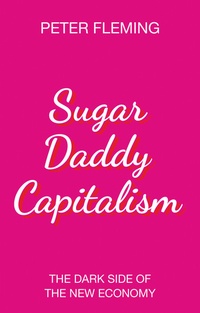
Sugar Daddy Capitalism
Description

More details
Other editions
Additional editions
Content
* Introduction: The Economics of Sleaze
* Chapter One: Uberfamiliar
* Chapter Two: Sugar Daddy Capitalism
* Chapter Three: Wiki-Feudalism
* Chapter Four: The Human ... All Too Human Workplace
* Chapter Five: No More Buddy Buddy
* Conclusion: Less Human
Introduction
The Economics of Sleaze
In October 2017, Hollywood mogul Harvey Weinstein was embroiled in a remarkable scandal that would have far-reaching consequences. It was alleged that for many years he'd abused his considerable power by sexually harassing and assaulting young women.1 After the first accusation hit the headlines, other women stepped forward. It wasn't just aspiring actresses who had fallen prey to his lechery, but employees in his own company too.2 In subsequent weeks the scandal would significantly widen, with iconic actors and directors accused of similar behaviour.
Most focused on Weinstein's louche character, casting the issue in strictly moral terms. Other commentators, however, suggested we place his predation in an economic context, one that is conducive of such behaviour.3 A trade union official pointed out that the situation faced by Weinstein's staff is typical of that in many jobs today: 'think about a young woman doing bar work, or working in hotels; all those kind of jobs where you can be replaced overnight if you don't play along'.4 Vulnerable women were easy targets for Weinstein because the economic penalties they'd incur for rejecting his sexual advances were clear.5 Weinstein had other ways to keep people quiet. His company insisted employees sign non-disclosure agreements.6 And when his victims threatened to go public, he hired corporate-intelligence agents - including ex-Mossad spies - to besmirch their reputations.7
Regardless, it didn't take long for the world to find out what was going on. The most creepy revelation was about Weinstein's notorious 'business meetings'. He would have an assistant invite young women to a hotel bar on the pretence of a job opportunity. Soon they'd be in his private room. Finally Weinstein would be standing there in a bathrobe demanding a massage. One victim recalls her business meeting with the film producer. The description is interesting because it foregrounds the complex entanglement of career advancement, sleaze and power:
I, too, went to the meeting thinking that perhaps my entire life was about to change for the better. I, too, was asked to meet him in a hotel bar. I, too, met a young, female assistant there who said the meeting had been moved upstairs to his suite because he was a very busy man. I, too, felt my guard go up but was calmed by the presence of another woman my age beside me. I, too, felt terror in the pit of my stomach when that young woman left the room and I was suddenly alone with him. I, too, was asked if I wanted a massage, champagne, strawberries. I, too, sat in that chair paralyzed by mounting fear when he suggested we shower together. What could I do? How not to offend this man, this gatekeeper, who could anoint or destroy me?8
The scandal soon rocked other institutions far away from Hollywood, including the Houses of Parliament in London, as women told their own stories during the '#Me Too' campaign.9 A culture of sexual harassment at Parliament Buildings had allegedly been festering for years and was now out of control. It was revealed that one MP even had a young assistant (whom he called 'sugar tits') purchase sex toys for his mistress.10 A specific employment arrangement prevailed here too. Westminster assistants 'are effectively self-employed' and thus on the nasty end of a very unequal power relationship.11 They have few protections like those of regular workers and are basically on their own. Finally, there is what I call the neoliberal knockout punch in this regard: if workers don't like any of this, then no one's pointing a gun at their head. They're always free to leave.
Penis Captivus
This book is not really about sexual harassment. But these disturbing cases do help capture a broader shift in Western economies that I want to explore: namely, deformalization, whereby public officialdom and regulatory protection are absent in the business world. The deformalization of Western capitalism is a delayed and largely unanticipated outcome of the neoliberal revolution masterminded by neoclassical economists, particularly F. A. Hayek and Milton Friedman of the 'Chicago School'.
This loose group of scholars and academic activists didn't agree on all matters (Hayek challenged Friedman on monetary policy, for example). But they did share one dream. In an ideal society everyone would interact on a strictly private and personal basis. Money and self-interest would be the only universal principles permitted, with governments coming into the picture only as a last resort.12 Hence their undivided love of capitalism.
Margaret Thatcher and Ronald Reagan were so bewitched by the Chicago School that they made it their life mission to liberate capitalism from the shackles of big government. Business can regulate itself; private-market individualism represents the ultimate pinnacle of personal freedom; we no longer need governmental standards, labour laws or unions; pay rates and contractual terms/conditions are a private matter, negotiated behind closed doors between individuals. As long as it's legal, anything goes. It is little wonder that Harvey Weinstein soon makes an appearance to exploit the grey zones of this new economic universe.
Informality isn't bad per se, of course. Some of the most progressive and spontaneously cooperative gestures have emerged outside the state and big business.13 But I want to explore deformalization specifically in relation to market individualism. It's being disseminated everywhere. How exactly did the cool rationalization of daily life under neoliberal capitalism end up intersecting with a reliance on some all-too-human power relationships, many of which are frighteningly arbitrary and contingent in nature?
On the surface, the ideas promoted by the Chicago School seem distant from the murky and underhand world of Weinstein and his backroom deals. Hayek and Friedman believed that capitalism unbarred would lead to a fairer society because our lives would be shaped by: (a) individual merit on the one hand, and (b) cold cash objectivity on the other. The economy could finally be rid of partiality and bias because the price mechanism has little respect for tradition, family connections or personal history. Whether you're black or white isn't important - green is the only colour that counts. Neoliberal thinkers loved the idea. Quantity or 'how much?' ought to be the only bond connecting people, not quality or 'who are you?' Hayek had such faith in the notion that he declared money to be man's greatest invention for obtaining liberty.14 If society was rebuilt around this tenet, then we'd all soon be rich micro-entrepreneurs, free to tailor our working lives to individual taste rather than be handcuffed to global standards imposed by trade unions and government.
This is all fantasy, of course. That's why reading Hayek's The Road to Serfdom or The Constitution of Liberty today is like encountering a work of fiction given how abstract its assumptions are.15 There are no real people involved. This is particularly so regarding its strident individualism, which has always been a dubious part of the mythology of capitalism. Hayek pursues it reductio ad absurdum and no society can function that way. Moreover, we now know that capitalist economies can't do without the state, since so-called 'free trade' requires a thick rulebook and governmental protection for big business interests. Indeed, if a welfare state still exists, it's geared towards helping corporations rather than those most in need.
Dark Corners
Although Hayek and Friedman are no longer seriously studied in mainstream economics and often dismissed as relics of the Cold War, their legacy is still writ large almost everywhere in Western societies today - but not quite in the way they envisaged, which is my point. Reorganizing society to privilege financial individualism didn't depersonalize business and commerce as boldly predicted in The Road to Serfdom. In fact, the opposite seems to have occurred, with Weinstein and the British Houses of Parliament indicative examples. Why so? As the public sphere recedes and the private sector grows to fill the gaps, trusted to regulate itself, the cash nexus certainly reigns supreme à la the Chicago School, but simultaneously takes on some very informal characteristics. Here, both questions of quantity ('how much?') and quality ('who are you?') inform economic life. That's mainly because the formalistic backdrop of legal protections and labour standards is not supposed to feature much in this new economic order.
This might be great if you are rich. But if you're not, then trouble soon looms. The isolated individual inevitably finds themselves in an insurmountable power struggle where all kinds of demands can be made of them because their bargaining leverage is limited. It's not hard to see why some bosses might take advantage of this, not only in the seedy way that Harvey Weinstein did, but in terms of economic exploitation too or what might be called flexploitation in the age of Uber-jobs. Positive informality - where close colleagues might help each other out, working around a pointless rule...
