

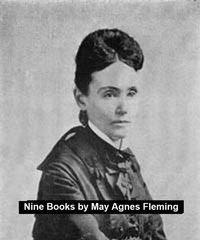
Nine Books
Description

This collection includes 9 books: The Actress' Daugher, The Baronet's Bride, Kate Danton, The Midnight Queen, Norine's Revenge, Sharing Her Crime, Sir Noel's Heir, A Terrible Secret, and The Unseen Bridegroom. According to Wikipedia: "May Agnes Fleming (November 15, 1840 - March 24, 1880) was a Canadian novelist. She was "one of the first Canadians to pursue a highly successful career as a writer of popular fiction." She was born May Early in Carleton, West Saint John, New Brunswick. She married an engineer, John W. Fleming in 1865. She moved to New York two years after her first novel, Erminie; or The gypsy's vow: a tale of love and vengeance was published there (1863). Under the pseudonym Cousin May Carleton, she published several serial tales in the New York Mercury and the New York Weekly. 21 were printed in book form, 7 posthumously. She also wrote under the pseudonym, M.A. Earlie. The exact count is unclear, since her works were often retitled, but is estimated at around 40, although some were not actually written by her, but were attributed to her by publishers cashing in on her popularity. At her peak, she was earning over $10,000 yearly, due to publishers granting her exclusive rights to her work."
All prices
More details
Content
CHAPTER VIII.. "COMING EVENTS CAST THEIR SHADOWS BEFORE."
"A look of pride, an eye of flame,
A full drawn lip that upward curled,
An eye that seemed to scorn the world."
The little town of Burnfield contained but one school, within the old brown walls and moss-grown eaves of which the "fathers of the hamlet" for many a generation had sat at the feet of some worthy pedagogue, or pedagoguess, as the case might be, to catch the wisdom that fell from their lips. In summer woman held her sway there, but in winter man reigned supreme on the throne of learning, and "boarded round," a custom not yet obsolete.
Once every year came the great anniversary of the school, the last day of April, when the "master's" term expired, and he left the town to the dominion of the new school-marm. Then took place the great public examination, in which lanky youths, weighed down with the consciousness of their responsibility and first tail-coats, and cherry-cheeked girls, bursting out of their hooks and eyes, showed off before the admiring Burnfieldians, and received their rewards of merit, more highly prized by them than the Cross of the Legion of Honor would be by some old French veteran. A new innovation had lately been introduced by one of the teachers--that of speaking dialogues at these distributions, and wonderful was the delight young Burnfield took in these displays. The more strait-laced of the parents at first objected to this, as smacking too much of "play acting," but young Burnfield had a decided will of its own, and looked contemptuously on the "slow" ideas of old Burnfield, and finally, in triumph, carried the day.
The great day arrived, and the anxious parents who had young ideas at school, were crowding rapidly toward the large old-fashioned school-house under the hill. Among them, in grim, unbending majesty, stalked Miss Jerusha Skamp, resplendent in what she was pleased to term her new "kaliker gound," a garment which partook of the nature of its forerunners in being exceedingly short and exceedingly skimpy, and the gorgeous patterns of which can be likened to nothing save a highly exaggerated rainbow. But Miss Jerusha, happy in the belief that nothing like it had appeared in modern times, walked majestically in, upsetting some loose benches, half a dozen small boys, and other trifles that lay in her way, and took her seat on one of the front benches. The boys, gorgeous in blue and gray homespun coats, with brass buttons of alarming size and brightness, were ranged on one side, and the girls, arrayed in all the hues of a flower-garden, on the other. Miss Jerusha's eyes wandered to the side where the girls sat, and rested with a look of evident pride and self-complaisance on one--a look that said as plainly as words, "There! look at that! there's my handiwork for you."
And certainly, amid the many handsome, blooming girls there, not one was more worth looking at than she on whom Miss Jerusha's eyes rested. The tall, slight, but well-portioned form had none of the awkwardness common to girls in their transition stages. The queenly little head was poised superbly on the sloping neck; the clear olive skin, with its glowing crimson lips and cheeks, was the very ideal of dark, rich, southern beauty; the jet-black shining hair, swept off the broad forehead in smooth silken braids, became well the scarlet ribbons that bound it, as did also the close-fitting crimson dress she wore.
Georgia (for of course every reader above the unsuspecting age of three years knows who it is), without being at all aware of it, always fell into the style of dress that best suited her and harmonized with her warm, tropical complexion--dark, rich colors, such as black, purple, crimson, or, in summer, white. The two years that have passed since we saw her last have changed her wonderfully; but the full, proud, passionate, flashing eyes are the same in their dark splendor; the short, curling upper lip and curved nostril tell a tale of pride, and passion, and daring, and scornful power--tell that time may have softened, but has not eradicated, the temper of our stormy little essence of wild-fire.
Yes, she sits there, leaning listlessly back in her seat, her little restless brown hands folded quietly enough in her lap, her long black lashes vailing her darkly glancing eyes, cast down by a sort of proud indolence; but it is the calm that precedes the tempest, the dangerous spirit of the drowsy and beautiful leopard, the deep, treacherous stillness that heralds the bursting sheets of fire from the volcano's bosom, the white ashes that overlie consuming flames hidden beneath them, but ready at any moment to burst forth. And there she sat, known only to those present as the "smart little girl," the star scholar of the school, good-looking, bright, generous, and warm-hearted, too, but "ugly tempered."
The dark, bright, handsome eyes of the girl of fifteen had already carried unexampled desolation into more than one susceptible breast, and some of the unhappy youths were so badly stricken as to be guilty of the atrocity of perpetrating soul-harrowing "pote"-ry to those same dangerous optics. But these were only the worst cases, and even they never tried it but in the first delirium of the attack, and, like all delirious fevers, it soon passed away, died out like a hot little fire under (to use a homely simile) the wet blanket of her cool, utter indifference, and they returned to their buckwheat cakes, and pork, and molasses with just as good an appetite as ever.
One by one the people came in until the school-house was filled, and then the exercises commenced. The premiums were arranged on a table, and on a desk beside it stood the master, who rose and called out:
"First prize for general excellence awarded to Miss Georgia Darrell."
There was a moment's profound silence, while every eye turned upon Georgia, and then, as if by general impulse, there was an enthusiastic round of applause, for her warm, ardent nature, and many generous impulses, made her schoolmates like her in spite of her ebullitions of temper. And in the midst of this Georgia rose, with a flashing eye and kindling cheek, and, advancing to where the teacher stood, received the first prize from his hand, courtesied, and, with head proudly erect, and cheeks hot with the excitement of triumph, walked back to her seat.
Then came the other premiums, for grammar, for geography, history, and astronomy; the first prize was still awarded to "Miss Georgia Darrell," until the good folks of Burnfield began to knit their brows in anger and jealousy, and accused the master of being swayed, like the rest, by a handsome face, and unjustly depriving their offspring for the sake of this "stuck-up Georgia Darrell," who--as Deacon Brown remarked, in a scandalized tone--seemed to despise the very "airth she walked on."
The distribution was over at last, and then came the dialogues. And here Georgia's star was in the ascendant again. She, and the teacher, perhaps, knew what acting was--not one of the rest had the remotest idea--and they held their very breath to listen, as losing her own identity her eyes blazed and her cheeks burned, and she strode up and down, declaiming with such vehement gestures, that they looked at one another in a sort of terror, wonder, and admiration. And once, when she and another were repeating a selection from Tamerlane, where she took the character of Bajazet, and Tamerlane, in a sort of wonder and admiration, says:
"The world! 'twould be too little for thy pride!
Thou wouldst scale heaven!"
Georgia's eyes of lightning blazed, and raising her hand with a passionate gesture, she strode over and fiercely thundered:
"I WOULD! Away! my soul
Disdains thy conference!"
The Tamerlane of the moment recoiled in terror, and there was an instant of death-like silence, while every heart thrilled with the knowledge that the dark, wild girl was not "acting," but speaking the truth.
It was all over at last, and, with a few words from the teacher, the assembly was dismissed. As Georgia gathered up her armful of prizes and put on her bonnet, the teacher came over, and, to the jealousy of the other pupils, held out his hand to her, who had from the first been his favorite.
"Good-by, Bajazet," he said, smiling; "you electrified the good people of Burnfield to-day."
Georgia laughed.
"Do you know you were not acting just now, Georgia? Do you know you are ambitious enough to scale heaven? Do you know that you have within you what hurled Lucifer from heaven?"
"Yes, sir," she said, lifting her eyes boldly; "I know it."
"And do you not fear?"
"No, sir."
"Do you know you are composed of elements that will make you either an angel or a--demon?"
"Miss Jerusha says I'm the latter now, sir," she said, with a light laugh.
He looked at her with a smile half fond, half...
