

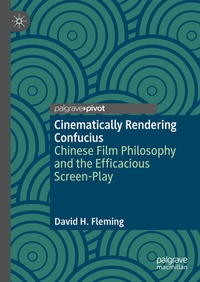
Cinematically Rendering Confucius
Description

Cinematically Rendering Confucius marks the first book-length enquiry into China's first two big screen treatments of arguably the best-known and most influential thinker in world history: Confucius. By interweaving methods drawn from Film Studies, Comparative Philosophy, and Media Archaeology in response to broader calls to deepen and thicken the scope and purview of film philosophical enquiry, this trailblazing book grounds Fei Mu's 1940 patriotic art film Kong Fuzi and Hu Mei's 2010 "Huallywood" blockbuster Kongzi as pre- and postsocialist examples of Chinese politico-philosophical filmmaking that straddle the PRC's revolutionary Marxist socio-political experiment. After exploring the geopolitics surrounding why Confucius has been historically included and excluded from the European classification of "philosopher" and addressing the difficulties that entering into "Chinese Thought" presents to non-natives, the book's first half undertakes a deep dive into the history of (re)mediating the Confucian image-imagination. Arguing that Confucius might be a form of film philosopher avant la lettre, we thereafter explore repetitions and differences surrounding the ever-changing treatment and representation of Confucius on-screen-concluding with a look at the latest AI-infused theory-film When Marx Met Confucius (2023).
More details
Other editions
Additional editions
Person
David H. Fleming is a Senior Lecturer in Film & Media at the University of Stirling. He is series editor of the Screens, Thinking, Worlds book series and author of The Squid Cinema From Hell: Kinoteuthis Infernalis and the Emergence of Chthulumedia (with William Brown 2020), Chinese Urban Shi-nema: Cinematicity, Society and Millennial China (with Simon Harrison, 2020), and Unbecoming Cinema: Unsettling Encounters with Ethical Event Films (2017). Forthcoming he has monographs entitled Infinite Ontologies of the Chthulustream (with William Brown) and Global Philosophers on Film: Conceptualising Aesthetics. David also increasingly researches using the video-essay form and has several practical film-philosophy works forthcoming, including his gonzo Hiber-nation: The Green Ray from Under the Skin with [In]Transition.
Content
Chapter 1: Propagandizing China's Master 'Philosopher': Kong Fuzi (1940) and Kongzi (2010).- Chapter 2: A Sage on the Global Stage: Or, the Chinese Kant Philosophise?.- Chapter 3: On Confucian Mediality and Ren-dering xiang -thought.- Chapter 4: " Our Confucius": Fei's Artful Aspirational Screen-Play.- Chapter 5: The "Second Coming" of Confucius: Or, Hu's Hu in Huallywood.- Chapter 6: End Game: Confucius a Go Go.- Afterword: On Xi Jinping and the Synthetic Spectres of Marx and Confucius.
