

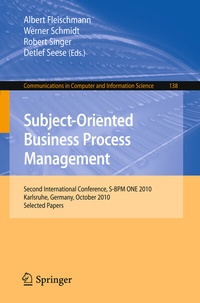
Subject-Oriented Business Process Management
Second International Conference, S-BPM ONE 2010, Karlsruhe, Germany, October 14, 2010 Selected Papers
Published on 12. August 2011
XII, 227 pages
978-3-642-23135-3 (ISBN)
Description

This book constitutes the thoroughly refereed post-proceedings of the Second International Conference on Subject-Oriented Business Process Management, S-BPM ONE 2010, held in Karlsruhe, Germany in October 2010.The 10 revised full papers presented together with one invited keynote paper and three panel statements were carefully reviewed and selected from initially 17 submissions. The papers present innovative cross-disciplinary ideas, concepts, methods, tools and results in foundational and applied research as well as studies on the realization of such innovations in the real world - all based on the promising new paradigm of subject-oriented business process management.
More details
Series
Language
English
Place of publication
Berlin
Germany
Publishing group
Springer Berlin
Target group
Professional and scholarly
Illustrations
XII, 227 p. 98 illus., 77 illus. in color.
File size
6,22 MB
ISBN-13
978-3-642-23135-3 (9783642231353)
DOI
10.1007/978-3-642-23135-3
Schweitzer Classification
Other editions
Additional editions
Albert Fleischmann | Werner Schmidt | Robert Singer
Subject-Oriented Business Process Management
Second International Conference, S-BPM ONE 2010, Karlsruhe, Germany, October 14, 2010 Selected Papers
Book
08/2011
1st Edition
Springer
€53.49
Shipment within 7-9 days
Content
- Title
- Foreword
- Organization
- Table of Contents
- Part I: Invited Key Note
- Key Lessons from Wikimanagement and BPM Best Practices: Aspiring for a Truly Holistic Approach in BPM
- Studies Conducted by the "BPM Labor" (BPM Laboratory)
- Empirical Findings
- BPM and Success
- Strategy Alignment
- Organizational Aspects
- Training and Culture
- IT Systems and BPM Models
- Aspiring for a Holistic Approach
- Methods
- Structure of BPM
- Human Side
- Challenges on the Way to a Holistic BPM
- References
- Part II: Contributed Papers
- Distributed Execution of S-BPM Business Processes
- Introduction
- Requirements
- Contributions
- Related Work
- Process Description Languages
- Formal Methods for Verifying Interaction Soundness
- Distributed Execution of Business Processes
- Subject-Oriented Business Process Management (S-BPM)
- Process Modeling
- Formal Description of PASS Processes
- Calculus of Communicating Systems (CCS)
- Mapping PASS to CCS
- Hiding the Internal Behavior
- Verifying Process Compatibility
- Distributed Modeling
- Process Execution
- Embedding
- Instantiation
- Message Routing
- Publish/Subscribe
- Communication between Subjects
- Embedding
- Implementation
- MundoCore
- Process Execution Engine
- Conclusion
- References
- Interaction Choreography Models in BPEL: Choreographies on the Enterprise Service Bus
- Introduction
- Choreography Modeling Paradigms
- BPEL$^gold$
- Participant Topology
- Interaction Description
- From BPEL$^gold$ to Executable BPEL Processes
- Evaluation of BPEL$^gold$
- Choreography-Aware Enterprise Service Bus
- Related Work
- Conclusion and Outlook
- References
- BPM 2.0: Business Process Management Meets Empowerment
- Introduction
- BPM and Flexibility
- Business Services and Susiness Process Management
- Flexibility
- Employees as Drivers for Flexibility
- Motivation
- Organizational Theory and BPM
- Subject-Orientation and Organizational Theories
- BPM 2.0: Empowering Employees
- Overview
- Challenges
- Procedure Model
- Role Concept
- Platform
- Summary
- BPM 2.0 Applied: A Case Study
- Scenario
- Iteration 1: Preparation
- Iteration 2: Encouraging Contributions
- Iteration 3: Improving the Formal Model Quality
- Summary
- Conclusion
- References
- Dynamic Catenation and Execution of Cross Organisational Business Processes - The jCPEX! Approach
- Introduction
- Example
- Requirements
- Evaluation of Existing Approaches
- EPC (Event-Driven Process Chain)
- BPMN 2.0
- WS-CDL
- Let's Dance
- Execution
- Our Solution - jCPEX! Process Router
- Information Hiding
- Enable Dynamic Change of Partners
- Generation and Publication of the Behavioural Interface
- Adding Metadata to Behavioural Interface
- Modelling a Suitable Partner Process
- Process Execution and Decentralized Architecture
- Process Rules
- Conclusions and Future Work
- References
- BPM and BPMN as Integrating Concepts in eGovernment - The Swiss eGovernment BPM Ecosystem
- Introduction
- Problem Definition
- Objective
- Content of Article
- BPM and BPMN
- Administrative Issues and BPM / BPMN
- Reasons for and Expansion of Standardisation Attempts on the Basis of BPM and BPMN
- Deployment Context for BPM in Swiss Public Administration
- Idiosyncrasies of BPM in the Administrative Environment
- BPM Deployment with Respect to Institutitional Administrative Parameters
- Specification of Standardisations in the BPM Environment in Switzerland
- Summary and Outlook
- References
- Establishing Conceptual and Functional Links between S-BPM and Business Rules
- Introduction
- Background
- S-BPM Approach
- Business Rules Approach
- General Requirements for Integrating the Two Concepts
- Identifying Intermediary Standards
- Capabilities of the BizTalk Rules Composer towards Process Integration
- Procedure for Rule Enactment within S-BPM
- Use Cases for the Approach
- Related Work
- Conclusion
- References
- Using Multi-subjects for Process Synchronization on Different Abstraction Levels
- Introduction
- Requirements for the Business Process Model Design
- Control Patterns for Multi-instance Generation
- Control Patterns for Multi-instance Synchronization
- Support of the Requirements by Process Modeling Techniques
- Design and Execution of Multiple Process Instances with the S-BPM Method
- A Short Method Overview
- Implementation of Multi Instance Patterns in S-BPM
- Application of the Workflow Control Patterns to an Order Process Using S-BPM
- Conclusion
- References
- Exporting Natural Language: Generating NL Sentences Out of S-BPM Process Models
- Motivation for This Work
- The Source of Generation: S-BPM Models
- Semantics of Actions and Interface SUBJECTS: Architectural Proposal
- Example: Semantic Definition of a Service SUBJECT
- Semantic Definition of an Action
- Example: An Interface SUBJECT for Weather Forecasts
- Basic Linguistic Concepts
- The Concept of Governance
- Morphing Nominal and Verbal Phrases
- Implementation of NL Sentences
- Definition of the Morphing Atomic Elements
- Definition of the Composed Elements
- Definition of Sentences
- Mapping Rules and Implementation
- Generating NL for the Internal Behavior
- Conclusion
- References
- Business Objects as a Mediator between Processes and Data
- Introduction
- Existing Solutions for Handling Data in Applications
- Advantages and Disadvantages of the Existing Solutions
- Requirements for More Dynamic Data Handling
- The Business Objects from Metasonic
- Current Business Objects from Metasonic
- The New Business Objects from Metasonic
- Advantages Using the New Business Objects
- Conclusion and Future Steps
- References
- A Study of the Subject-Oriented Approach for Automation and Process Modeling of a Service Company
- Introduction
- Business Service Orientation
- Active Compliance Management
- New Role of Employees
- ITSM and ITIL Version 3
- Subject-Oriented Approach
- Synergy between Natural and Artificial Environment
- Methodological Base of Research
- Metasonic Build
- Metasonic Proof
- Metasonic Flow
- Degree of a Readiness of the Problem
- Task
- Assumptions and Research Restrictions
- Example of Modeling and Automation of Processes of Library ITIL v3 by Means of Toolkit Metasonic Suite
- Results and Scientific Novelty of Research
- Issues for Further Research
- References
- Part III: Discussion
- Why We Need to Re-think Current BPM Research Issues
- I Apologize
- The Past through Tomorrow
- Technical Progress vs. Deficient Process Orientation
- Where the Real Issues Lie
- Research Areas in Search of Researchers
- Apology Revisited
- References
- Do We Need to Re-think Current BPM Research Issues?
- Introduction
- Business Processes are Socio-technical Systems
- Conclusion
- References
- Business Process Management - Do We Need a New Research Agenda?
- Introduction
- Taking a Scientific Approach
- Defining Business Process Management?
- Conclusions
- References
- Author Index
