

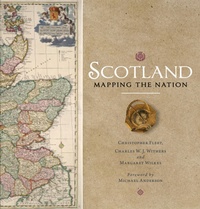
Scotland: Mapping the Nation
Published on 20. August 2012
336 pages
978-0-85790-239-9 (ISBN)
Description

Winner of the Saltire Society Research Book of the Year
Whilst documents and other written material are obvious resources that help shape our view of the past, maps too can say much about a nation's history. This is the first book to take maps seriously as a form of history, from the earliest representations of Scotland by Ptolemy in the second century AD to the most recent form of Scotland's mapping and geographical representation in GIS, satellite imagery and SATNAV.
Compiled by three experts who have spent their lives working with maps, Scotland: Mapping the Nation offers a fascinating and thought-provoking perspective on Scottish history which is beautifully illustrated with complete facsimiles and details of hundreds of the most significant manuscript and printed maps from the National Library of Scotland and other institutions, including those by Timothy Pont, Joan Blaeu and William Roy, amongst many others.
Whilst documents and other written material are obvious resources that help shape our view of the past, maps too can say much about a nation's history. This is the first book to take maps seriously as a form of history, from the earliest representations of Scotland by Ptolemy in the second century AD to the most recent form of Scotland's mapping and geographical representation in GIS, satellite imagery and SATNAV.
Compiled by three experts who have spent their lives working with maps, Scotland: Mapping the Nation offers a fascinating and thought-provoking perspective on Scottish history which is beautifully illustrated with complete facsimiles and details of hundreds of the most significant manuscript and printed maps from the National Library of Scotland and other institutions, including those by Timothy Pont, Joan Blaeu and William Roy, amongst many others.
Reviews / Votes
'Scotland: Mapping the Nation reaches far beyond the country's borders, for there is much wisdom of broader appeal lurking within its pages' -- Ben Parfitt * Geographical Magazine * 'Mixes lavish illustration with academic rigour and engaging anecdotes' * Sunday Herald * 'much more than a visual treat . . . elegantly written, thoroughly referenced and exsquisitely presented' * TES, Scotland * 'Some books are simply so magnificent in their scope and execution you know they are destined to become classics from the moment you open the cover and begin to turn the pages. "Scotland: Mapping the Nation" is one of those books' * Undiscovered Scotland * 'This beautiful and fascinating book is a real eye-opener. It is utterly absorbing: when you have read it you will never think of maps, or perhaps of Scotland, in the same way again' -- T.C. Smout, Professor Emeritus of Scottish History at St Andrews University, and Geographer Royal for Scotland 'This is a beautiful and fascinating book . . . The wealth of illustrations and their variety, all with excellent descriptions, make every chapter a delight to read' -- Simon Miles * EDUCT News * 'Few books are awaited with such eager anticipation. The authors [of this book] write of being 'enthralled' by their subject. It shines from every page and so does their scholarship' -- Nicholas Crane, writer, broadcaster and author of 'Mercator: The Man Who Mapped the Planet' 'The book is beautifully presented, with more than enough maps to interest historians from all disciplines. It achieves a good balance of easy reading and detail and is something readers will, as I have done, go back to again and again' -- Neil Ramsay * History Scotland * 'This book is a pleasure to read and will be much valued by all those interested in Scotland, maps, or both.' -- Elizabeth Baigent * Journal of Historical Geography * 'Anyone who enjoys poring over old maps will be thrilled by this lavish publication . . . colourful, intricate, incredibly detailed images show how a country with an uncertain outline has been transformed into the modern industrialised nation of today' * Scottish Field *More details
Language
English
Place of publication
Edinburgh
United Kingdom
Publishing group
Birlinn General
Illustrations
Maps; Illustrations, color
File size
51,93 MB
ISBN-13
978-0-85790-239-9 (9780857902399)
Copyright in bibliographic data and cover images is held by Nielsen Book Services Limited or by the publishers or by their respective licensors: all rights reserved.
Schweitzer Classification
Other editions
Additional editions

Chris Fleet | Charles W. J. Withers | Margaret Wilkes
Scotland: Mapping the Nation
Book
08/2012
Birlinn Ltd
€44.80
Article exhausted; check different version
Persons
Chris Fleet studied Geography at the University of Durham. He is Senior Map Curator in the National Library of Scotland. In 2010, he was awarded the Fellowship of the Royal Scottish Geographical Society.
Margaret Wilkes is a Member of the Steering Committee of the Scottish Maps Forum, a Director of The Royal Scottish Geographical Society, Convenor of its Collections & Information Committee and Joint Chairman of its Edinburgh Centre.
Charles W.J. Withers is Professor of Historical Geography at the University of Edinburgh. He is a Fellow of the British Academy, the Royal Society of Edinburgh and The Royal Scottish Geographical Society.
Margaret Wilkes is a Member of the Steering Committee of the Scottish Maps Forum, a Director of The Royal Scottish Geographical Society, Convenor of its Collections & Information Committee and Joint Chairman of its Edinburgh Centre.
Charles W.J. Withers is Professor of Historical Geography at the University of Edinburgh. He is a Fellow of the British Academy, the Royal Society of Edinburgh and The Royal Scottish Geographical Society.
Content
- Cover
- Title page
- Copyright page
- Contents
- Foreword by Professor Michael Anderson
- Preface and acknowledgements
- Timeline of Scottish map history
- CHAPTER 1 Putting Scotland on the map
- CHAPTER 2 Maps of Scotland before c.1595
- CHAPTER 3 A kingdom and a nation depicted, c.1583-1700
- CHAPTER 4 Scotland occupied and defended
- CHAPTER 5 Towns and urban life
- CHAPTER 6 The changing countryside
- CHAPTER 7 Islands and island life
- CHAPTER 8 Seas and waters
- CHAPTER 9 Travel and communications
- CHAPTER 10 Mapping science
- CHAPTER 11 Open spaces - recreation and leisure
- CHAPTER 12 Popular culture
- CHAPTER 13 Maps at work - working with maps
- Guide to further reading
- Index
